
Building a stronger, more defined posterior is a common fitness goal, and for good reason. The right glute exercises enhance your physique and build a foundation for overall strength, power, and injury prevention. This guide covers the best glute exercises to help you reach your goals, whether you’re a beginner or an experienced lifter.
Many people struggle to see results because their routine lacks variety or proper form. A successful glute workout must target all the muscles in your posterior chain from different angles. Forget endless, ineffective squats — we’re diving into the science-backed movements that deliver real strength and shape.
Strong glutes aren’t just for aesthetics. They’re central to your body’s stability and power, supporting your lower back, hips, and knees. Incorporating these targeted glute exercises will improve your athletic performance, reduce pain, and build a more resilient body. Let’s get started.
Understanding Your Gluteal Muscles
Before jumping into the exercises, it’s crucial to understand what you’re working. Your glutes are a group of 3 distinct muscles, each with a specific function. A well-rounded glute workout targets all 3. For a deeper dive, you can learn more about the gluteal muscles and their functions on our blog.
- Gluteus maximus: This is the largest and most powerful of the three. It’s the muscle that gives your butt its primary shape. Its main job is hip extension, which means moving your thigh backward. It’s the powerhouse for movements like standing up from a squat, climbing stairs, and sprinting.
- Gluteus medius: Located on the outer side of your hip, this muscle is key for hip abduction (moving your leg out to the side). It also plays a vital role in stabilizing your pelvis, especially when you’re standing on one leg. Training the gluteus medius helps create a fuller, rounder look from the side.
- Gluteus minimus: The smallest of the three, this muscle lies directly beneath the gluteus medius. It assists the medius with hip abduction and stabilization. Though small, a strong gluteus minimus is essential for healthy hip function and preventing an inward collapse of the knee.
Together, these three muscles determine how well your glutes perform, and how they look, so a complete routine has to train all of them, not just the biggest one.
The benefits of a strong posterior chain
Focusing on your glutes delivers benefits that extend far beyond the mirror. A strong posterior chain is fundamental to your overall health and fitness. Here are some of the most significant advantages of dedicating time to your glutes.
- Improved athletic performance: Your glutes generate immense power. Stronger glutes translate directly to running faster, jumping higher, and lifting heavier. They are the engine behind most explosive athletic movements.
- Injury prevention: Weak glutes can lead to a cascade of problems, including lower back pain, hip impingement, and knee issues. By strengthening them, you create a stable pelvis, which improves your posture and movement quality, protecting your joints from excessive strain.
- Enhanced posture: Many of us spend hours sitting, which can lead to tight hip flexors and underactive glutes. This combination, often called “gluteal amnesia,” can cause your pelvis to tilt forward, resulting in poor posture. Strong glutes help pull the pelvis back into a neutral alignment.
- Increased metabolic rate: The glutes are the largest muscle group in your body. Building more muscle through a process called muscle hypertrophy increases your resting metabolic rate, meaning you burn more calories throughout the day, even at rest.
Together, these four benefits explain why a strong posterior chain pays off well beyond how you look.
Glute exercises: The 10 best for strength and shape
Now for the main event. These 10 exercises are selected to ensure you target all three gluteal muscles, combining compound movements for overall strength and isolation exercises for targeted growth. Remember to focus on form and a strong mind-muscle connection for the best results.
1. Barbell hip thrust
The hip thrust is arguably the single best movement for isolating the gluteus maximus. It allows you to use heavy weight to directly load the glutes in their primary function of hip extension. If you have access to one, you can also learn how to use the hip thrust machine for a stable and effective alternative.
How to do it: Sit on the floor with your upper back against a bench. Place a padded barbell across your hips. Drive your heels into the floor, lifting your hips toward the ceiling until your body forms a straight line from your shoulders to your knees. Squeeze your glutes hard at the top before lowering with control.
2. Barbell back squat
A classic for a reason, the squat is a fantastic compound movement that builds overall lower body strength. While it also heavily involves the quads, performing a deep squat with proper form is excellent for glute development. You can also explore bodyweight squats if you’re just starting out.
How to do it: Position a barbell on your upper back. Stand with your feet shoulder-width apart. Push your hips back and bend your knees to lower yourself as if sitting in a chair. Keep your chest up and back straight. Go as deep as your mobility allows before driving through your heels to return to the start.
3. Romanian deadlift (RDL)
The RDL is a phenomenal exercise for targeting the glutes and hamstrings. Unlike a conventional deadlift, the RDL emphasizes the eccentric (lowering) phase and the stretch in your posterior chain, which is crucial for muscle growth. For detailed guidance, check out these tips on how to do the Romanian deadlift.
How to do it: Hold a barbell or dumbbells in front of your thighs. With a slight bend in your knees, hinge at your hips, pushing your butt backward. Lower the weight while keeping your back flat until you feel a deep stretch in your hamstrings. Squeeze your glutes to drive your hips forward and return to a standing position.
4. Bulgarian split squat
This unilateral (single-leg) exercise is a challenging but highly effective glute builder. It addresses muscle imbalances, improves stability, and allows you to deeply target the glutes of your working leg. It’s a prime example of the power of unilateral training.
How to do it: Stand a few feet in front of a bench and place the top of one foot on it behind you. Holding dumbbells if you wish, lower your body until your front thigh is parallel to the floor. Keep your torso upright. Drive through your front heel to stand back up.
5. Walking lunge
Lunges are a dynamic and functional movement that builds strength, balance, and coordination. By taking a slightly longer stride and leaning your torso forward, you can shift the emphasis from your quads to your glutes and hamstrings.
How to do it: Holding dumbbells at your sides, take a large step forward with one leg. Lower your hips until both knees are bent at a 90-degree angle. Your front knee should be above your ankle, and your back knee should hover just above the ground. Push off your back foot and step forward into the next lunge.
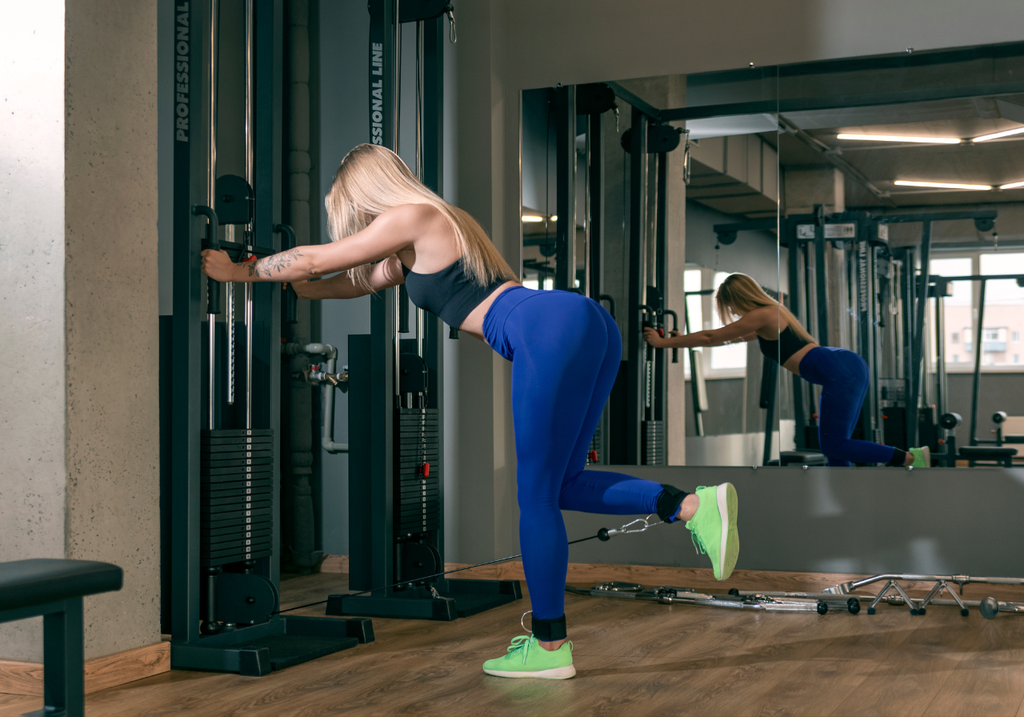
6. Cable kickback
As one of the best glute machine exercises, the cable kickback is a superior isolation movement for the gluteus maximus. The constant tension from the cable machine provides a unique stimulus that free weights cannot replicate, helping to create that rounded, lifted look.
How to do it: Attach an ankle cuff to a low-set cable pulley. Facing the machine, kick your leg straight back, focusing on squeezing your glute at the peak of the contraction. Avoid arching your lower back. Return to the starting position with control.
7. Hip abduction
This movement is essential for targeting the gluteus medius and minimus, the muscles on the side of your hips. Strong abductors are crucial for pelvic stability and creating a well-rounded shape. You can do this on a machine or with a resistance band around your thighs.
How to do it: On a hip abduction machine, sit down and place your outer thighs against the pads. Push your legs apart against the resistance, focusing on the outer glutes. Hold briefly before returning to the start. These are key exercises to gain muscle mass in your legs and glutes.
8. Glute bridge
The glute bridge is a foundational bodyweight exercise that is perfect for activating the glutes before a workout or as a burnout exercise at the end. You can easily progress it by placing a dumbbell or plate across your hips.
How to do it: Lie on your back with your knees bent and feet flat on the floor, hip-width apart. Place your arms by your sides. Drive through your heels and lift your hips off the floor until your body forms a straight line. Squeeze your glutes at the top and lower slowly.
9. Dumbbell step-up
The step-up is a simple yet powerful functional exercise. It mimics climbing stairs and places a significant load on the glute of the leading leg. It’s a great way to build single-leg strength and power.
How to do it: Stand in front of a sturdy box or bench, holding dumbbells. Place one foot fully on the bench. Drive through that heel to lift your body up until your leg is straight. Step down with control and repeat, either alternating legs or completing all reps on one side before switching.
10. Kettlebell swing
The kettlebell swing is an explosive hip-hinge movement that builds power throughout the entire posterior chain. It teaches you to generate force from your hips, not your arms, making it one of the most effective exercises to lift glutes fast.
How to do it: Stand with feet slightly wider than shoulder-width, holding a kettlebell with both hands. Hinge at your hips, letting the kettlebell swing back between your legs. Explosively drive your hips forward, squeezing your glutes, to propel the kettlebell up to chest height. Let gravity bring it back down into the next rep.
Comparing Glute Exercises: Compound vs. Isolation
A successful glute workout includes a mix of compound and isolation movements. Compound exercises are multi-joint movements that build overall strength, while isolation exercises target a specific muscle. Understanding the difference helps you structure your training for maximum results.
| Feature | Compound exercises | Isolation exercises |
|---|---|---|
| Primary goal | Build overall strength and muscle mass | Target specific muscles for shape and definition |
| Examples | Squats, Deadlifts, Lunges, Hip Thrusts | Cable Kickbacks, Hip Abductions, Glute Bridges |
| Muscles worked | Multiple muscle groups at once (e.g., glutes, quads, hamstrings) | Primarily one muscle group (e.g., gluteus maximus or medius) |
| When to use | At the beginning of your workout when you are fresh and can lift heavier | Towards the end of your workout to finish off the target muscle |
Building your ultimate glute workout
Putting it all together is key. A well-structured plan that incorporates progressive overload is what drives growth. Aim to train your glutes 2-3 times per week, allowing at least one day of rest in between for recovery. Don’t forget to perform a proper warm-up before each workout to prepare your muscles.
Here is a sample glute-focused workout you can perform twice a week. Focus on increasing the weight or reps over time. You can also monitor your effort using the RPE (Rate of Perceived Exertion) scale to ensure you’re training hard enough.
| Exercise | Sets | Reps |
|---|---|---|
| Barbell Hip Thrust | 3 | 8-12 |
| Romanian Deadlift | 3 | 10-15 |
| Bulgarian Split Squat | 3 | 10-12 per leg |
| Hip Abduction Machine | 3 | 15-20 |
| Cable Kickback | 3 | 12-15 per leg |
Remember that training volume is a critical factor for muscle growth. Adjust the number of sets based on your recovery and experience level.
Common mistakes to avoid
Even with the best exercises, progress can stall if you’re making common mistakes. Here are a few pitfalls to watch out for in your quest for stronger glutes.
- Neglecting the smaller muscles: many people focus exclusively on the gluteus maximus with squats and thrusts. However, for a rounded shape and healthy hips, you must include exercises like hip abductions to target the gluteus medius and minimus.
- Using momentum: sacrificing form for heavier weight is a recipe for poor results and potential injury. Always perform each rep with control, especially on isolation movements. Focus on squeezing the target muscle rather than just moving the weight.
- Not eating enough protein: you break down muscle fibers during training; they rebuild stronger with proper rest and nutrition. Consuming enough protein is essential for muscle repair and growth.
- Lifting with your back: in movements like RDLs and kettlebell swings, the power should come from a hip hinge, not from rounding your lower back. Keep your core engaged and your spine neutral to protect yourself and effectively target the glutes. ACE Fitness–sponsored research has repeatedly emphasized that proper biomechanics, not just raw effort, are what drive effective glute activation.
Fix these 4 mistakes, and your glute training will start converting effort into visible, lasting results.
Frequently asked questions
Here are answers to some common questions about training your glutes.
How long does it take to see results from glute exercises?
Results vary based on genetics, consistency, and nutrition. However, with a dedicated plan training 2-3 times per week and applying progressive overload, most people notice visible changes in shape and firmness within 4-8 weeks. You can learn more about what to expect when starting a gym routine here.
Can you do glute exercises at home without equipment?
Absolutely. You can build a very effective glute workout at home using bodyweight exercises like glute bridges, squats, lunges, and single-leg RDLs. Adding affordable resistance bands can significantly increase the intensity. Our guide to a complete home workout has more ideas.
How many times a week should I do glute exercises?
For optimal growth, training glutes 2-3 times per week is a solid target for most people. What matters most, though, is your total weekly training volume — research consistently shows that when volume is matched, training frequency on its own has little effect on strength or muscle gains. Spreading your sets across 2-3 sessions instead of cramming them into one simply makes that volume easier to recover from and perform well.
What’s the difference between glute and hamstring exercises?
Glute-focused exercises primarily involve hip extension (e.g., hip thrusts) and abduction (e.g., hip abductions). Hamstring exercises focus on knee flexion (e.g., leg curls) but also assist in hip extension. Movements like the Romanian deadlift are excellent because they effectively train both muscle groups simultaneously.
Do glute exercises help you lose weight or just tone?
They contribute to both. Strength training builds muscle, which increases your resting metabolism and helps with overall fat loss, especially when combined with a caloric deficit. The term “toning” simply refers to the appearance of visible muscle definition, which is achieved by building muscle and reducing body fat.
Start Your Glute Exercises Today
Building a strong, shapely, and powerful posterior is an achievable goal with the right approach. It requires more than just a few squats; it demands a balanced routine that targets all three gluteal muscles with a mix of compound and isolation movements. The best glute exercises are those performed with intention, proper form, and consistent progression.
By incorporating the 10 exercises in this guide into a structured plan, you are setting yourself up for success. Remember that consistency is the most important factor. Stay patient, fuel your body with proper nutrition, and challenge yourself regularly.
Ready to take your training to the next level? Download the BeFit app to track your workouts, follow guided programs, and see your progress in real time. Your stronger, more powerful self is waiting.