

If you’re looking for an exercise that builds full-body strength, enhances coordination, and torches calories without a single piece of equipment, it’s time to get reacquainted with a fundamental human movement.
The question of what is a bear crawl is more than just a fitness query; it’s an invitation to unlock a primal pattern that can revolutionize your training. This movement is a cornerstone of functional fitness, challenging your body in ways that isolated exercises simply cannot.
Many modern workouts focus on lifting heavy weights or running long distances, but often neglect the crucial elements of stability and coordinated strength. The bear crawl bridges this gap.
It forces your core, shoulders, and hips to work in harmony, improving your overall athleticism and resilience against injury. Understanding what is a bear crawl is the first step toward building a more capable and connected body!
What is a bear crawl, exactly?
At its core, the bear crawl is a quadrupedal bodyweight movement, meaning you move on all fours, much like our primate ancestors or a bear.
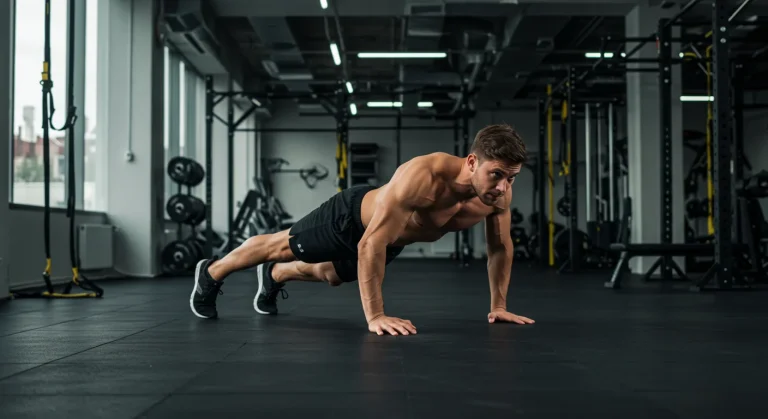
You support your body on your hands and feet with your torso parallel to the ground. Unlike a static plank, the bear crawl is dynamic, requiring you to move forward, backward, or laterally while maintaining a stable and controlled posture.
The fundamental position involves placing your hands directly beneath your shoulders and your knees directly beneath your hips. From there, you lift your knees just an inch or two off the floor, engaging your core to keep your back flat.
The movement itself is contralateral: you move your right hand and left foot forward together, and then your left hand and right foot. This opposition is key to the exercise’s benefits for coordination.
It’s a foundational exercise in functional training because it mimics natural, primal movement patterns. It teaches your body to function as an integrated system, transferring force effectively from your lower body through your core to your upper body. This makes it incredibly effective for building practical, real-world strength.
The science behind the movement: how it works
The deceptively simple bear crawl triggers a complex cascade of muscular and neurological activity. The primary challenge comes from maintaining a rigid torso while your limbs are in motion.
Your core muscles, including the transverse abdominis, obliques, and rectus abdominis, must work overtime to prevent your hips from rotating or your lower back from sagging. This creates exceptional anti-rotation core strength.
Simultaneously, your shoulders and hips are put to the test. As you move one hand forward, the stationary shoulder must stabilize the entire weight of your upper body.
This strengthens the deltoids, rotator cuff muscles, and serratus anterior. Likewise, the glutes and hip stabilizers are constantly firing to keep your pelvis level and support your lower body through the movement pattern.
This exercise is a masterclass in engaging the 7 major muscle groups. Beyond the muscles, the bear crawl is a powerful tool for improving proprioception—your body’s awareness of its position in space.
The contralateral movement pattern forges stronger neural pathways between the brain and the body, enhancing motor control and coordination that translates to better performance in other sports and activities.
Key benefits of adding bear crawls to your routine
Incorporating bear crawls into your fitness regimen offers a wealth of benefits that extend far beyond the gym. It’s a versatile tool for achieving various fitness goals, from strength building to conditioning.
- Total-body strength and endurance: The bear crawl is a true full-body exercise. It simultaneously works your shoulders, arms, chest, back, core, glutes, and legs, making it an incredibly efficient way to build muscular endurance from head to toe.
- Superior core stability: Unlike crunches, which target superficial abdominal muscles, the bear crawl strengthens the deep stabilizing muscles of your core. This leads to better posture, a more stable spine, and a reduced risk of lower back pain.
- Improved coordination and motor skills: The contralateral movement of the bear crawl requires your brain to work hard, enhancing communication between the left and right hemispheres. This improves your overall coordination and agility.
- Enhanced shoulder health and stability: By bearing weight through your arms in a closed-chain position, you build strength and stability in the delicate shoulder joint. This can help prevent injuries common in overhead lifting or throwing sports.
- Low-impact cardiovascular conditioning: Performing bear crawls for time or distance can significantly elevate your heart rate, providing an excellent cardio workout without the high impact on your joints associated with running or jumping.
- Ultimate versatility and accessibility: One of the greatest benefits is its simplicity. You need no equipment and minimal space, making it the perfect addition to any home workout, hotel room session, or gym routine.
How to perform the perfect bear crawl: a step-by-step guide
Mastering the form is crucial to reaping the benefits and avoiding injury. Rushing the movement or using improper technique will negate its core-strengthening effects. Follow these steps carefully to perform a perfect bear crawl.
- Establish your starting position: Begin on all fours in a quadruped position. Place your hands directly under your shoulders, with your fingers spread wide for a stable base. Align your knees directly under your hips. Your back should be flat, like a tabletop.
- Engage your core and lift: Before you move, take a deep breath and brace your core as if you’re about to be punched in the stomach. Tuck your toes under and lift your knees about one to two inches off the floor. This is your starting and finishing point for every “step.”
- Initiate the contralateral movement: Move your right hand and your left foot forward a small, equal distance—about four to six inches. The key is to move them at the exact same time. Your body should remain stable, with minimal shifting.
- Alternate sides smoothly: Next, move your left hand and your right foot forward the same small distance. Continue this alternating pattern, crawling forward with slow, deliberate, and controlled movements.
- Maintain form throughout: Keep your hips low and level—imagine balancing a glass of water on your lower back. Your head should remain in a neutral position, with your gaze directed at the floor slightly ahead of you. Avoid letting your back sag or your hips rise.

Bear crawl variations to challenge yourself
Once you have mastered the standard bear crawl, you can introduce variations to increase the difficulty and target different aspects of your fitness. These variations keep your workouts interesting and ensure you continue to make progress.
Each variation offers a unique challenge. The backward crawl tests your coordination, the lateral crawl hammers your obliques and hips, and adding resistance or other exercises can turn it into a high-intensity conditioning tool. Here is a comparison of some popular variations.
| Variation | Primary challenge | Key focus |
|---|---|---|
| Backward bear crawl | Coordination and proprioception | Hamstrings, glutes, and shoulder stabilization |
| Lateral bear crawl | Hip stability and core anti-rotation | Obliques, glute medius, and adductors/abductors |
| Bear crawl with push-up | Upper body strength and endurance | Chest, shoulders, triceps, and core. Learn how to do push-ups correctly first. |
| Weighted bear crawl | Strength and core stiffness | Full-body strength under load (advanced only) |
Integrating bear crawls into your workout plan
The versatility of the bear crawl allows it to be programmed into almost any workout routine. How you use it depends on your goals, whether it’s for activation, conditioning, or as a primary strength movement.
As part of your warm up, a few sets of short-distance bear crawls are perfect for activating the core, mobilizing the hips, and preparing the shoulders for a heavy lifting session. It wakes up the central nervous system and gets your body ready to work.
As a finisher, bear crawls are brutal in the best way. Try performing them for a set distance (e.g., 20 meters) or for time (e.g., 45 seconds on, 15 seconds off) at the end of your workout. This is an excellent way to improve your conditioning and mental toughness when you’re already fatigued.
You can also build it into a circuit or a specific workout split. For instance, on a full-body day, you could pair bear crawls with exercises like pull-ups and kettlebell swings for a highly effective metabolic circuit. The possibilities are endless, making it a valuable addition to any fitness enthusiast’s toolkit.
Common mistakes to avoid
To maximize the benefits and prevent potential strain, it’s essential to be aware of common form errors. Focus on quality over quantity. Slow, controlled movement is far more effective than a fast, sloppy crawl.
- Hips too high in the air: This is the most common mistake. When your hips rise, you disengage your core and place more stress on your shoulders. Consciously keep your knees bent and close to the floor.
- Excessive hip swaying: If your hips are rocking side-to-side, your core is not properly braced. Slow down, narrow your steps, and focus on keeping your torso as still as possible. This highlights the importance of stability, a key component of unilateral training principles.
- Letting the lower back sag: A sagging back indicates a weak or inactive core and can put undue pressure on your lumbar spine. Keep your abs tight and maintain a neutral, flat back throughout the movement.
- Moving too quickly: Speed is not the goal, especially when you are learning. Rushing leads to a breakdown in form. Focus on the mind-muscle connection and feel the correct muscles working with each step.
- Incorrect head and neck position: Avoid craning your neck to look forward or letting your head drop completely. Keep your head in line with your spine to maintain proper alignment and avoid neck strain.
Frequently asked questions
How long should I do a bear crawl for?
For beginners, start with short durations of 20-30 seconds or distances of 10 meters. Focus on perfect form. As you get stronger, you can increase the time or distance, working up to sets of 60 seconds or more.
What muscles does the bear crawl work?
The bear crawl is a full-body exercise. It primarily targets the core (abdominals, obliques, lower back), shoulders (deltoids), chest, triceps, and quadriceps. It also engages the glutes and hamstrings for stabilization.
Is the bear crawl a good cardio exercise?
Yes, absolutely. Performing bear crawls for an extended period or at a faster pace can significantly elevate your heart rate, making it an effective and low-impact cardiovascular conditioning tool that also builds strength.
Can I do bear crawls every day?
While it’s a bodyweight exercise, it is still demanding. If you are using it as a light warm-up, daily practice may be fine. However, if you are performing intense bear crawl workouts, it’s best to allow for at least one day of rest in between to allow your muscles to recover properly.
One exercise, total body results
The bear crawl is a powerful tool for building a stronger, more resilient, and better-coordinated body.
By challenging your strength, stability, and motor control all at once, it delivers a level of efficiency that few other movements can match. It reminds us that sometimes the most effective training methods are the most fundamental.
Whether you use it as a dynamic warm-up, a brutal finisher, or a central part of your routine, mastering the bear crawl will pay dividends in your overall fitness and athletic ability. Start slow, prioritize perfect form, and embrace the challenge of this primal movement.
Ready to see how the bear crawl fits into a comprehensive training plan? Explore more expert-led workouts on the BeFit blog or download the BeFit app to get personalized fitness guidance and track your progress toward a stronger you!