
Have you ever felt lost at the gym, unsure which exercise to do or how to track your progress? Technology can be your biggest ally on that journey. Workout apps put a full training assistant in the palm of your hand, changing the way we train.
Still, with so many workout apps available, picking the right one can be harder than building your own training plan. Some promise artificial intelligence, others focus on community, and others simply track sets and reps. But which one actually helps you progress?
To answer that question, we evaluated the most-used workout apps across 9 criteria that make a real difference for people who train seriously. Keep reading for a detailed breakdown of each app and the advantages of adding one to your routine.
What are workout apps and how do they work?
Workout apps are software programs built for smartphones that act as digital training assistants. In essence, they guide, log, and analyze your physical activity. In doing so, they replace old paper training logs with a far more dynamic and interactive experience.
The basic setup involves creating a profile where you define your goals, experience level, and available equipment. From there, the app suggests — or lets you build — training routines. During your workout, you log sets, reps, and loads, building a detailed history of your performance.
These apps work as a logbook for your progress. Instead of relying on memory or messy notes, you get an accurate record that’s essential for applying progressive overload. In short, they’re the natural evolution of the paper training log, making the whole process more efficient and motivating.
What to consider before choosing a workout app
AI personalization is what separates an app that actually builds a plan around you from one that hands everyone the same workout. Progress tracking, in turn, is what lets you see your evolution over time — without it, it’s hard to know whether your effort is paying off.
It’s also worth watching how each app varies your training over time. Some keep the same routine for months, which builds familiarity but can stall progress. Others adjust your workout every session based on recent performance — powerful, but not always ideal if you prefer sticking to a fixed plan for a few weeks at a time. There’s no universally right answer here, just the one that fits how you train.
8 Best Workout Apps: Complete ranking
We scored each app on a scale of up to 45 points, combining 9 criteria: AI personalization, progress tracking, exercise instructions, workout variation, customization, analytics, social features, content variety, and user experience.
Befit tops the list, closely followed by Fitbod and Hevy, while apps built around generic content or simplified onboarding land at the bottom of the ranking.
| Rank | App | Overall score (/45) |
|---|---|---|
| 1st | Befit | 35.0 |
| 2nd | Fitbod | 33.0 |
| 3rd | Hevy | 31.5 |
| 4th | BetterMe | 26.0 |
| 5th | Jefit | 25.5 |
| 6th | Strong | 21.0 |
| 7th | Nike Training Club | 20.0 |
| 8th | Mad Muscles | 15.5 |
Below, see what makes each of these apps stand out — or fall short — in practice.
How we calculated each app’s score
Each of the nine dimensions in the table was scored individually on a 0-to-5 scale, based on hands-on testing, available features, and execution quality within each app. Adding up the nine scores gives the total of up to 45 points that determines each app’s ranking position.
This method keeps a single strength — like a nice interface or a large exercise library — from artificially inflating the overall score of an app that falls short on more decisive criteria, like personalization and progress tracking.
For anyone who wants to see exactly how each score was built, here’s the detailed breakdown by dimension:
| Dimension | Befit | Fitbod | Hevy | Strong | BetterMe | Nike TC | Jefit | Mad Muscles |
|---|---|---|---|---|---|---|---|---|
| AI-personalized training plans | 5.0 | 4.5 | 3.0 | 0.5 | 3.5 | 1.5 | 2.5 | 1.5 |
| Tracking & progression | 5.0 | 4.0 | 4.5 | 4.5 | 2.5 | 2.0 | 4.0 | 2.0 |
| Exercise quality (instructions & video) | 4.0 | 4.0 | 4.0 | 3.0 | 4.5 | 4.0 | 3.5 | 3.0 |
| Dynamic plan variation | 4.0 | 5.0 | 2.0 | 1.0 | 2.0 | 1.0 | 2.0 | 1.0 |
| Fully customizable workouts | 4.0 | 3.5 | 4.0 | 4.0 | 2.0 | 1.0 | 3.5 | 1.5 |
| Advanced analytics | 3.0 | 5.0 | 3.5 | 2.5 | 1.0 | 0.5 | 2.5 | 0.5 |
| Social & community | 2.5 | 1.5 | 5.0 | 1.5 | 2.0 | 2.0 | 3.0 | 1.0 |
| Content variety (sports-focus, yoga, pilates, cardio) | 3.0 | 1.5 | 1.5 | 1.0 | 5.0 | 4.5 | 2.0 | 2.0 |
| App experience (UX) | 4.5 | 4.0 | 4.0 | 3.0 | 3.5 | 3.5 | 2.5 | 3.0 |
| Total (/45) | 35.0 | 33.0 | 31.5 | 21.0 | 26.0 | 20.0 | 25.5 | 15.5 |
One important caveat about what this score doesn’t factor in: cost was not used as an evaluation criterion, since pricing varies from country to country, and one app may be cheaper or more expensive than another depending on the region. That said, all of them offer a paid premium tier.
1. Befit
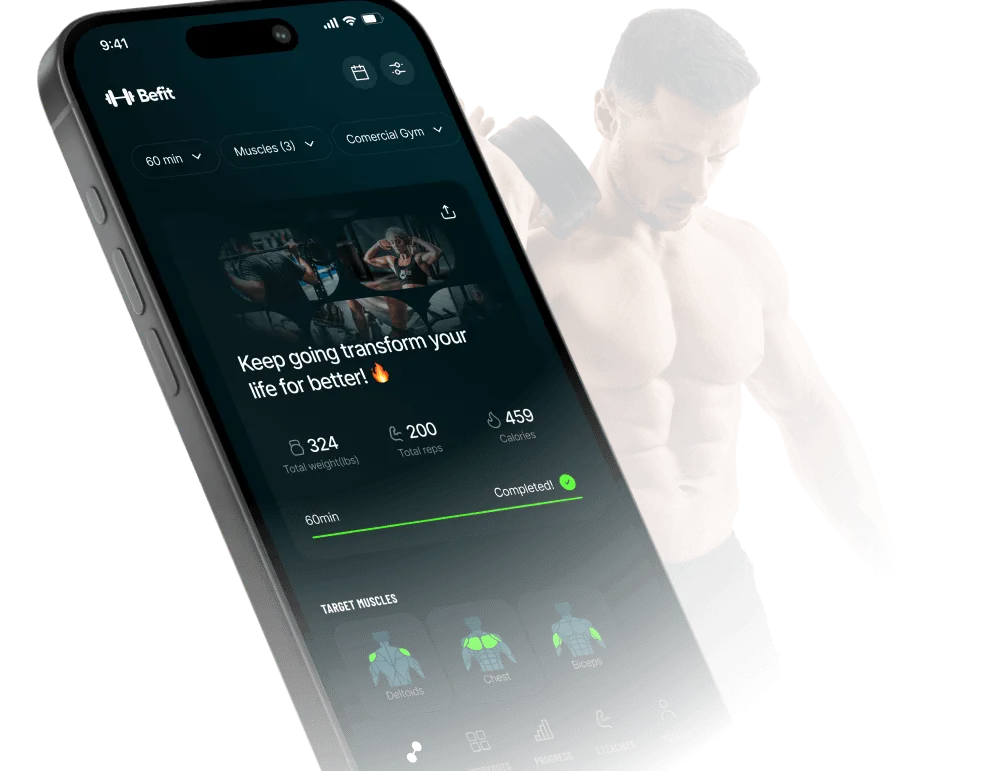
Befit tops the ranking by combining AI-generated training plans with robust progress tracking. The app builds your workout around your goals, equipment, and schedule, and lets you choose how often that plan evolves. Among its benefits:
- 500+ exercises, all fully customizable (sets, loads, splits, equipment);
- Progress tracking among the best in the comparison;
- Apple Watch and Strava integration.
That said, workout variation happens at the plan-cycle level rather than every session like apps that regenerate daily — a deliberate choice favoring structured progressive overload. Advanced analytics are still maturing, and content leans heavily toward strength training, with less yoga or pilates.


2. Fitbod
Fitbod regenerates your workout every session, factoring in logged performance, muscle recovery, and balance across muscle groups. If you overloaded chest last week, the app automatically shifts volume elsewhere. Its strengths include:
- One of the most sophisticated adaptive engines in the category;
- 1RM estimates and muscle recovery heatmaps;
- 1,000+ exercises, all editable.
On the other hand, daily regeneration makes it hard to stick to a fixed weekly plan, which can work against anyone seeking more predictable progression. The app also has no free version — after a 7-day trial, it simply stops working — and social features are practically nonexistent.
3. Hevy
Hevy delivers the best social experience in the category, with a feed for sharing workouts and following other people. Highlights include:
- Fast, clean interface;
- Fully customizable workouts;
- Solid analytics for volume, PRs, and progression.
Even so, Hevy Trainer, the app’s AI plan generator, is a recent addition and still shallow compared to more mature apps in that department. The exercise library is also smaller (around 400), and workouts don’t vary automatically — what you build is what you repeat.
4. BetterMe
BetterMe stands out for the breadth of its content: workouts, pilates, wall pilates, yoga, and nutrition, with above-average video production. It’s a solid option for anyone chasing general wellness, not just strength training.
That said, strength training isn’t the app’s strong suit: progression analysis is shallow, customization is limited, and there’s no serious toolkit for anyone lifting regularly. Worth flagging: BetterMe’s billing practices are a recurring complaint — unexpected auto-renewals come up often, and the company holds an F rating with the Better Business Bureau.
5. Jefit
With 1,400+ exercises and one of the few full web versions on the market, Jefit is useful for anyone who likes planning workouts from a computer. Also worth noting:
- Strong tracking depth for advanced users;
- A long-standing community with shared routines.
On the flip side, the mobile interface feels dated and a bit cluttered next to modern competitors, with a steeper learning curve. Programming is template-based rather than genuinely personalized, and plans don’t adapt to your progress.
6. Strong
Strong is a near-perfect digital logbook: fast, clean, and distraction-free, ideal for anyone who already has a program and just wants somewhere reliable to log it. Its strengths:
- Extremely fast set logging;
- Solid Apple Watch integration;
- Simple, effective progression charts.
What it lacks is exactly what other apps in the ranking offer: no AI, no plan generation — you have to bring everything yourself. Exercise instructions are basic, and there’s no automatic adaptation of any kind.
7. Nike Training Club
Completely free, Nike Training Club offers guided HIIT, yoga, mobility, and running classes with polished production — a legitimate entry point for anyone who wants to start without spending anything.
But it’s worth understanding what it isn’t: a training system. There’s no personalized plan generation, no set/rep/load logging, and virtually no customization. For anyone doing strength training at the gym, it’s one of the most limited options on this list.
8. Mad Muscles
Mad Muscles bets on simple onboarding and ready-made routines with zero setup — if you want something pre-built to follow right away, it delivers that.
However, the promised “personalization” is superficial: plans barely change based on your profile, tracking is basic, and exercise guidance is thin. Add an aggressive subscription funnel and frequent refund complaints, and Mad Muscles closes out the ranking as the weakest option on the list.
Why download a workout app?
Training without guidance usually runs into the same problem: lack of progression and organization. Without a plan that evolves with you, it’s easy to stall, doing the same weights and exercises even if you hit the gym consistently. A good workout app solves that.
Bringing an app into your strength training routine offers real advantages — it acts as a complete ecosystem for your fitness journey. Here are the most important benefits:
- Organization and planning: With an app, you get access to structured training plans, like an ABC split, and can plan your week ahead of time. That ensures every muscle group gets balanced work, optimizing your training periodization.
- Progress monitoring: Tracking increases in load, sets, and reps is key to hypertrophy. Apps automate that logging, making it easier to apply progressive overload intelligently and safely.
- Access to a large exercise library: Not sure how to perform a move, or want to switch things up? The best apps include hundreds of exercises with videos and detailed instructions, helping you keep proper form on equipment and avoid injury.
- Flexibility and variety: Many apps offer training for different goals and settings — from intense strength sessions to cardio or bodyweight workouts.
- Cost-effectiveness: While they don’t fully replace human coaching, top-tier apps offer a surprising level of personalization and guidance for a fraction of the cost of a personal trainer — a great option for consistent results on a controlled budget.
For anyone training at home or juggling a busy schedule, these apps also remove the need to hire a personal trainer for a structured plan, at a fraction of the monthly cost.
Frequently asked questions
Which workout app has artificial intelligence?
Befit, Fitbod, Hevy, BetterMe, Nike Training Club, Jefit, and Mad Muscles all offer some level of AI personalization, but Befit and Fitbod have the most advanced engines in the category.
Is it worth paying for a workout app?
Yes, especially if you’re looking for a plan that adapts to your progress and offers detailed tracking — features free apps typically don’t deliver.
Which workout app is best for beginners?
Befit and Nike Training Club are both solid entry points: the former builds a structured plan from day one, and the latter offers guided classes at no cost.
What’s the difference between Befit and Fitbod?
Befit generates plans that evolve by cycle, prioritizing structured progressive overload, while Fitbod regenerates your workout every session based on muscle recovery. The choice comes down to whether you prefer continuity or maximum daily adaptation.
Can I use the same app for training at home and at the gym?
Yes, many of the best gym apps are versatile. They let you indicate which equipment you have available and adapt your workout to your environment — making them perfect for a full home workout or a gym session alike.
Befit: the most complete app for people who train for real
Among all the options evaluated in this comparison, Befit leads for one simple reason: it’s the only app that combines AI personalization and robust progress tracking without sacrificing structure. While other apps force you to choose between a fixed plan or an adaptation so constant it never sustains a routine, Befit builds your workout around your goals, equipment, and availability — and lets you decide how often that plan evolves.
If your goal is to move past generic workouts and progress consistently, without relying on spreadsheets, paper, or trial and error, download Befit and build your personalized plan right now. Keep exploring our blog for more tips and guides to power up your fitness journey.