

If you’re working hard at the gym, you want to know if your effort is paying off. A standard scale only tells part of the story, because it shows your total weight without saying what that weight is made of.
Your weight changes from day to day with water and digestion, and losing weight doesn’t always mean losing fat: you could be losing muscle instead. That’s where bioimpedance comes in. This test estimates your body fat, muscle and water, giving you a more useful baseline for tracking progress.
In this guide, you’ll learn how a bioimpedance test works, what each number means, where to get one and the 5 steps to prepare so your results are as reliable as possible!
What is bioimpedance exactly?
Bioimpedance, or bioelectrical impedance analysis (BIA), is a test that estimates body composition (fat mass, lean mass and body water) by measuring how your body resists a weak, painless electrical current. It’s quick, non-invasive and usually takes less than a minute.
Muscle tissue contains a lot of water and electrolytes, so electricity flows through it easily. Fat tissue contains much less water and resists the current more. By measuring this resistance, the device estimates how much fat and fat-free mass you have, along with your total body water.
Health professionals and coaches use bioimpedance to track your body composition over time. If your goal is muscle hypertrophy, it helps you check that you’re gaining muscle rather than just fat. If you’re trying to slim down, it shows whether you’re preserving muscle while losing fat.
How a bioimpedance test works?
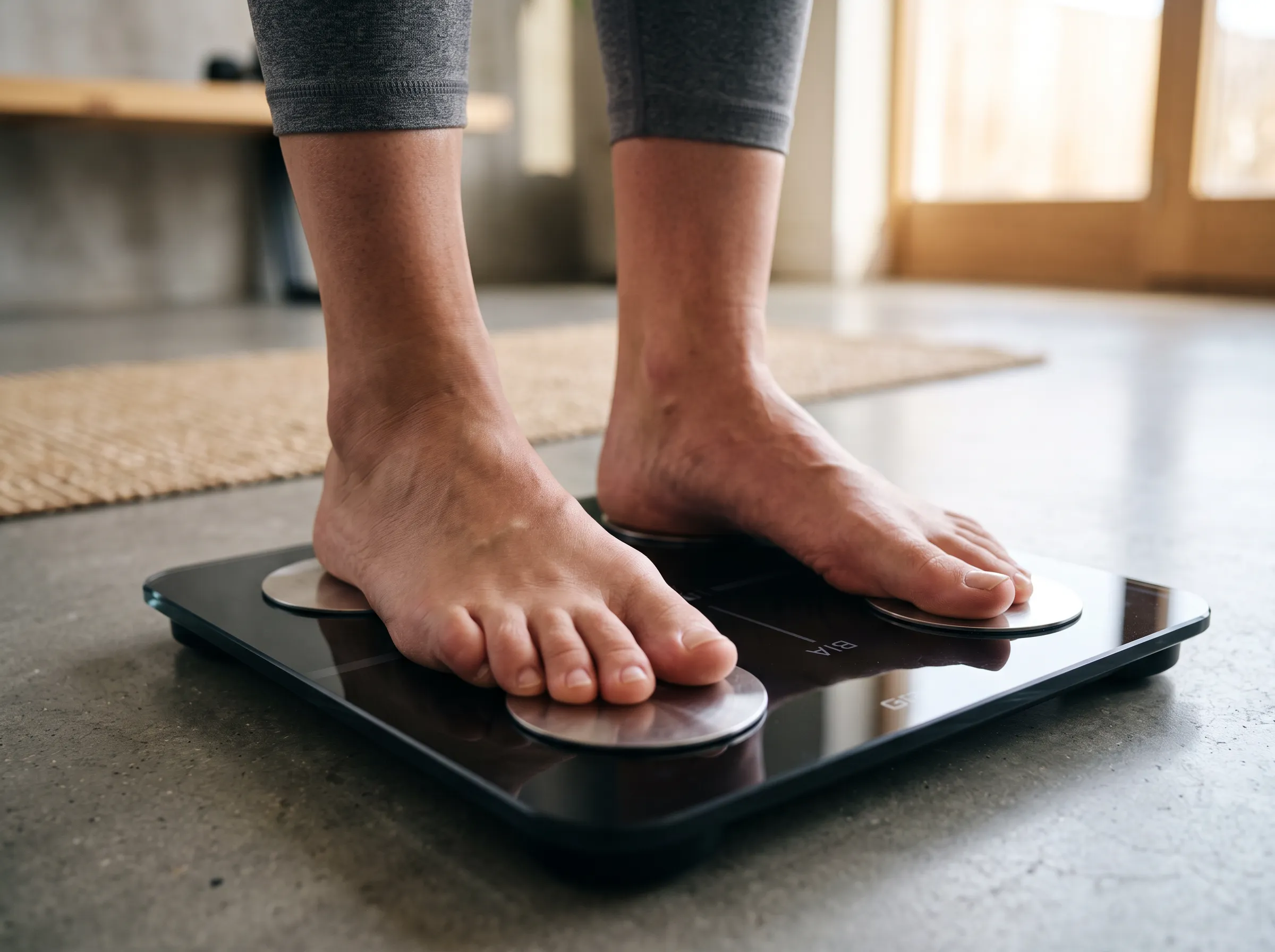
When you step on a bioimpedance scale or hold its handles, metal electrodes touch your bare skin. The device sends a very low, safe electrical signal through your body, which you won’t feel, and measures the opposition it meets along the way, called impedance.
The device then plugs that measurement into equations along with your age, height, weight and sex to estimate your body composition. Because these are estimates, the result depends heavily on your hydration and on the equipment used.
Clinical guidelines from the European Society for Clinical Nutrition and Metabolism (ESPEN) state that BIA gives reasonable estimates of body water and fat-free mass in healthy people when performed under standardized conditions. That makes it most useful for tracking changes over time, as long as you test the same way every time.
Key benefits of tracking your body composition
Relying only on a regular scale often leads to frustration. Tracking your body composition helps you stay motivated even when your weight doesn’t change, and it brings these advantages:
- Accurate fat tracking: You can see exactly how much fat you are losing. Therefore, you know if your caloric deficit is actually working.
- Muscle preservation monitoring: You can ensure you maintain lean mass while dieting. Consequently, your metabolism remains strong.
- Hydration awareness: The test reveals your total body water levels. Thus, you can adjust your fluid intake for optimal performance.
- Better goal setting: You can set specific targets for muscle gain or fat loss. Moreover, this makes your fitness journey much more objective.
- Metabolic tracking: Advanced scales estimate your resting calorie burn. Therefore, you can adjust your diet accurately.
With this data, you can adjust your training and nutrition based on real trends instead of guesswork. Just remember that the metabolic rate on the report is also an estimate, so use it as a reference, not an exact value.
Bioimpedance vs. other body fat measurements
There are several ways to measure body composition, and each has pros and cons. Comparing them helps you choose the right tool for your needs:
| Method | Accuracy | Accessibility | Cost |
|---|---|---|---|
| Bioimpedance | Moderate (depends on device and preparation) | Very easy (home, gym or clinic) | Low to medium |
| Skinfold calipers | Moderate (depends on the tester’s skill) | Requires a trained professional | Low |
| DEXA scan | High | Clinical settings only | High |
| Hydrostatic weighing | High | University or lab settings | High |
Bioimpedance offers the best balance of convenience and cost for everyday fitness enthusiasts, while DEXA and hydrostatic weighing require appointments and higher costs. The key is to always test on the same device under the same conditions, so your comparisons are meaningful.
Types of bioimpedance scales and devices
Not all bioimpedance devices are the same. The most common is the foot-to-foot scale, where you stand barefoot on metal pads. The current travels up one leg and down the other, so it mainly measures the lower body and estimates the rest with algorithms.
Hand-to-hand devices, which you hold in front of you, do the opposite: they measure mainly the arms and upper body. Hand-to-foot machines with both grips and foot pads send the current through the whole body. The more advanced models, with eight electrodes, provide segmental analysis of the arms, legs and trunk, and many gyms use them in a full physical assessment.
How to prepare for a bioimpedance test: 5 steps
Hydration has a big impact on the electrical current, so poor preparation can skew your numbers. Protocols vary slightly between devices, but these steps are the most widely recommended:
- Fast for a few hours: test at least 3 to 4 hours after your last meal, and avoid drinking large amounts of water right before.
- Avoid intense exercise: skip hard cardio or lifting for 12 hours beforehand, since sweating and blood flow changes affect the reading.
- Skip caffeine and alcohol: avoid caffeine on the day of the test and alcohol for 48 hours before, as both affect your body water.
- Empty your bladder: go to the bathroom about 30 minutes before the test.
- Remove metal accessories: take off watches, rings and other metal items before stepping on the device.
By following these rules, you minimize variables. Thus, you can trust that any changes in your body fat percentage are real. Moreover, taking body measurements properly ensures you stay on the right track.
Where to get a bioimpedance test?
Many commercial gyms have a professional bioimpedance machine, and you can often book a session with a trainer who will help you read the report. Nutritionists and dietitians also use these devices to estimate your energy needs and build personalized meal plans.
[Sports medicine clinics often offer advanced segmental analysis for athletes. If you prefer to test at home, a smart scale is a good way to track trends, even if it’s less precise than clinical equipment.
Common errors that skew your results
Even with good equipment, a few mistakes can lead to misleading readings. The most common is testing right after a workout. Sweating and increased blood flow change how the current moves through your body, which can distort your body fat percentage in either direction, so always test when rested.
Another mistake is testing with socks or tights on. The current needs direct contact with your skin, so your feet must be bare and clean. Very dry skin can also increase resistance, while creams and oils can interfere with contact.
For women, testing in the days before or during menstruation can skew results due to fluid retention. If possible, schedule your tests at the same point in your cycle.
Finally, don’t obsess over a single reading. Your numbers will vary a bit from day to day, so look at the trend over several weeks.
Frequently asked questions
-
What is the difference between bioimpedance and a regular scale?
A regular scale only measures your total body weight. However, a bioimpedance scale sends an electrical current through your body to estimate your muscle, fat, and water percentages. Therefore, it provides a much more detailed health profile.
-
Do you need to fast for a bioimpedance test?
Yes, fasting for at least three to four hours before the test is highly recommended. Digesting food and liquids can alter your body’s electrical resistance. Consequently, fasting ensures the most accurate and consistent body composition results.
-
How much does a bioimpedance test cost?
Many gyms include the test for free or charge a small fee of $15 to $30 per scan. Meanwhile, buying a home smart scale typically costs between $30 and $150. Therefore, it is an affordable way to track your health.
-
Can anyone get a bioimpedance test?
Most people can safely use this technology. However, individuals with pacemakers or other implanted medical devices should avoid it, as the electrical current might interfere with their equipment. Furthermore, pregnant women should consult their doctor first.
Bioimpedance: see what the scale can’t show you
Understanding bioimpedance changes how you track your fitness goals. Instead of chasing a number on the scale, you can follow what really matters: less fat, more muscle and better health.
Prepare properly and test under consistent conditions, and you’ll be able to adjust your diet and workouts with confidence. Over time, you’ll also get a clearer idea of how long it takes to see results at the gym.
Ready to turn your results into progress? Download the Befit app to get personalized training plans, log your workouts and build muscle while losing fat.