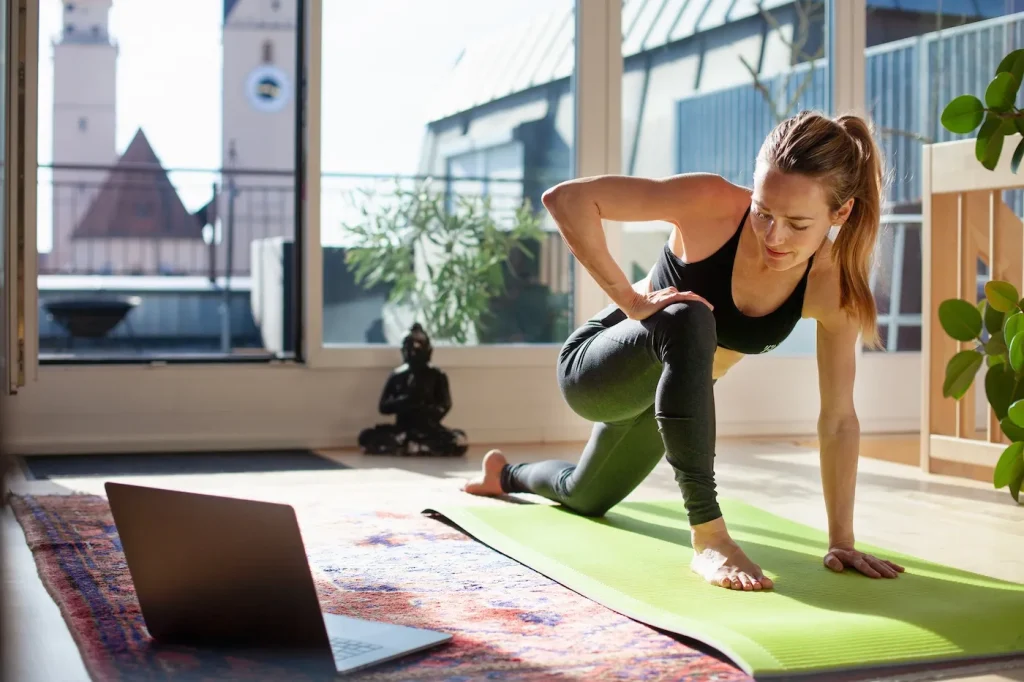

The home workout is no longer just an alternative for people who don’t go to the gym. It has become the first choice for many people looking for practicality, savings, and flexibility. With workout apps, videos, and online programs, you can build effective routines with minimal or even no equipment.
Training at home doesn’t mean giving up results. With proper planning, you can build strength, improve endurance, lose weight, and even gain muscle mass (hypertrophy). The secret isn’t the place you train, but how you organize your exercises, volume, and progression over time.
In this guide, you’ll learn how to build a home workout in 4 practical steps, discover the best exercises for each goal, follow ready-made routines for beginners, weight loss, and strength, and get tips to stay consistent.
For more on equipment, check out home workout equipment, and to understand the importance of professional guidance, see physical assessment.
What is a home workout?
A home workout is any structured exercise routine you do at home, using your own body weight or simple accessories such as dumbbells, resistance bands, a jump rope, or kettlebells. It can include strength training, cardio, mobility, or a combination of all three, and it can be adapted to any fitness level.
What separates a real home workout from “just moving around” is planning: a clear goal, exercises that cover all major muscle groups, a weekly frequency, and gradual progression. When these elements are in place, training at home can meet the World Health Organization’s physical activity recommendations for adults: 150 to 300 minutes of moderate activity per week, plus muscle-strengthening exercises at least two days a week.
Benefits of a home workout
Training at home removes many of the obstacles that make people quit exercising, such as commuting, crowded gyms, and fixed schedules. These are the main advantages:
- Flexible schedule: Train whenever you want, without depending on gym hours.
- Savings: No membership fees or commuting costs.
- Privacy: Ideal if you feel insecure or prefer to train alone.
- Adaptability: Routines tailored to your goals and fitness level.
- Consistency: Fewer barriers make it easier to stick to the habit.
Of all these benefits, consistency is the one that matters most for results. A simple workout done three times a week for months beats a perfect plan you abandon after two weeks.
How to build a home workout in 4 steps
Building your own home workout routine is simpler than it looks. Follow these four steps in order, and you’ll have a complete plan adapted to your level and goal.
1. Define your goal
The first step is to decide what you want to achieve: lose weight, gain muscle, improve your conditioning, or simply stay active. Your goal changes how you organize the workout, from the type of exercise to the rest time between sets.
For example, if your focus is weight loss, circuits and HIIT with short rest periods are good choices. If you want to gain muscle, prioritize strength exercises with controlled execution, more sets, and longer rest. Write your goal down: it will guide every decision in the next steps.
2. Choose your exercises
A balanced home workout includes movements for all muscle groups. Here are some options that work well with little or no equipment:
- Lower body: squats, lunges, glute bridges.
- Upper body: push-ups, triceps dips, resistance band rows.
- Core: plank, crunches, leg raises.
Check our leg workout article for lower body strengthening ideas, and our guide to back exercises at home to strengthen your posterior chain without equipment.
If you’re a beginner, a full body workout, which trains the whole body in each session, is usually the most efficient option. You can also explore the Befit exercise library to see how to perform each movement correctly.
3. Set frequency and volume
Frequency is how many times you train per week, and volume is the total amount of work (sets × repetitions). Both should match your level, so your body has time to recover between sessions:
- Beginners: 2 to 3 times per week.
- Intermediate/advanced: up to 5 times per week, alternating muscle groups.
As a starting point, 2 to 3 sets of 8 to 15 repetitions per exercise works well for most people. Leave at least one rest day between intense sessions for the same muscle group, since that’s when muscles recover and get stronger.
4. Control intensity
Adjust repetitions, rest time, and execution speed based on your level. A good exercise should feel challenging in the last two or three reps, while still allowing proper form.
When the workout gets easy, it’s time to apply progressive overload: add reps, reduce rest, slow down the lowering phase of the movement, or switch to a harder variation (for example, from knee push-ups to regular push-ups). This is what keeps you progressing, even without heavy weights.
Create your home workout in seconds with Befit
If you don’t want to build your routine from scratch, the Befit workout generator does the work for you. In just a few clicks, you get a ready-to-use home workout based on your goal, available time, and equipment.
It’s a practical way to test new combinations of exercises, vary your routine, and avoid the boredom that makes so many people give up. Use it whenever you want a fresh workout that fits your day.
Types of home workout
There isn’t just one way to train at home. Each type has a different focus, and you can combine them throughout the week. Compare the main options:
| Type | What it is | Best for | Equipment |
|---|---|---|---|
| Functional training | Mimics daily movements to improve strength, endurance, and coordination | Overall fitness and daily performance | Optional |
| Bodyweight training | Uses only your own body as resistance | Beginners and those with no equipment | None |
| Training with accessories | Adds external load to the exercises | Strength and muscle gain | Dumbbells, bands, jump rope, or kettlebells |
| HIIT | High-intensity intervals with short rest periods | Maximum calorie burn in less time | None or minimal |
If you’re just starting, bodyweight training is the safest entry point. As you gain experience, adding accessories and HIIT sessions helps you keep evolving and avoid plateaus.
Home workout examples for every goal
Now that you know the structure, here are three ready-made routines you can do today. Choose the one closest to your goal, and remember to warm up first.
Beginner home workout
This routine works the whole body with simple movements and no equipment. Do it 2 to 3 times a week, resting about 60 seconds between sets:
- Squat – 3×12
- Knee push-up – 3×10
- Plank – 3×20s
- Jumping jacks – 3×30s
When you can complete all sets comfortably, increase the plank time to 30 seconds and try a few regular push-ups. This is the first step of progressive overload.
HIIT home workout for weight loss
This circuit raises your heart rate quickly and burns a lot of calories in a short time. Do one exercise after the other, without stopping, until the rest period:
- Jumping jacks – 40s
- Jump squats – 30s
- High knees – 30s
- Rest – 20s
Repeat the circuit 4 to 6 times. If jumping is uncomfortable for your joints, swap jump squats for regular squats and high knees for marching in place.
Strength home workout
This routine focuses on building strength and muscle. Perform the movements with control, especially in the lowering phase, and rest 60 to 90 seconds between sets:
- Lunge – 3×12
- Push-up – 3×8
- Glute bridge – 3×12
- Resistance band row – 3×10
To increase the challenge, hold a backpack with books during lunges and glute bridges, or use a stronger resistance band. Small adjustments like these keep the stimulus high.
Tips for better results
Some simple habits make a big difference in how fast you see results with your home workout. Follow these guidelines:
- Warm up for 5 to 10 minutes before training.
- Keep proper form to prevent injuries.
- Track your progress with apps or notes.
- Change exercises every 4 to 6 weeks.
- Combine training with proper nutrition.
Tracking deserves special attention: writing down reps, load, and time shows whether you’re really progressing. Tools that use artificial intelligence can help here too, as we explain in our article on building a routine with AI tools.
How long does it take to see results with a home workout?
It depends on your goal, frequency, and nutrition, but in general you’ll feel more energy and better endurance in the first 2 to 4 weeks. Early strength gains usually come quickly, because your body learns to perform the movements more efficiently.
Visible changes, such as muscle definition or weight loss, usually appear after 8 to 12 weeks of consistent training combined with a balanced diet. The key is not to give up in the first weeks: results from a home workout are cumulative.
Can you gain muscle with a home workout?
Yes. Muscles respond to effort and tension, not to the place where you train. Bodyweight exercises and resistance bands can stimulate hypertrophy, as long as the sets are close to fatigue and you apply progressive overload over time.
The limitation usually appears in more advanced stages, when bodyweight alone becomes easy. At that point, harder variations (such as single-leg squats or decline push-ups) and accessories like adjustable dumbbells help you keep progressing.
When to seek professional guidance
Even at home, professional guidance is essential to adjust load and intensity. A physical assessment helps set safe limits and realistic goals, especially if you’re sedentary, have joint pain, or are returning after a long break.
A professional can also identify posture issues, correct your exercise technique, and adapt your routine to any health condition. This investment reduces the risk of injury and makes your progress faster and safer.
Frequently Asked Questions
-
How many times a week should I do a home workout?
Beginners should start with 2 to 3 sessions per week. Intermediate and advanced practitioners can train up to 5 times a week, alternating muscle groups to allow recovery.
-
How long should a home workout last?
Between 20 and 45 minutes is enough for most goals. HIIT sessions can be even shorter, around 15 to 20 minutes, because of their high intensity.
-
Do I need equipment to work out at home?
No. Bodyweight exercises are enough to start and get results. Accessories such as resistance bands and dumbbells are useful later, to increase the challenge.
-
Is a home workout as effective as the gym?
For most goals, yes, especially for beginners and intermediates. What determines results is consistency, intensity, progression, and nutrition, not the location.
Start your home workout with Befit
A home workout is a practical, budget-friendly, and effective way to stay fit and healthy. With discipline, the right exercises, and progressive adjustments, you can achieve results as good as those you’d get at the gym.
Now that you know how to build your routine, download the Befit app and get personalized workouts, tutorial videos, and progress tracking tools to keep evolving without leaving home.