
Building a strong, well-defined physique takes more than training the muscles you see in the mirror. Your back makes up much of your posterior chain [internal link: posterior chain], and it plays a key role in strength, posture and everyday movement.
Many gym-goers do rows and pulldowns without feeling the right muscles working, often feeling their arms more than their back. Knowing the parts of the back helps you build a stronger mind-muscle connection, which makes each rep more effective.
In this guide, you’ll learn the muscles of the 3 main back regions, what each one does and the best exercises to train them, plus tips to program your workouts and avoid common mistakes.

What are the parts of the back called?
The back is usually divided into three regions: upper, middle and lower. The main muscles are the trapezius, rhomboids, teres major and minor, latissimus dorsi (lats) and erector spinae, with deeper muscles such as the multifidus and quadratus lumborum supporting the lower spine.
These muscles sit in overlapping layers and work together to support your spine, move your shoulder blades and arms, and stabilize your torso. Some are large and visible, like the lats and traps, while others are deep and mainly provide stability.
[Because the back is so complex, no single exercise can develop it fully. You need a variety of movements to train every region, and understanding the anatomy helps you build a balanced workout split.
The 3 main regions of the back and their muscles
Dividing the back into regions makes it easier to understand what each muscle does and how to train it. In practice, these regions overlap: the lats, for example, extend from the middle to the lower back.
Here’s what you’ll find in each region and why it matters for your training.
1. Upper back: trapezius, rhomboids and teres muscles
The upper back mainly controls the movement and stability of your shoulder blades, and it helps you keep an upright posture throughout the day. The trapezius, or traps, dominates this area. This large muscle runs from the base of your skull and neck down to the middle of your spine. Its upper fibers elevate your shoulders, the middle fibers pull your shoulder blades together, and the lower fibers pull them down.
Beneath the traps are the rhomboids (major and minor), which retract the shoulder blades. Near the armpit, the teres major helps pull your arm down and back, working alongside the lats. The teres minor is part of the rotator cuff and rotates your arm outward, which helps keep the shoulder stable.
2. Middle back: latissimus dorsi
The latissimus dorsi, or lats, are the broadest muscles of the back. These wing-shaped muscles span from the middle and lower back to the upper arm bone, which makes them essential for almost every pulling movement. Their main job is to pull your arms down and back toward your body. Well-developed lats create the V-taper that makes the waist look narrower.
The lats also connect to the thoracolumbar fascia, a layer of connective tissue in the lower back, so they help stabilize your spine during heavy lifts. To develop them fully, combine vertical pulls, like pull-ups and pulldowns, with horizontal rows. See our guide to mid back exercises.
3. Lower back: erector spinae and deep stabilizers
The erector spinae run along the entire length of your spine. These thick muscle bundles extend your spine, keep you upright and stop your torso from folding forward when you lift something off the floor. Deeper down, the multifidus stabilizes each segment of the spine, and the quadratus lumborum helps with side bending and pelvic stability.
Many people neglect this region, even though it’s central to core stability and everyday movement. Training the lower back progressively helps your spine tolerate load better, and regular exercise is one of the most recommended strategies for reducing the risk of low back pain coming back.
Why you must train all back muscles evenly?
Focusing on only one area of your back can lead to strength imbalances, such as strong lats but weak muscles around the shoulder blades. Training all regions keeps your shoulders more stable and your pulling strength balanced. Balanced training also supports muscle hypertrophy across the whole torso.
A strong back also serves as a stable base for pressing movements like the bench press, which helps you produce more force. In sports, the back transfers power between the lower and upper body, whether you run, swim or play contact sports.
Many people spend hours sitting at a desk, and strengthening the upper and middle back can make it easier to maintain a comfortable, upright posture. Still, posture depends on many factors, so think of back training as part of the solution, not a quick fix.
The best back exercises for each region
The best back exercises engage several muscles at once, and changing angles lets you emphasize specific regions. That’s why your routine should cover different movement patterns. Use this table as a guide:
| Muscle Region | Primary Function | Best Exercises |
|---|---|---|
| Upper Traps | Shoulder elevation | Dumbbell shrugs, barbell shrugs, farmer carries |
| Mid-Back (Rhomboids) | Scapular retraction | Seated row, face pulls, chest-supported rows |
| Latissimus Dorsi | Arm extension and adduction | Pull-ups, lat pulldowns, straight-arm pulldowns |
| Lower Back (Erectors) | Spinal extension | Back extensions, deadlifts, good mornings |
-
Muscles
- Primary
-
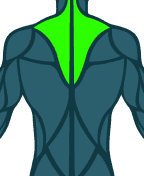 Trapezius
-
Instructions
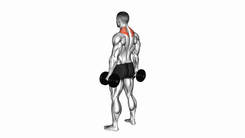
- Keep your torso upright
- Hold the dumbbells with your hands positioned at shoulder width
- Contract your abdomen
- Perform the movement in a controlled manner
-
Important Tips
- Do not move your shoulders forward
- Do not bend your elbows during the movements
- Do not let your torso lean backward
Dumbell Shrugs
-
Muscles
- Primary
-
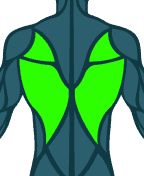 Back
Back
- Secondary
-
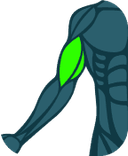 Biceps
-
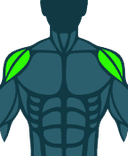 Shoulders
-
Instructions
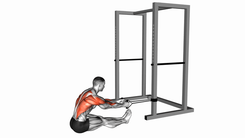
- Sit on the floor with your legs extended, looping the resistance band around your feet.
- Hold the ends of the band with both hands, keeping your back straight and chest up.
- Pull the band towards your lower abdomen, squeezing your shoulder blades together.
- Slowly extend your arms back to the starting position, controlling the band’s resistance.
-
Important Tips
- Maintain a straight back and engaged core throughout the exercise.
- Focus on pulling with your back muscles, not just your arms.
- Control the movement both when pulling and releasing the band.
- Avoid shrugging your shoulders towards your ears.
Band Seated Row
-
Muscles
- Primary
-
Back
- Secondary
-
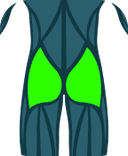 Glutes
-
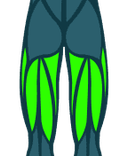 Hamstrings
-
Instructions
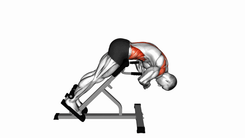
- Position your feet correctly and adjust the bench height so that your hips are above the bench support
- Cross your arms over your chest
- Contract your glutes
- Perform the movement in a controlled manner
-
Important Tips
- Avoid lifting your hips off the bench support
- Avoid throwing your torso excessively backward at the end of the upward movement
- Avoid using momentum or sudden movements
Back extension machine
Free weights and machines both offer unique benefits for back development. The bent over row bbuilds back strength and core stability at the same time, while chest-supported machines let you train the back without tiring your lower back.
If you train outside the gym, you can still get great results with bodyweight movements and resistance bands. Check out our back exercises at home.
How to strengthen the back with smart programming
Knowing the exercises is only half the work. To keep progressing, you also need to manage frequency, volume and intensity. Training your back at least twice a week works well for most people, with about 10 to 20 working sets per week split across your sessions. Learn more about training volume per muscle group.
Balance your pulling angles too. A simple rule is to pair each vertical pull with a horizontal one, such as a lat pulldown with a cable row, to build both width and thickness.
Unilateral exercises, like single-arm rows, are also worth including. They allow a longer stretch of the lats and help correct strength differences between sides.
Common errors when training the parts of the back
The most common mistake is using momentum. When you jerk the weight back, your hips and lower back take over and the target muscles do less work. Control the weight through the full range of motion.
Another frequent mistake is not retracting your shoulder blades during rows. If your shoulders stay rounded forward, your biceps end up doing much of the work, so squeeze your shoulder blades together at the top of every rep.
Many people also skip direct lower back work entirely. Exercises like back extensions, done with good form and gradual progression, help strengthen the erectors for heavier compound lifts.
Finally, a tight grip can tire your forearms before your back. Lifting straps help on heavy pulls, and some lifters feel their lats work better with a thumbless grip on pulldowns and rows.
Frequently asked questions
-
How many times a week should you train your back?
You should ideally train your back two to three times per week for optimal muscle growth. This frequency allows you to accumulate enough weekly volume while providing adequate time for recovery between sessions.
-
Is it normal for your lower back to hurt after a back workout?
Mild muscle soreness in the lower back is completely normal after exercises like deadlifts or back extensions. However, sharp or shooting pain indicates poor technique or an underlying injury that requires immediate medical attention.
-
Can you train back and chest on the same day?
Yes, training back and chest on the same day is an excellent antagonist superset strategy. This approach pumps blood into the entire upper torso and saves time without compromising your overall strength output.
-
Does training your back help improve posture?
Absolutely. Strengthening the muscles of your upper and mid-back pulls your shoulders backward into their natural position. Consequently, consistent back training effectively counteracts the slouched posture caused by sitting at a desk all day.
Parts of the back: train every region for a stronger, balanced body
Understanding the parts of the back helps you choose the right exercises and train each region with purpose. With this knowledge, you can build a balanced back that looks strong and performs well in the gym and in daily life.
Consistency and good form are what drive long-term progress. Prioritize the mind-muscle connection over the heaviest possible weight: as your technique improves, each workout becomes more effective.
Start combining vertical pulls, horizontal rows and lower back work in your routine today. To make it easier, download the Befit app and get workout plans that cover every part of your back, so you can build a stronger, healthier body.