
Are you tired of crowded gyms, expensive monthly memberships and long commutes just to get a solid workout? A calisthenics workout at home is the perfect way to reclaim your time and transform your physique. You don’t need fancy machines or heavy plates: your own body becomes the most versatile gym you will ever own.
Many people believe bodyweight training is only useful for endurance or quick warm-ups. However, gymnasts prove every day that mastering your own body weight builds extraordinary strength and muscle definition. Best of all, this training style adapts to any fitness level, space or schedule.
In this guide, you will learn the science behind bodyweight training and how to maximize your gains. You will also discover the seven best moves to work every major muscle group, plus a complete step-by-step routine to start your calisthenics workout at home today.
What is calisthenics and how does it build strength?
Before diving into the exercises, it is important to understand the fundamentals of this ancient training discipline. So, what is calisthenics exactly? The term comes from the Greek words “kallos” (beauty) and “sthenos” (strength). Essentially, it is a form of resistance training that utilizes your own bodyweight and gravity to challenge your muscles through fluid, controlled movements.
Unlike traditional weightlifting machines that isolate single muscles on a fixed path, calisthenics relies heavily on compound movements. Consequently, every exercise requires multiple muscle groups and joints to work together in harmony. For example, a simple push-up engages your chest, shoulders, triceps, core, and even your glutes to maintain a rigid body line.
This full-body integration develops superior neuromuscular coordination, balance, and proprioception. Furthermore, because you move your body through space rather than moving an external object, you build incredible relative strength. As a result, you not only look stronger, but you also move with greater agility and control in your everyday life.
Does home calisthenics work for muscle growth?
A common question among gym-goers is: does home calisthenics work for real hypertrophy? The short answer is yes. Your muscles do not have eyes; therefore, they cannot tell the difference between a metal barbell and your own body mass. Instead, muscle fibers respond mainly to mechanical tension, metabolic stress, and muscular damage.
To trigger muscle hypertrophy, you must challenge your muscle fibers near the point of momentary muscular failure. In a traditional gym, you achieve this by adding more weight plates to a bar. Conversely, in a calisthenics workout at home, you manipulate biomechanics and leverage to increase the difficulty of each movement.
For instance, shifting your body angle, slowing down the tempo, or transitioning to single-limb variations dramatically increases the load on the target muscles. In addition, understanding your optimal training volume per muscle group ensures you perform enough weekly sets to stimulate consistent growth. Thus, with proper progression, bodyweight training builds a lean, muscular, and athletic physique just as effectively as free weights.
Key benefits of a free calisthenics workout at home
Choosing to follow a free calisthenics workout at home offers numerous physical, mental, and financial advantages. Whether you are a busy professional or a student on a budget, removing the friction of going to a facility makes consistency much easier. Here are the primary benefits you will experience when you commit to home bodyweight training:
- Zero financial cost: You do not need to pay initiation fees, monthly dues, or buy expensive dumbbell sets to get started. Gravity is completely free and available twenty-four hours a day.
- Unmatched convenience and privacy: You can train in your pajamas, play your favorite music out loud, and never wait in line for a squat rack. Consequently, you save hours of commuting time every single week.
- Superior joint health and mobility: Closed-chain bodyweight exercises allow your joints to move along their natural anatomical pathways. Therefore, you experience far less joint stress and tendon inflammation compared to heavy machine lifting.
- Automatic core engagement: Almost every calisthenics movement requires you to stabilize your spine and pelvis against gravity. As a result, you build a rock-solid midsection without doing thousands of boring crunches.
- High caloric expenditure: Because these exercises recruit massive amounts of muscle tissue simultaneously, they demand significant energy. Furthermore, they improve your cardiovascular conditioning while sculpting lean muscle mass.
7 best moves for your calisthenics workout at home
To build a balanced and symmetrical physique, your routine must cover all fundamental human movement patterns. Specifically, you need upper-body pushing, upper-body pulling, lower-body squatting, hip hinging, and core stabilization. Below are the seven foundational exercises that form the backbone of any effective calisthenics workout at home.
1. The standard push-up (horizontal push)
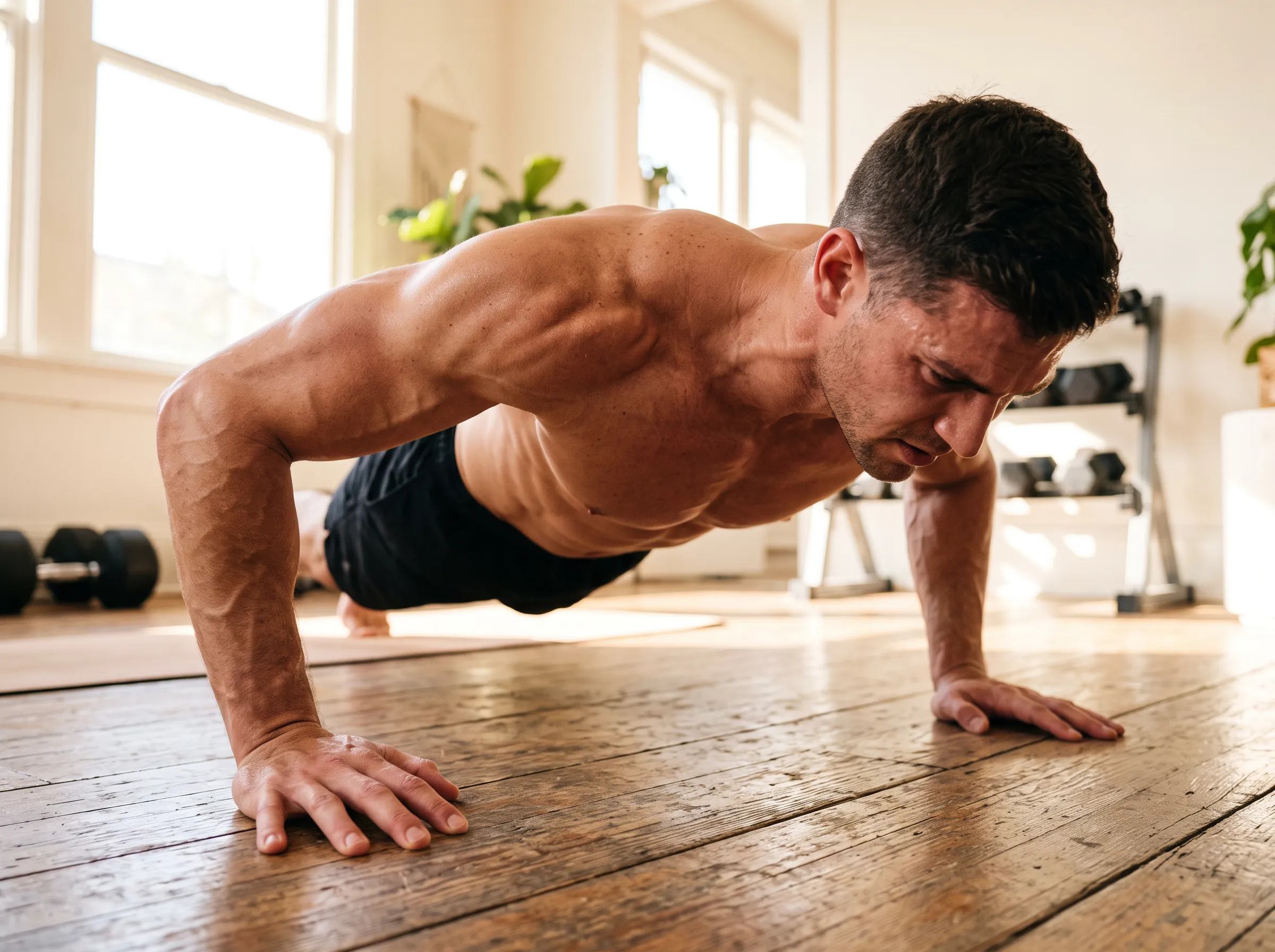
The push-up is the undisputed king of upper-body bodyweight exercises. Primarily, it targets the pectoralis major, anterior deltoids, and triceps, while requiring isometric strength from the entire core. If you want to master how to do push-ups with flawless technique, focus on maintaining a straight line from your head to your heels.
Start in a high plank position with your hands placed slightly wider than shoulder-width apart. Next, screw your palms into the floor to create external rotation in your shoulders, keeping your elbows tucked at a 45-degree angle. Lower your chest until it hovers an inch above the floor, pause briefly, and press back up explosively while exhaling.
2. Bodyweight squats (bilateral knee flexion)
When it comes to lower-body development, the bodyweight squat is essential for building strong quadriceps, hamstrings, calves, and glutes. Moreover, performing deep squats regularly improves hip, knee, and ankle mobility, which protects your lower back from daily wear and tear.
Stand with your feet shoulder-width apart and point your toes slightly outward at a 15-degree angle. Initiate the movement by pushing your hips back slightly and bending your knees simultaneously. Keep your chest proud and lower your torso until your thighs are at least parallel to the floor, then drive through your mid-foot to return to the standing position.
3. Inverted table rows or towel rows (horizontal pull)
Many people struggle to train their back muscles during a calisthenics workout at home because they lack pulling equipment. Fortunately, you can perform inverted rows underneath a sturdy dining table or use a bedsheet wedged securely into a closed doorframe. This horizontal pulling motion strengthens the latissimus dorsi, rhomboids, rear deltoids, and biceps.
Lie on your back underneath a heavy, stable table and grip the edge with your hands shoulder-width apart. Engage your glutes and core so your body forms a rigid plank with only your heels touching the floor. Pull your chest upward toward the underside of the table by driving your elbows down and back, squeeze your shoulder blades together, and lower yourself with control.
4. Chair triceps dips (vertical push)
To build impressive arm thickness and lower-chest definition, dips are an absolute must. Furthermore, understanding what is the triceps and its three distinct heads helps you appreciate why dips are so effective for arm growth. You can easily perform this movement using the edge of a sturdy chair, a couch, or a low coffee table.
Sit on the edge of the chair and place your hands right next to your hips, gripping the front edge firmly. Slide your hips forward off the seat with your knees bent at 90 degrees (or legs extended straight for more difficulty). Bend your elbows straight back—never flaring them out to the sides—until your upper arms are parallel to the floor, then press through your palms to lock out your arms.
5. Reverse lunges or Bulgarian split squats (unilateral leg)
Because your legs carry your body weight all day, bilateral squats can eventually become too easy for muscle growth. Therefore, incorporating unilateral training is the secret to doubling the load on each leg without using external weights. Reverse lunges and split squats heavily target the glutes and quads while fixing left-to-right strength imbalances.
Stand tall with your feet hip-width apart and brace your abdominal wall. Take a controlled step backward with your left foot, landing softly on the ball of your foot. Lower your back knee toward the floor until both knees form 90-degree angles, keeping your front shin vertical, and push forcefully through your front heel to return to the starting stance.
-
Muscles
- Primary
-
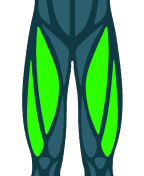 Quadriceps
- Secondary
-
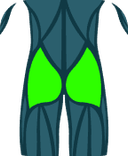 Glutes
-
Instructions
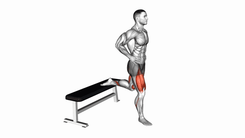
- Position one foot in front and the other on a bench behind you, with only the front part or top of the back foot resting on the bench
- Keep your torso upright, and ensure the front foot remains flat on the floor while the back foot is supported on the bench
- In a controlled manner, flex your hips and knees, lowering as far as possible while keeping your front foot firmly on the floor
- Then, return to the starting position by extending your hips and knees
-
Important Tips
- Keep your torso upright and avoid leaning forward excessively; a slight forward tilt is acceptable
- Avoid letting your front knee collapse inward; maintain alignment with your hip
- Avoid using momentum or sudden movements
Bulgarian Split Squat
6. Pike push-ups (vertical push for shoulders)
Building broad, capped shoulders without dumbbells requires shifting your body angle to mimic an overhead press. The pike push-up shifts the center of mass over your hands, transferring the workload from your chest directly onto your anterior and medial deltoids, as well as your upper traps and triceps.
Begin in a standard push-up position, then walk your feet forward toward your hands while pushing your hips high into the air. Your body should form an upside-down “V” shape with your head positioned between your arms. Bend your elbows and lower the top of your head toward the floor just in front of your hands, then press back up into the pike position along the same diagonal path.
7. Hollow body hold and forearm plank (core stability)
In gymnastics and advanced calisthenics, the core is the transmission that transfers force between your upper and lower body. Mastering how to do a plank and the hollow body hold teaches you full-body tension and pelvic control. These isometric exercises target the rectus abdominis, transverse abdominis, and obliques deeply.
For the hollow body hold, lie flat on your back and press your lower spine firmly into the floor by tucking your tailbone. Simultaneously lift your shoulder blades, extended arms, and straight legs a few inches off the ground, forming a shallow banana shape. Hold this tension while breathing shallowly, ensuring your lower back never arches off the mat.
How to progress your exercises without weights
To keep gaining strength after your first few weeks, you must apply the principle of progressive overload. When you cannot add iron plates, you must make the movements biomechanically harder. Consequently, knowing when to push harder—including the strategic benefits of training to failure on safe exercises—will keep your muscles adapting continuously.
The table below illustrates how to scale each of the seven foundational movements from a basic beginner variation to an advanced strength challenge:
| Movement pattern | Beginner variation | Intermediate variation | Advanced variation |
|---|---|---|---|
| Horizontal push | Incline push-up (hands on chair) | Standard floor push-up | Decline or archer push-up |
| Knee flexion | Box squat (sitting to a chair) | Full-depth bodyweight squat | Pistol squat (single-leg squat) |
| Horizontal pull | Doorframe towel row (high angle) | Under-table row (knees bent) | Under-table row (legs straight/elevated) |
| Triceps dip | Chair dip (knees bent, feet close) | Chair dip (legs fully extended) | Two-chair dip (feet elevated) |
| Unilateral leg | Assisted split squat (holding wall) | Alternating reverse lunge | Bulgarian split squat (rear foot on couch) |
| Vertical push | Downward dog isometric hold | Standard floor pike push-up | Elevated pike push-up (feet on chair) |
| Core stability | Knee plank or tucked hollow hold | Forearm plank (60 seconds) | Full hollow body hold (arms overhead) |
Move to the next column only when you can complete all your sets with clean form at the top of the rep range. When you reach the advanced column, a doorway pull-up bar and portable parallel bars open up even harder progressions.
Complete beginner calisthenics workout routine
Now that you know the exercises and progressions, it is time to assemble them into a structured beginner calisthenics workout. For optimal muscle recovery and protein synthesis, a full-body training approach performed three times per week (such as Monday, Wednesday, and Friday) is ideal. If you want to expand your setup later, check out our guide on how to build a home workout for more customization ideas.
Before starting the main circuit, always spend five minutes warming up with arm circles, torso twists, jumping jacks, and hip openers. Furthermore, pay close attention to your recovery intervals; recent sports science regarding optimal rest between sets shows that resting 60 to 90 seconds between bodyweight sets maximizes both strength output and hypertrophy.
- Bodyweight squats: Perform 3 sets of 15 to 20 repetitions. Focus on a slow 3-second lowering phase and an explosive drive upward.
- Standard or incline push-ups: Perform 3 sets of 8 to 15 repetitions. Stop each set 1 repetition short of form breakdown.
- Inverted table or towel rows: Perform 3 sets of 10 to 15 repetitions. Pause for 1 full second at the top of every rep to squeeze your back muscles.
- Alternating reverse lunges: Perform 3 sets of 10 to 12 repetitions per leg. Keep your torso upright and engage your glutes throughout the movement.
- Pike push-ups: Perform 3 sets of 6 to 10 repetitions. Focus on lowering your head forward between your hands to create a tripod shape.
- Chair triceps dips: Perform 3 sets of 10 to 15 repetitions. Keep your shoulders pressed down away from your ears to protect your shoulder capsule.
- Forearm plank or hollow hold: Perform 3 sets of 30 to 45 seconds. Squeeze your quads, glutes, and abs as hard as possible for the entire duration.
The full routine takes around 35 to 40 minutes. For more beginner-friendly movements with video demonstrations, explore the beginner exercises in the Befit library.
Common mistakes to avoid when training at home
Although a calisthenics workout at home is safer than lifting heavy barbells without a spotter, poor habits can still stall your progress or cause overuse injuries. When you train without mirrors or a coach watching you, self-awareness becomes critical. Avoid these four common pitfalls to ensure steady, pain-free gains:
- Rushing through repetitions with momentum: Bouncing at the bottom of a push-up or squat uses elastic tendon energy rather than muscular contraction. Instead, control every inch of the movement, taking two seconds to lower yourself and one second to push up.
- Using a partial range of motion: Half-reps yield half-results. Lower your chest all the way down on push-ups and drop your hips below parallel on squats to recruit the maximum number of muscle fibers.
- Neglecting pulling movements: Because push-ups are so easy to do on the floor, many beginners overtrain their chest and shoulders while ignoring their back. Consequently, this creates rounded shoulders and poor posture. Always match your pushing sets with an equal number of rowing sets.
- Ignoring nutrition and sleep: Even the best training program will fail if you do not fuel your body properly. Consume adequate daily protein, stay hydrated, and sleep at least seven to eight hours per night so your muscle tissues can repair and grow stronger.
Fixing these habits early saves you weeks of stalled progress. Before adding harder variations, make sure your form, range of motion and recovery are on point.
Frequently asked questions
-
Can doing calisthenics at home replace the gym?
Yes, a well-programmed calisthenics routine can completely replace a traditional gym membership for building upper-body strength, core stability, and lean muscle mass. By using advanced leverage progressions and unilateral leg exercises, you can continually challenge your muscles without ever touching a weight machine.
-
Do I need a pull-up bar to do calisthenics at home?
While a doorway pull-up bar is a great low-cost investment for vertical pulling, you do not strictly need one to start. You can effectively train your back and biceps using sturdy dining tables for inverted rows, knotted bedsheets wedged in a closed door, or floor-based back extensions.
-
How many times a week should I do a calisthenics workout at home?
For most beginners and intermediate athletes, performing a full-body calisthenics workout three to four times per week is ideal. This frequency provides enough training volume to stimulate muscle growth while allowing 48 hours of rest between sessions for central nervous system and muscular recovery.
-
Can I start calisthenics at home if I am overweight?
Absolutely, you can start calisthenics at any body weight by scaling the exercises to match your current strength level. Begin with elevated variations—such as wall push-ups, box squats onto a chair, and high-angle doorframe rows—to reduce joint impact while you build foundational strength and lose body fat.
Start building your bodyweight strength today
Transforming your body does not require a fancy facility or thousands of dollars in home gym equipment. As we have explored, committing to a consistent calisthenics workout at home gives you everything you need to build functional strength, impressive muscle definition, and resilient joints. By mastering the seven foundational moves and applying smart biomechanical progressions, you become the master of your own physical potential.
Remember that the secret to long-term fitness success is consistency and structured progression. Do not worry if you cannot perform a standard push-up or a deep pistol squat on your very first day. Start with the beginner variations in our comparison table, focus on immaculate form, and celebrate every small victory as your repetitions climb week after week.
Are you ready to take the guesswork out of your home training and track your progress like a pro? Download one of the best workout apps by getting the BeFit app today! With BeFit, you get personalized bodyweight workout plans, video demonstrations for flawless technique, and smart tracking tools to help you crush your fitness goals right from your living room.