The 10 Best Hip Abductor Exercises for Your Workout
A good hip abductor workout trains the gluteus medius, gluteus minimus, and tensor fasciae latae — muscles responsible for moving the leg away from the body sideways and, more importantly, for stabilizing the hip during single-leg activities like walking, running, and squatting.
On this page you'll find 10 hip abductor exercises curated by Befit, with execution videos, posture tips, and variations for the gym, home gym, and bodyweight training. Every exercise has been reviewed by a fitness professional specialized in strength training.
If you already know what you want, use the level and equipment filters to jump straight to the right exercise. If you'd rather start somewhere, check the top exercises below — the movements with the strongest consensus for abductor activation.
And if you want a hip abductor workout built from scratch, personalized to your goal, your time, and your equipment, that's exactly what the Befit app does automatically.
How to build your Abductors workout
Volume per session: 2 exercises, 6 to 8 total sets — abductors are a small muscle group, used more for stability than heavy hypertrophy volume.
Movement split: 1 exercise with progressive resistance (abduction machine or cable) and 1 with a resistance band or bodyweight, good for activation before leg workouts.
Sets and reps: 3 sets of 15 to 20 reps — moderate load and higher reps work well for this group.
Frequency: 2 to 3 times a week — including as a warm-up before squats and other leg exercises, since activated abductors help keep the knee aligned.
Top Abductors exercises
| # | Exercise | Level | Equipment | Muscle focus | |
|---|---|---|---|---|---|
| 1 |
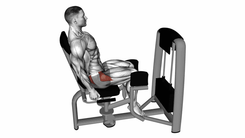 Abductor Machine |
Beginner | Abduction Machine | Abductors | See execution |
| 2 |
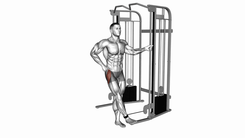 Cable Hip Abduction |
Intermediate | Dual cable pulley machine | Abductors | See execution |
| 3 |
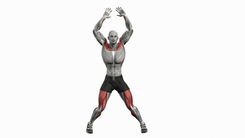 Jumping Jack |
Beginner | Abductors | See execution | |
| 4 |
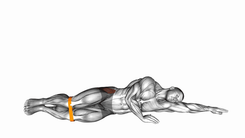 Clamshell |
Beginner | Resistance band | Abductors | See execution |
| 5 |
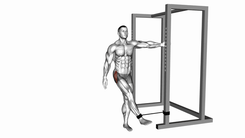 Resistance Band Hip Abduction |
Beginner | Resistance band | Abductors | See execution |
| 6 |
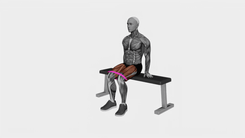 Seated Mini Band Hip Abduction |
Beginner | Resistance band | Abductors | See execution |
| 7 |
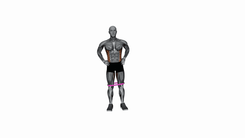 Standing Hip Abduction |
Beginner | Resistance band | Abductors | See execution |
| 8 |
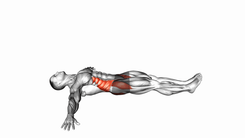 Lying Hip Abductor Stretch |
Beginner | Abductors | See execution |
Abductor Machine
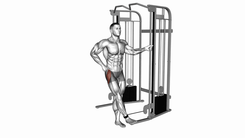
Cable Hip Abduction
Jumping Jack
Clamshell
Resistance Band Hip Abduction
Seated Mini Band Hip Abduction
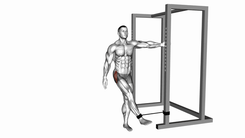
Standing Hip Abduction
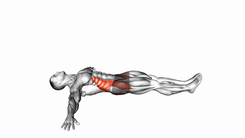
Lying Hip Abductor Stretch
All 8 Abductors exercises
Abductors workout at home vs. at the gym
Training hip abductors at home is simple: a resistance band (mini band) above the knees is already enough for standing, lying, or seated hip abduction.
Clamshells (lying on your side, knees bent, opening and closing like a shell) and jumping jacks round out a good abductor workout with no equipment at all.
At the gym, the toolkit is bigger. You've got an abduction machine for guided, progressive resistance, and a low pulley for standing hip abduction with adjustable load.
Use the Bodyweight or Home Gym filter above to see only exercises that fit your setup.
How Befit builds your Abductors workout with AI
Picking an exercise is only half the problem. The other half is: how many sets, how many reps, what load, in what order, when to switch things up. And that changes every week as you progress.
Befit solves this with an AI that builds a personalized training plan for your goal (hypertrophy, strength, definition), your level, your time per session, and your equipment. Every week, the algorithm adjusts volume and load based on what you've logged.
You don't need to know how to program periodization. Just train and log it.

Safety tips for Abductors training
- Keep the movement controlled — fast abduction with momentum reduces the abductor's work and shifts effort to your lower back.
- On the abduction machine, avoid opening beyond what your hip allows without pain — forcing excessive range of motion can irritate the joint.
- If you notice your knee "caving in" during squats, it's worth including abductor work as activation before your leg workout, not just as an isolated exercise at the end.
- With a resistance band, pick a strength that lets you complete the reps under control — a band that's too strong tends to snap the movement back too fast.
- Rest at least 24 to 48 hours between direct abductor sessions.
Frequently asked questions about Abductors training
-
How many exercises should I do for a hip abductor workout?
An effective hip abductor workout has 2 exercises per session — 1 with progressive resistance (machine or cable) and 1 with a resistance band or bodyweight. Total volume between 6 and 8 sets per week is enough for this group.
-
How many sets and reps for hip abductors?
Abductors respond well to moderate load and higher reps — 3 sets of 15 to 20 reps work better than heavy loads with low reps.
-
Is it worth training hip abductors?
It's worth it, especially if you feel your knee is unstable or "caving in" during squats and other leg exercises — strong abductors help stabilize the hip and knee during single-leg-support movements.
-
Can you train hip abductors at home?
Yes. A resistance band already covers standing, lying, and seated hip abduction. Use the Bodyweight filter in the exercise list above.
-
What other muscle group pairs well with abductors?
Abductors pair well with quads, glutes, or any leg day — usually used as warm-up activation before squats, to improve knee control during the main movement.
-
How many times a week should I train abductors?
Two to three times a week works well, including as a warm-up before other leg workouts, not just as a standalone session.
-
What's the best exercise for hip abductors?
The abduction machine and cable hip abduction offer the most progressive, controlled resistance. For quick activation before training, band hip abduction (mini band) is simple and effective.
-
How do I know I'm training abductors the right way?
You should feel the side of your hip/glute working, not your lower back. If your lower back tires before your abductor does, check whether you're using torso momentum to complete the movement. Film a set and compare it to the execution video on Befit.