
If you want bigger arms, your triceps deserve more attention than your biceps. They make up roughly two-thirds of your upper arm, so they have the biggest impact on overall arm size. That’s why so many lifters ask the same question: French press or overhead tricep extension, which one should you do?
The confusion is understandable. Both exercises place your arms overhead, stretch the back of your arm, and train the same muscle. The real differences come down to equipment, grip, loading potential, and joint comfort, and those details decide which option works best for your body.
In this guide, you’ll learn what each exercise is, the 5 key differences between them, what science says about growing your triceps with overhead movements, how to perform both with proper form, and how to fit them into your weekly routine.
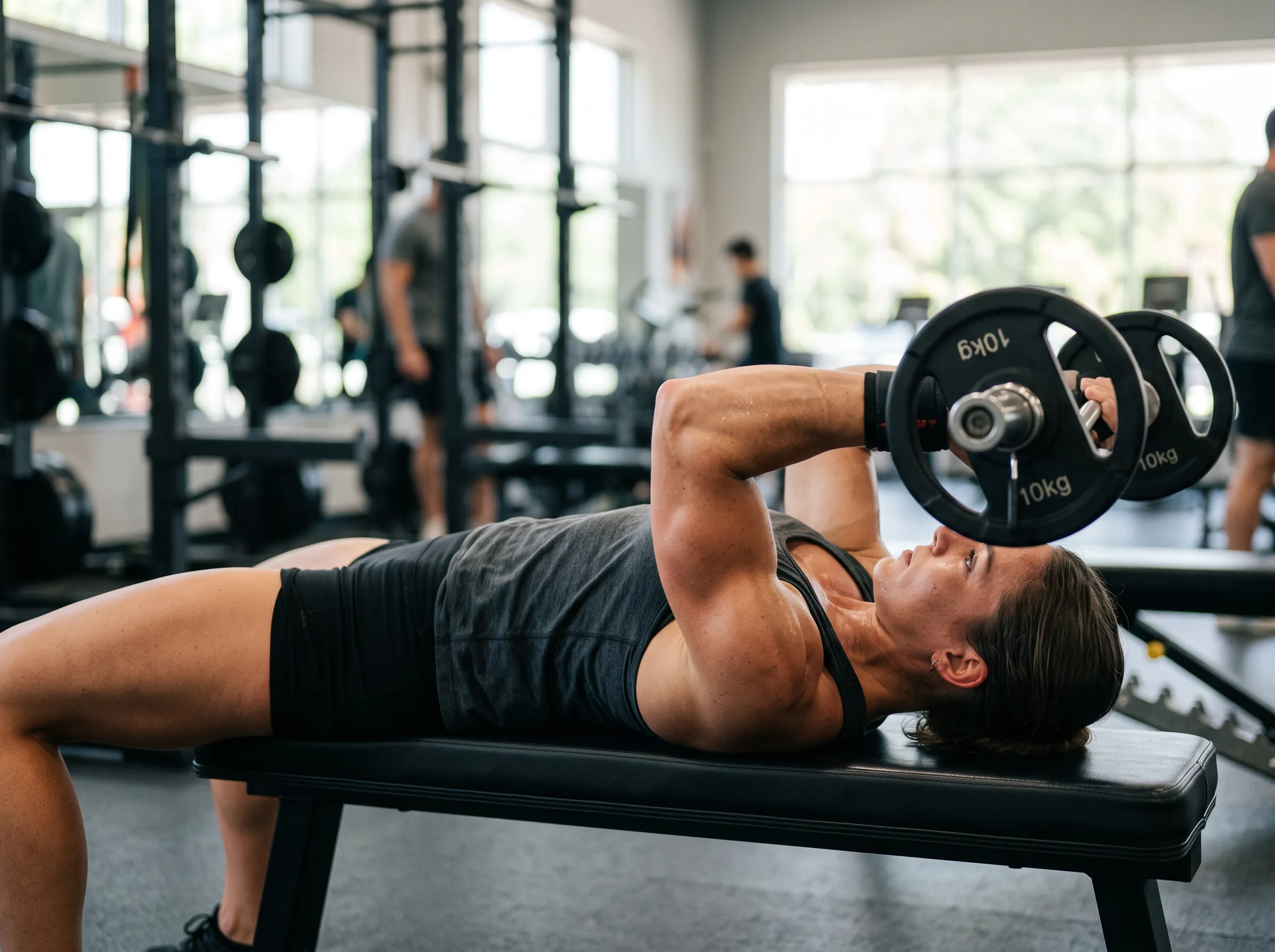
What Is the French Press and What Is the Overhead Tricep Extension?
Here’s the short answer: the French press and the overhead tricep extension are both overhead elbow extension exercises. You raise your arms above your head, lower the weight behind it by bending your elbows, and press it back up. The main difference is the tool you use: the French press usually relies on an EZ bar, while the overhead tricep extension is most often done with a dumbbell, a cable, or a resistance band.
One quick note about names: in some gyms and countries, “French press” also refers to a lying EZ-bar extension, which is closer to a skull crusher. In this article, we’re talking about the overhead version. If you want to compare it with the lying variation, read our guide on whether you should do skull crushers or French presses.
The French Press: An Overhead Extension With an EZ Bar
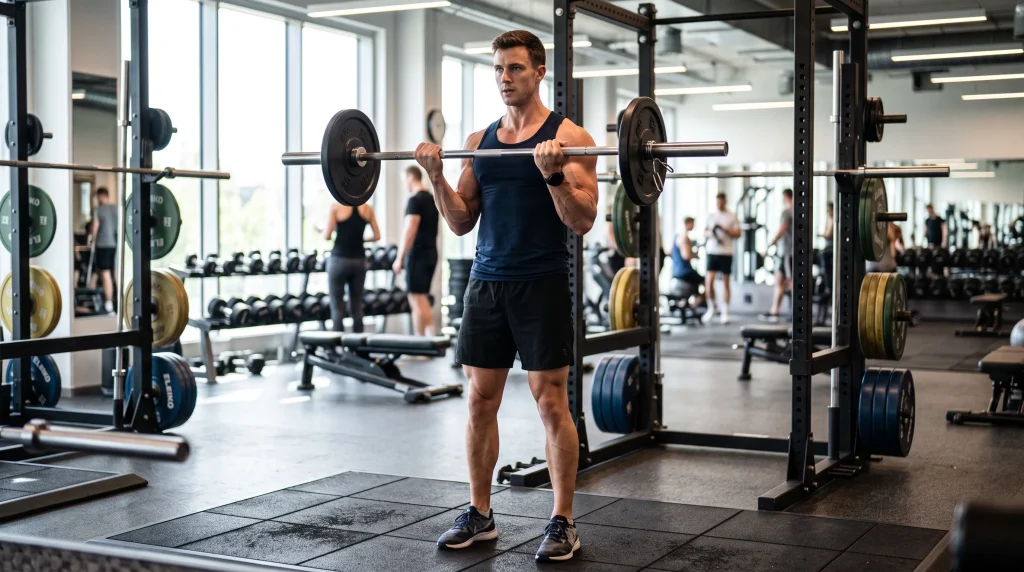
In the French press, you hold an EZ bar (or a straight barbell) with a narrow grip, press it overhead, and lower it slowly behind your head. You can do it seated on an upright bench or standing. Because both hands share one fixed bar, the movement feels very stable.
That stability lets many lifters handle more weight than they would with a single dumbbell. The angled grip of the EZ bar also takes some pressure off your wrists, which is why it remains a staple in classic strength and bodybuilding programs.
The Overhead Tricep Extension: Dumbbell, Cable or Band
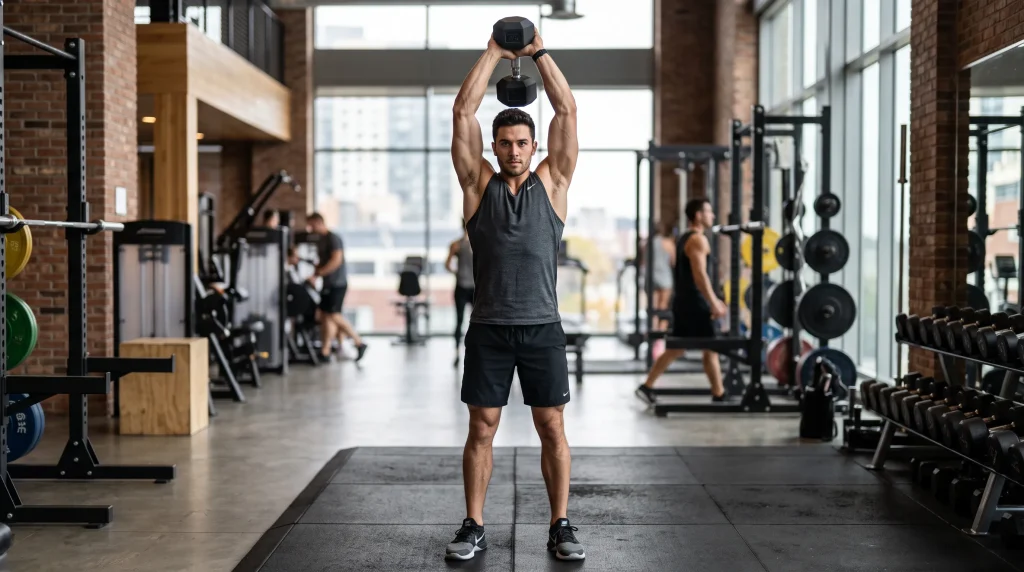
The overhead tricep extension is a broader category. The most common version uses a single dumbbell held with both hands under the top plate. You can also do it with a cable and rope, with a resistance band, or one arm at a time.
Its biggest advantage is freedom of movement. Your wrists and elbows can find their natural path, which many people find more comfortable on their joints. It also requires very little equipment, so it works just as well at home as it does at the gym.
-
Muscles
- Primary
-
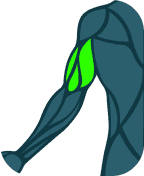 Triceps
-
Instructions
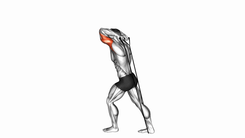
- Stand with feet shoulder-width apart, holding the band behind your back.
- Place your lower hand on the band at your lower back, and your upper hand holding the band overhead.
- Extend your upper arm fully, pushing the band upwards.
- Slowly lower the band back down in a controlled manner.
-
Important Tips
- Keep your elbow close to your head.
- Avoid arching your lower back excessively.
- Control the movement on the way down.
Band Overhead Tricep Extension
French Press or Overhead Tricep Extension: 5 Key Differences
Even though both exercises follow the same movement pattern, a few practical differences can change your results and comfort. Here are the five that matter most:
- Equipment: the French press uses an EZ bar or barbell; the overhead tricep extension uses a dumbbell, cable, or band.
- Joint freedom: the bar locks your hands in place, while the dumbbell and rope let your wrists and elbows rotate slightly.
- Loading potential: the French press usually allows heavier loads thanks to its stable, two-handed grip.
- Core and stability demand: a single dumbbell overhead challenges your core and shoulder stabilizers a bit more.
- Unilateral options: the overhead extension is easy to do one arm at a time, which helps fix strength imbalances.
None of these differences makes one exercise “wrong.” They simply help you choose the right tool for your goals, your joints, and your gym setup. The table below sums it up:
| Feature | French press | Overhead tricep extension |
|---|---|---|
| Primary equipment | EZ bar or barbell | Dumbbell, cable, or resistance band |
| Joint freedom | Fixed hand position | Wrists and elbows move freely |
| Loading potential | Very high | Moderate to high |
| Core engagement | Moderate | High |
| Single-arm option | Not practical | Easy to do |
| Best suited for | Heavy loading and strength gains | Joint comfort, mobility, and symmetry |
Use this comparison to rotate exercises between training blocks. Many lifters run the French press for a few weeks, then switch to the overhead extension to give their joints a different stimulus. For more ways to use the bar, check out these 5 exercises with the W bar.
Muscles Worked in the French Press and Overhead Tricep Extension
The triceps brachii has three heads: the long head, the lateral head, and the medial head. All three join into one tendon at the elbow and work together to straighten your arm. You can dive deeper into the anatomy in our guide on what the triceps is.
The long head is special because it’s the only one that crosses the shoulder joint. When you raise your arms overhead, it stretches much more than it does with your arms at your sides. Both the French press and the overhead tricep extension put the long head in this lengthened position, and that’s the main reason they’re so effective for building thicker arms. The lateral and medial heads also work hard to extend the elbow in every rep.
Beyond the triceps, your core keeps your torso upright and stops your lower back from arching, while your shoulder stabilizers help control the weight above your head. This is why both exercises build useful strength, not just muscle size. To train the lateral head from a different angle, pair either one with a pushdown in your triceps workout.
Which Builds More Muscle: French Press or Overhead Tricep Extension?
Research hasn’t directly compared the French press to the dumbbell overhead extension, but it does show why overhead positions are so effective. A study published in the European Journal of Sport Science compared overhead extensions with pushdowns. Twenty-one adults trained on a cable machine with one arm overhead and the other in a neutral position, doing 5 sets of 10 reps twice a week.
The results favored the overhead arm: long-head growth was about 1.5 times greater, and the lateral and medial heads also grew more than in the neutral-position arm. Interestingly, this happened even though the overhead arm always lifted 34% to 39% less weight. You can read the full study on PubMed.
Since the French press and the overhead tricep extension both train your triceps overhead, both benefit from this effect. Between the two, the better choice is the one you can perform with full range of motion, steady progression, and no joint pain. To understand the bigger picture of muscle growth, read our guide on what muscle hypertrophy is.
Benefits of the French Press and the Overhead Tricep Extension
Each exercise brings its own strengths to your routine. Knowing them helps you decide which one to prioritize in each training phase.
French Press Benefits
The French press shines when you want to push heavier loads safely. Its main benefits include:
- High loading potential: the stable bar lets you move more weight over time.
- Wrist-friendly grip: the angled EZ bar keeps your wrists in a more natural position than a straight bar.
- Confidence near failure: the fixed hand position gives you control in the hardest reps.
- Strong long-head stimulus: the overhead position stretches the biggest part of your triceps.
- Carryover to pressing: stronger triceps support your bench press and overhead press.
Because you can load it heavier, the French press works well as your first triceps isolation exercise of the day, while your muscles are still fresh.
Overhead Tricep Extension Benefits
The overhead tricep extension stands out for comfort and versatility. Its main advantages are:
- Joint-friendly movement: your wrists and elbows follow their natural path.
- Minimal equipment: one dumbbell, a cable, or a band is enough.
- Unilateral training: single-arm sets help balance strength between your arms.
- More core engagement: controlling a single weight overhead challenges your stabilizers.
- Great pump: the deep stretch and constant tension make it ideal for higher-rep sets.
That freedom of movement makes the overhead extension a smart choice for lifters with a history of elbow discomfort or anyone training at home.
How to Do the French Press and Overhead Tricep Extension With Proper Form
Good technique keeps the tension on your triceps and protects your elbows, shoulders, and lower back. Follow these step-by-step guides.
Step-by-Step: Seated EZ-Bar French Press
This is the classic seated version, which gives your spine extra support:
- Sit on a bench with an upright back support and plant your feet firmly on the floor.
- Hold the EZ bar with a narrow grip on the angled sections and press it straight overhead.
- Keep your elbows pointing toward the ceiling and close to your head.
- Lower the bar slowly behind your head for about two seconds until you feel a deep stretch.
- Pause briefly, then press the bar back up and squeeze your triceps at the top.
Breathe in as you lower the bar and breathe out as you press it up. If your lower back starts to arch, brace your core harder or reduce the load.
Step-by-Step: Dumbbell Overhead Tricep Extension
This version uses a single dumbbell held with both hands:
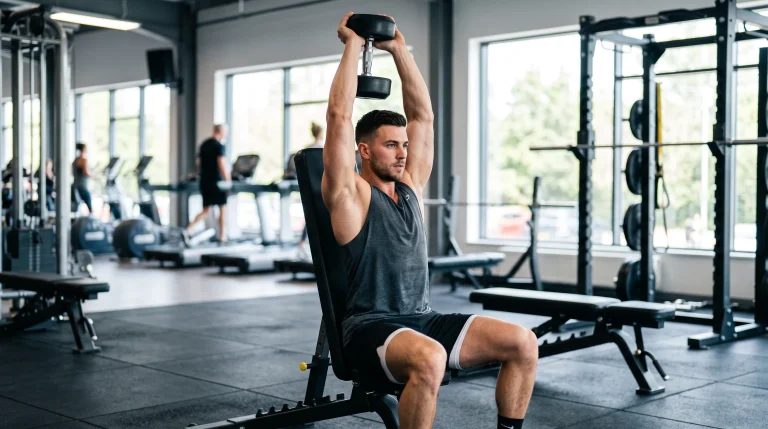
- Sit on a bench with back support, or stand with your feet hip-width apart.
- Cup the top plate of the dumbbell with both hands and press it overhead.
- Keep your upper arms close to your head and your elbows still.
- Lower the dumbbell behind your head slowly, letting your wrists find a comfortable angle.
- Extend your arms fully and squeeze your triceps at the top.
Check that the dumbbell is secure in your hands before you start, especially as the weight increases. You can watch the movement in the dumbbell standing triceps extension demo.
Variations of the French Press and Overhead Tricep Extension
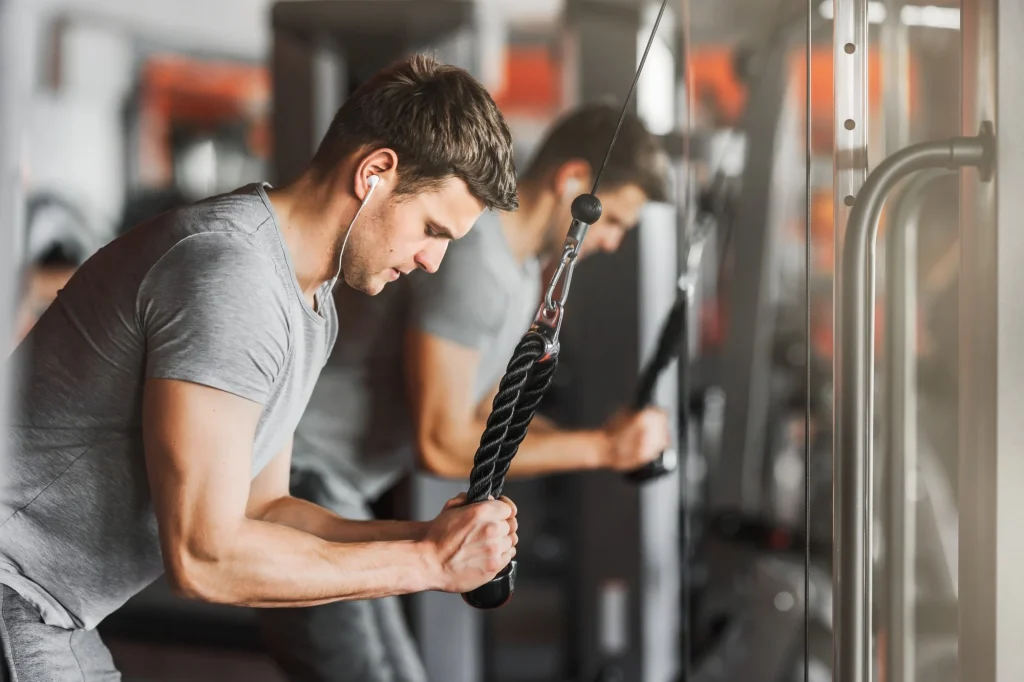
You don’t have to stick to bars and dumbbells. Cable overhead extensions, done with a rope or a W bar, keep tension on your triceps throughout the entire range of motion, and they match the setup used in the study above. You can see how it’s done in the overhead rope triceps extension demo.
Single-arm overhead extensions are another great option. Training one arm at a time stops your stronger side from taking over, and you can learn more about this approach in our article on the power of unilateral training.
For home workouts or travel, resistance bands work perfectly. Simply step on one end of the band and press the other end overhead. Check out our guide on how to use resistance bands for training for more ideas.
Common Mistakes in the French Press and Overhead Tricep Extension
A few technique errors show up in both exercises and can slow your progress or cause elbow pain.
- Flaring your elbows: this shifts the tension from your triceps to your shoulders.
- Arching your lower back: heavy weights often push your ribs up and your spine into an unsafe position.
- Using too much weight: if your form breaks down, momentum is doing the work instead of your muscles.
- Rushing the lowering phase: dropping the weight fast can irritate your elbow tendons.
- Cutting the range of motion short: half reps skip the deep stretch that makes these exercises so effective.
- Skipping your warm-up: cold elbows and shoulders handle overhead loading poorly.
Control every descent for at least two seconds and add weight gradually. Our guide on how to use progressive overload without injuring yourself explains how to do this safely, and a proper warm-up before a workout prepares your joints for the work ahead.
How to Add the French Press or Overhead Tricep Extension to Your Workout Split
Order matters. Start your session with compound exercises such as the bench press or overhead press, then move on to your triceps isolation work. This way, your arms won’t give out during your heavy presses, and your triceps still get a strong final stimulus.
For hypertrophy, aim for 3 to 4 sets of 8 to 12 reps, resting 60 to 90 seconds between sets. Training your triceps twice a week works well for most people, whether on a dedicated arm day or a push day. To fine-tune these numbers, read about training volume per muscle group and rest time between sets.
Here’s an example of how one of these exercises fits into a push day:
- Barbell bench press: 4 sets of 6 to 8 reps.
- Incline dumbbell press: 3 sets of 8 to 10 reps.
- French press or overhead tricep extension: 3 sets of 8 to 12 reps.
- Cable triceps pushdown: 3 sets of 12 to 15 reps.
Choosing one overhead exercise and pairing it with a pushdown covers all three heads of your triceps. If you’re still deciding how to organize your week, our guide to the best workout split can help.
Frequently Asked Questions
-
Does the French press or overhead tricep extension target the long head of the triceps?
Yes. The French press and the overhead tricep extension both place your arms overhead, which stretches the long head of the triceps. Either exercise will help you build thicker, fuller arms.
-
Is the French press harder on the elbows than the overhead tricep extension?
It can be. The fixed hand position on a bar may stress the elbows more than a dumbbell, which lets your joints move freely. Using an EZ bar, controlling the descent, and avoiding excessive loads prevents most issues.
-
Can you do the French press and overhead tricep extension in the same workout?
You can, but it’s usually redundant, since they train your triceps at the same overhead angle. You’ll get better results by choosing one of them and pairing it with a pushdown, which works the triceps with your arms at your sides.
-
Should you use a barbell, EZ bar, or dumbbell for overhead tricep extensions?
An EZ bar offers great stability and heavy loading potential, while a dumbbell allows freer joint movement. A straight barbell tends to strain the wrists, so choose the option that feels most comfortable for your wrists and elbows.
-
Is the French press the same as a skull crusher?
Not exactly. In this guide, the French press is done overhead, while the skull crusher is done lying on a bench, lowering the bar toward your forehead. Some gyms use the names interchangeably, but the lying version stretches the long head less than the overhead one.
-
Is the French press or overhead tricep extension better for beginners?
The dumbbell overhead tricep extension is usually easier to learn, since it needs little setup and lets your joints move naturally. Once you master the movement, the French press is a great way to start lifting heavier.
French Press or Overhead Tricep Extension: Build Bigger Arms With Befit
When it comes to choosing between the French press or overhead tricep extension, there’s no wrong answer. Both train your triceps in the stretched overhead position that drives growth. The French press lets you load heavier with a stable grip, while the overhead extension offers more joint freedom, core work, and single-arm options. Pick the one that feels best on your elbows and stay consistent.
Prioritize proper form over heavy weights, keep your elbows stable, and add load gradually. Tracking every session also makes it easier to see your progress and know when it’s time to increase the weight.
To put all of this into practice, download the Befit app. It creates a personalized workout plan with AI based on your goals, experience level, and available equipment, shows step-by-step videos for every exercise, and logs your sets, reps, and weights so you can watch your triceps grow week after week.