
Are you struggling to build bigger arms? Many people focus almost entirely on their biceps, hoping to fill out their shirt sleeves. However, the triceps make up roughly two-thirds of your upper arm mass, so choosing the right triceps exercises is essential if you want bigger, well-defined arms.
You can’t achieve balanced arm development without training the back of your arm. Strong triceps also improve your performance in pressing movements like the bench press and the shoulder press. In other words, adding specific triceps exercises to your routine can transform both your physique and your pressing strength.
In this guide, you’ll learn how the triceps work, what science says about building them and the 10 best triceps exercises, with step-by-step technique for each one. You’ll also find a comparison table, a sample routine and the most common mistakes to avoid.
Anatomy of the triceps muscle
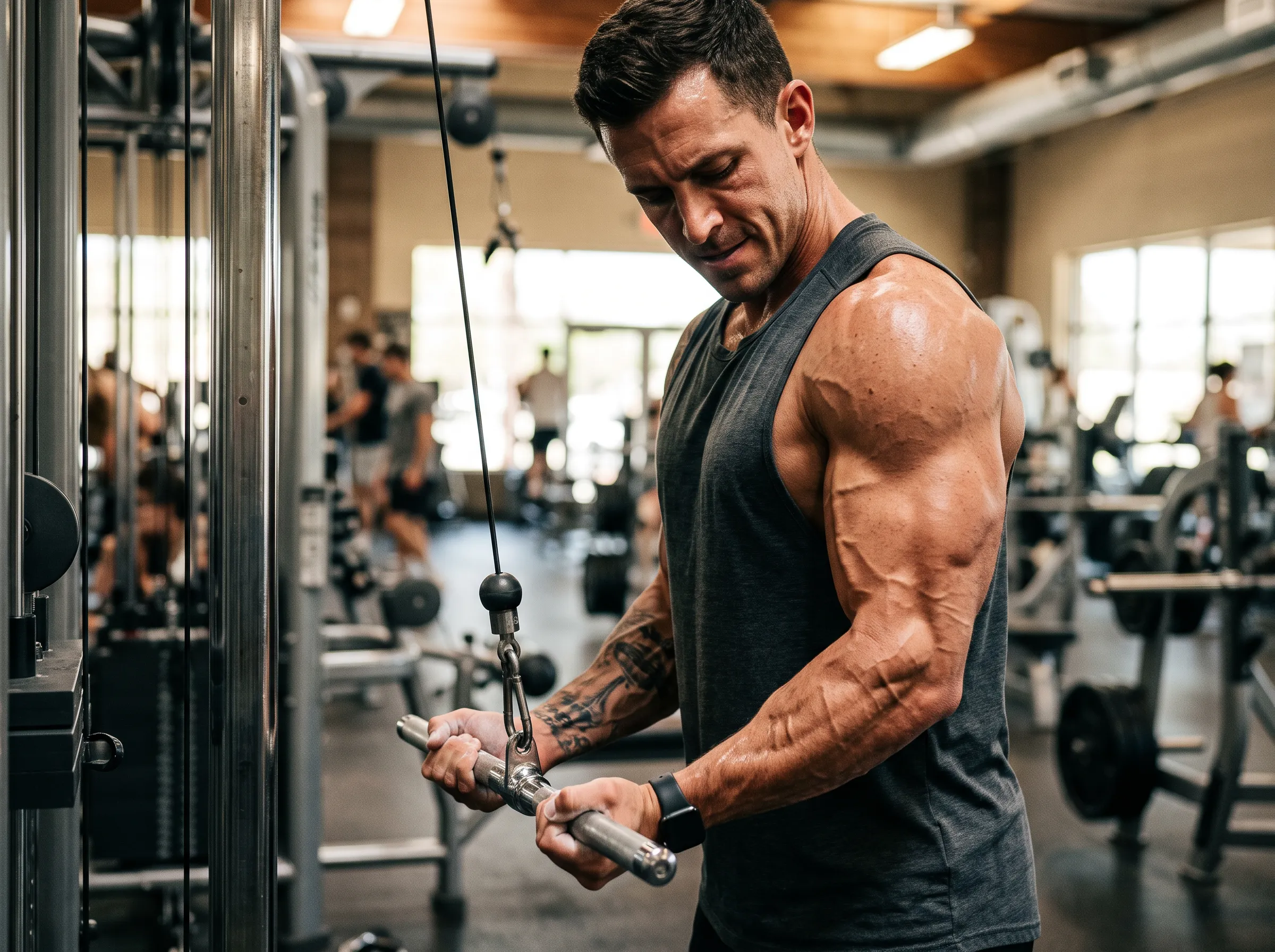
The triceps brachii is a three-headed muscle located on the back of your upper arm. Its three parts work together to extend your elbow, and understanding each one helps you choose the right exercises.
The long head originates on the shoulder blade, which means it crosses both the shoulder and the elbow joints. It’s the largest of the three heads and contributes the most to overall arm size. Because of its attachment to the shoulder blade, movements with your arms overhead stretch it the most.
The lateral head sits on the outside of the arm and creates the classic horseshoe shape when you flex. The medial head lies underneath the long and lateral heads and works in practically every elbow extension, including heavy presses.
To maximize growth, your triceps workout needs to target all three heads, which means using a variety of exercises and arm positions. You can learn more about this anatomy in our guide on what the triceps is.
How triceps exercises stimulate muscle growth
Muscle growth, known as hypertrophy, is driven mainly by mechanical tension: lifting challenging loads and increasing that challenge over time. Metabolic stress, the burning sensation and “pump” you feel during higher-rep sets, also contributes. You can read more about this process in our article on what muscle hypertrophy is.
The main function of the triceps is elbow extension, so any movement that straightens your arm against resistance trains them. Controlling the lowering phase of each rep keeps the muscle under tension for longer, which makes every set more effective.
Arm position also makes a big difference. A study published in the European Journal of Sport Science compared 12 weeks of cable triceps extensions with the arm overhead versus the arm at the side. The overhead position produced about 1.4 times more triceps growth, especially in the long head, even though participants used lighter loads.
That’s why the best triceps programs combine exercises with the arm overhead, at your side and in pressing positions. Varying your exercise selection helps you train each head at different muscle lengths.
Major benefits of a dedicated triceps workout
Strong triceps offer advantages that go far beyond aesthetics. A dedicated triceps workout improves your overall upper body strength. Here are the main benefits you can expect from consistent training:
- Bigger arms: since the triceps make up most of your upper arm, growing them is the most direct way to make your arms look bigger.
- Stronger presses: your triceps assist heavily in compound movements, so stronger triceps help you lift more in the bench press and overhead press.
- Better shoulder support: the long head attaches to the shoulder blade, so strengthening it contributes to shoulder stability during heavy lifts.
- Better athletic performance: pushing, throwing and striking all rely on powerful elbow extension.
- Fewer imbalances: balanced arm training helps prevent compensations that can overload the elbow and shoulder.
To combine these benefits with the rest of your training, check out our upper body workout guide.
The 10 best triceps exercises for bigger arms
Choosing the right movements is key to steady growth. An EMG study sponsored by the American Council on Exercise (ACE) compared eight common triceps exercises and found the highest muscle activation in diamond push-ups, kickbacks and dips.
Activation isn’t the same as growth, though, so the list below combines high-activation exercises, heavy compound lifts and overhead movements that train the triceps at long muscle lengths.
1. Close-grip bench press
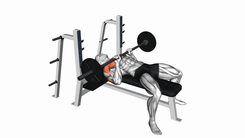
The close-grip bench press is an excellent compound movement for the triceps. It lets you lift heavy weights, which creates a lot of mechanical tension, so it’s a staple for building strength and muscle mass.
To perform it, lie flat on a bench and grip the barbell with your hands roughly shoulder-width apart. Keep your elbows close to your body as you lower the bar to your lower chest. Then press the weight up until your elbows are fully extended.
Don’t place your hands too close together. An excessively narrow grip puts unnecessary stress on your wrists without adding any benefit for the triceps.
-
Muscles
- Primary
-
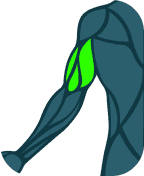 Triceps
- Secondary
-
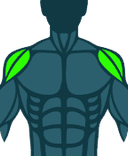 Shoulders
-
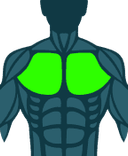 Chest
-
Instructions
- Lie down on a bench with your back supported, knees bent, and feet on the floor.
- Hold a barbell over your chest with your hands placed close, palms facing forward, and arms folded at your sides.
- Raise the barbell while extending your arms.
- As your arms become straight, slowly return to the initial position and repeat.
-
Important Tips
- Keep your wrists straight.
- Keep your elbows close to your torso and dipped under the bench during starting position.
- Maintain a natural breathing pattern.
Barbell close grip press
2. Triceps dips
Dips are a classic bodyweight exercise for building serious mass. They work all three heads of the triceps at once, and you can add weight with a dip belt as you get stronger.
To focus on the triceps, keep your torso as upright as possible. Leaning forward shifts much of the work to your chest. Lower your body until your elbows reach about 90 degrees, then push back up to the starting position.
If bodyweight dips are too hard at first, start with an assisted dip machine or a resistance band. Over time, you’ll build the strength you need for the unassisted version.
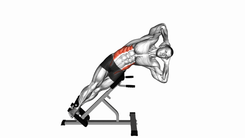
-
Muscles
- Primary
-
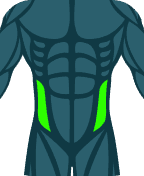 Obliques
- Secondary
-
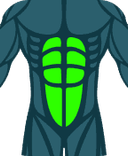 Abdominals
-
Instructions
- Sit sideways on the bench and position your hip against the support, leaving only your torso hanging off the bench
- Place your hands behind your head and one foot in front of the other
- Contract your abdomen
- Perform the lateral flexion movement of the torso in a controlled manner
-
Important Tips
- Avoid lifting your hip off the backrest of the bench
- Avoid rotating your torso; perform only lateral flexion
- Avoid jerks and sudden movements
45 Degree Side Bend
3. Overhead triceps extension
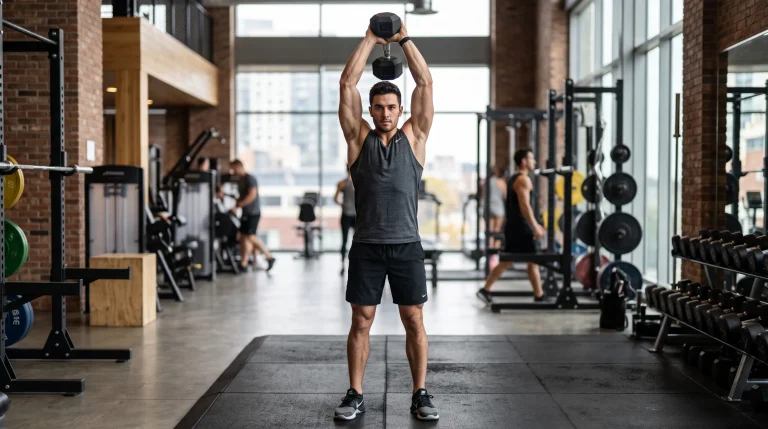
This exercise places the long head in a deeply stretched position, which, as we saw in the study above, is a strong stimulus for growth. You can do it with a dumbbell, barbell or cable, so it fits into any training environment.
To perform the seated dumbbell version, sit on a bench with back support and hold one dumbbell with both hands above your head. Lower the weight behind your head until you feel a deep stretch, then extend your elbows to lift it back to the top.
Keep your core tight and avoid arching your lower back. Try to keep your elbows pointing toward the ceiling throughout the movement.
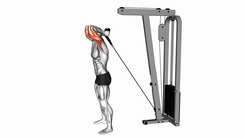
-
Muscles
- Primary
-
Triceps
-
Instructions
- Initially, lean forward and position your arms above your head aligned with your ears
- Use a pronated grip (palms facing up)
- Start the movement with your elbows bent
- Perform the movement in a controlled manner
-
Important Tips
- Keep your shoulders and arms stabilized during the movement
- Avoid using momentum or sudden movements
- Maintain the alignment of your elbows with your ears
Overhead Rope Triceps Extension
4. Skull crushers
Skull crushers isolate the triceps while still allowing fairly heavy loads. They’re popular among bodybuilders for adding arm thickness and can be done with an EZ-bar or dumbbells.
Lie flat on a bench holding the weight above your chest, with your upper arms perpendicular to the floor. Lower the bar slowly toward your forehead, keeping your upper arms still. Then squeeze your triceps to return the bar to the starting position.
To understand how this exercise compares with a similar movement, read our article on whether to do skull crushers or French presses in your triceps workout.
5. Cable triceps pushdown
Cable pushdowns keep constant tension on the muscle throughout the range of motion, which makes them excellent for adding volume and metabolic stress. You can use a straight bar, a V-bar or a rope.
Stand tall facing the cable machine with your elbows pinned to your sides. Push the attachment down until your arms are fully extended, then return slowly to the starting position while resisting the weight.
With a rope attachment, you can pull the ends apart at the bottom of the movement, a small tweak that helps many people feel a stronger contraction in the lateral head.
6. Dumbbell kickbacks
Kickbacks are excellent for achieving a strong peak contraction and, in the ACE study, they ranked among the exercises with the highest triceps activation. Follow these steps for good execution:
- Hold a dumbbell in one hand and hinge forward at the hips.
- Keep your back straight and your upper arm parallel to the floor.
- Extend your elbow to move the weight back until your arm is completely straight.
- Squeeze the muscle at the top of the movement for one second.
- Slowly lower the dumbbell back to the 90-degree starting position.
Avoid heavy weights in this exercise. Instead, focus on the mind-muscle connection and a strong squeeze at the top.
7. JM press
The JM press is a hybrid between a close-grip bench press and a skull crusher. It allows relatively heavy loads in an elbow extension pattern, which is why powerlifters often use it to build lockout strength.
Lie on a bench and grip the barbell with a narrow grip. Lower the bar toward your upper chest or chin, letting your elbows travel forward rather than flaring out to the sides. Then press the weight back up, mainly by extending your elbows.
This movement takes practice to master. Start with an empty barbell to learn the bar path before adding weight.
8. Diamond push-ups
Diamond push-ups are a versatile bodyweight option that requires no equipment. In the ACE study, they produced the highest triceps activation of all exercises tested, while also working the chest and shoulders. That makes them perfect for home workouts.
Place your hands close together under your chest so your thumbs and index fingers form a diamond. Keep your core tight and your body in a straight line. Lower yourself until your chest nearly touches your hands, then push back up to full extension.
If this variation is too difficult, start with your knees on the floor. For more variations, check out our guide on how to do push-ups.
9. French press
The French press is an overhead extension usually done seated or standing with an EZ-bar. Because your arms stay overhead, it strongly targets the long head and is excellent for building overall arm mass.
Hold the EZ-bar above your head, lower it behind your head while keeping your elbows pointing up, then extend your arms fully and squeeze at the top. The EZ-bar is more comfortable for the wrists than a straight bar.
Don’t let your elbows drift forward or flare out as you press the weight up. Keeping them still ensures the tension stays on the triceps.
10. Single-arm cable pushdown
Training one arm at a time helps fix strength and size imbalances. The single-arm cable pushdown isolates each arm, which supports symmetrical development.
Stand facing a cable machine set to a high pulley and grab a handle with an underhand or overhand grip. Keep your elbow tucked at your side, push the handle down and squeeze your triceps at the bottom.
Unilateral exercises are a great tool for a balanced physique. You can explore this concept in our article on the power of unilateral training.
Comparing triceps exercises by equipment
Different types of equipment offer different benefits for arm development. Barbell movements allow heavy loading, while cables provide continuous tension. Use this table to choose the right exercises for your goals:
| Equipment type | Best exercise options | Primary benefit |
|---|---|---|
| Barbell | Close-grip bench press, JM press | Allows the heaviest loads and maximum mechanical tension |
| Dumbbell | Overhead extension, kickbacks | Helps fix imbalances and allows a natural range of motion |
| Cable machine | Triceps pushdown, single-arm pushdown | Provides constant tension throughout the movement |
| Bodyweight | Dips, diamond push-ups | Highly accessible and great for building relative strength |
For complete development, combine options from at least two or three of these categories in your weekly training. A good rule of thumb is to include one heavy press, one overhead extension and one cable or dumbbell isolation exercise.
Sample triceps routine for bigger arms
To build bigger arms, you need a structured approach. For most people, training the triceps twice a week works well. Here’s an effective routine you can follow.
Start with a heavy compound movement to build strength: 3 sets of 6 to 8 reps of the close-grip bench press, resting about two minutes between sets. This is where you’ll generate the most mechanical tension.
Next, move to an exercise that stretches the long head: 3 sets of 10 to 12 reps of overhead dumbbell extensions. Focus on a deep stretch at the bottom of each rep and rest for 90 seconds between sets. You can adjust your breaks with our guide to rest time between sets.
Finally, finish with a constant-tension movement: 3 sets of 12 to 15 reps of cable rope pushdowns, squeezing hard at the bottom of every rep. To understand why this works, read what a muscle pump is.
To know whether your training is really building muscle, it helps to track more than your arm measurements. A useful indicator is the FFMI (fat-free mass index), which shows how much lean mass you carry relative to your height and makes it easier to follow your progress over the months. Find out yours with the Befit FFMI calculator:
Fat-Free Mass Index and FFMI Calculator: Find Out How Much Lean Mass You Have
Your result
Your FFMI, normalized to 1.80 m (5'11"), is:
—
Classification (men)
The cutoff of 25 is the highest value observed in steroid-free athletes (Kouri et al., 1995).
Compared to the population
Source: Schutz et al., 2002.
Your data
Common mistakes when doing triceps exercises
Many lifters struggle to grow their arms because of poor technique, which shifts the tension away from the target muscle. Avoid these common mistakes to keep progressing and prevent injuries.
First, don’t let your elbows flare out during extensions or pushdowns. Keep them close to your body, because flaring shifts the tension from your triceps to your shoulders and chest.
Second, avoid using momentum to move the weight. Swinging your body reduces the work your muscles actually do. Always control the lowering phase of each rep to keep your triceps under tension.
Third, don’t cut your range of motion short. Fully extending your elbow gives you a complete contraction, and lowering the weight far enough gives you the stretch that drives growth. For more form tips, read the most common training mistakes that kill your progress.
Frequently asked questions
-
Should I train triceps before or after chest?
In general, train triceps after chest, either in the same session or on a different day. Chest exercises already fatigue the triceps, so training them first would hurt your pressing strength. You can also train them on a dedicated arm day. Learn more about organizing your week in our push-pull workout guide.
-
Is it normal for one triceps to be stronger than the other?
Yes, small imbalances are completely normal. Your dominant arm is usually a bit stronger and larger. To even them out, include unilateral exercises like the single-arm cable pushdown, start with your weaker arm and match the reps on the stronger side.
-
Can push-ups alone build big triceps?
Push-ups, especially diamond push-ups, are a great starting point for building triceps size. However, to keep growing over time, you’ll eventually need added resistance or isolation exercises.
-
Why don’t I feel my triceps working during dips?
Your torso is probably leaning too far forward, which shifts the load to your chest. Keep your body upright and your elbows close to your sides to focus on the back of your arms.
-
How many sets of triceps should I do per week?
For most people, 10 to 20 sets per week, counting both pressing and isolation exercises, is a good starting range. Beginners can start with less volume and increase it gradually as they progress.
Build bigger arms with triceps exercises and Befit
Building bigger arms takes much more than endless biceps curls. Prioritizing triceps exercises is the key to balanced, impressive arm development, and understanding the anatomy of this muscle helps you choose movements that hit all three heads.
Good technique is just as important for long-term progress. Control the weight on every rep, use a full range of motion and increase the challenge gradually to keep your triceps growing and your pressing strength improving. For more routines, see our complete triceps workout guide and our list of the best arm exercises.
Ready to take your arm training to the next level? Download the Befit app to get personalized workout plans, clear exercise instructions and progress tracking that help you stay consistent and watch your arms grow.