
Building strong glutes requires more than just standard squats. You must master the hip extension to unlock true lower body power. This fundamental movement pattern is the secret to better posture, athletic performance, and muscle growth. Therefore, adding it to your routine is absolutely essential.
Many gym-goers struggle to activate their glutes properly. Consequently, they experience lower back pain or plateau in their lifts. Learning how to perform this movement correctly will completely change your training results. Furthermore, you will notice improvements in your daily activities.
This guide will walk you through the seven best variations. Moreover, we will explain the mechanics behind the movement. Ultimately, you will have all the tools needed to build a stronger and more resilient lower body.
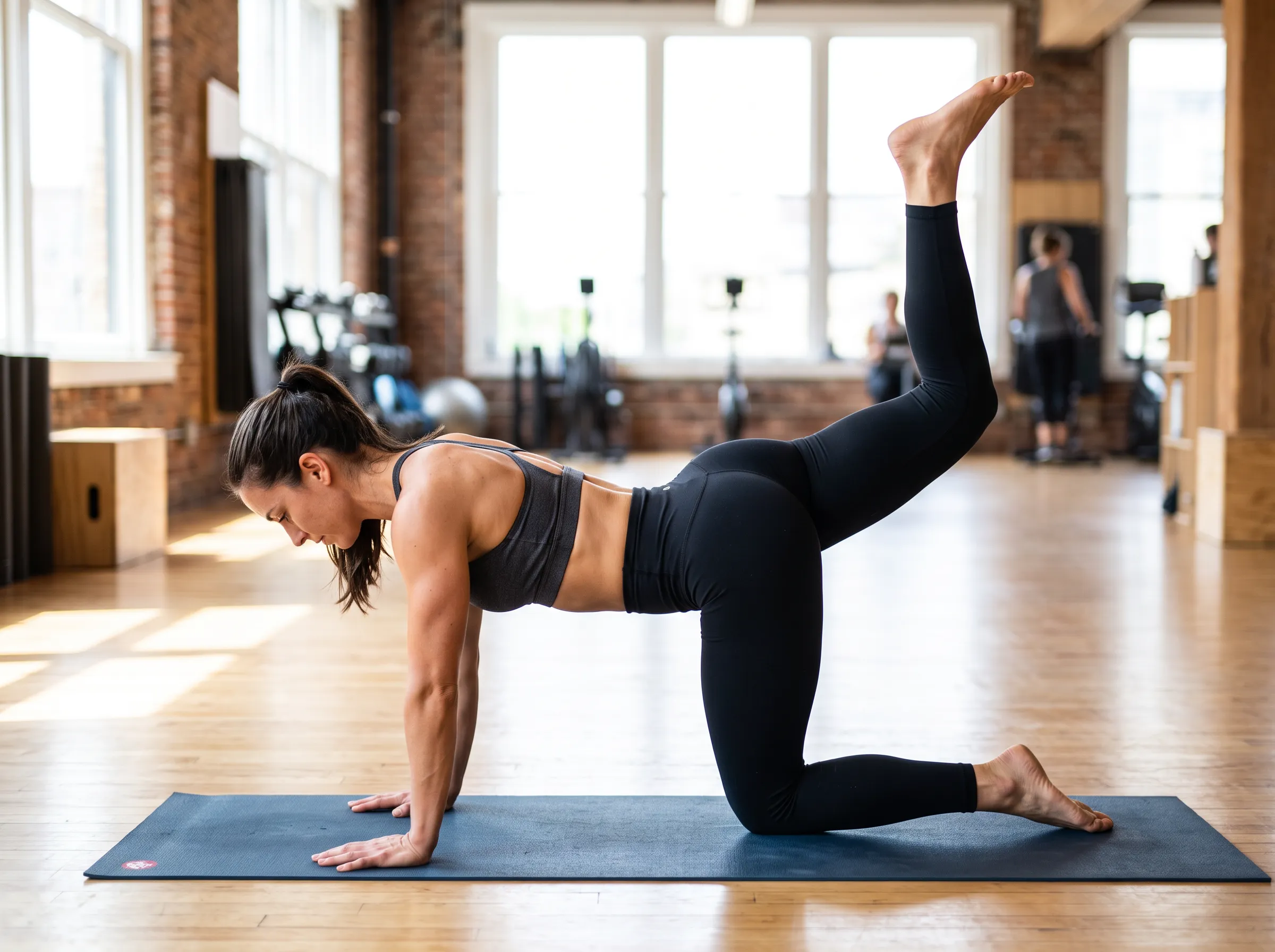
What is hip extension?
Hip extension is the action of opening the hip joint: you perform it when you push your leg backward, or when you thrust your hips forward from a bent position.
This biomechanical action straightens the angle between your pelvis and your thigh. Standing up from a chair involves this exact motion, and sprinting and jumping rely heavily on it too.
Your body uses the gluteus maximus and hamstrings as the primary drivers here, so targeting this movement is one of the most direct ways to build these muscle groups. Understanding what gluteus is helps you visualize the muscles working and build a better mind-muscle connection during your workouts.
What is hip extension good for?
This movement is the foundation of lower body strength. Strong hips let you lift heavier weights safely, and they help protect your spine during heavy compound movements.
It also directly improves athletic performance — runners, jumpers, and cyclists all need explosive hip power. Research on glute training consistently links stronger hip extension to faster sprint times, which is why athletes prioritize this joint action.
This movement pattern also fixes postural issues. Sitting all day causes tight hip flexors and weak glutes, which tilts your pelvis forward and strains your lower back. Strengthening the opposing muscles pulls your pelvis back into a neutral alignment, reducing pain and improving everyday mobility.
The anatomy behind the movement
To maximize your results, it helps to understand the muscles doing the work. The gluteus maximus is the largest and strongest muscle involved — it acts as the primary engine when you push your hips forward and provides the bulk of the power during heavy lifts.
Your hamstrings play a crucial supporting role. They assist the glutes in pulling the leg backward. Therefore, a comprehensive hamstring workout will naturally improve your hip mechanics. Meanwhile, the adductor magnus helps stabilize the pelvis during the motion.
The erector spinae muscles in your lower back don’t create the movement itself, but they keep your spine rigid and safe. Maintaining a neutral spine keeps the tension where it belongs — on your glutes.
7 best hip extension variations for maximum results
You can train this movement pattern with a range of tools and techniques. Here are seven variations to include in your routine for well-rounded muscle hypertrophy and strength gains.
1. Machine hip extension
The machine hip extension is great for isolating the glutes. Most gyms have a specific machine with a padded pendulum — you stand facing it and push the pad backward with your leg, which keeps continuous tension throughout the entire range of motion.
Beginners benefit especially from this variation, since the machine guides your path and removes balance issues, letting you focus entirely on squeezing the glute. It’s also easy to adjust the weight for progressive overload.
2. Cable hip extension
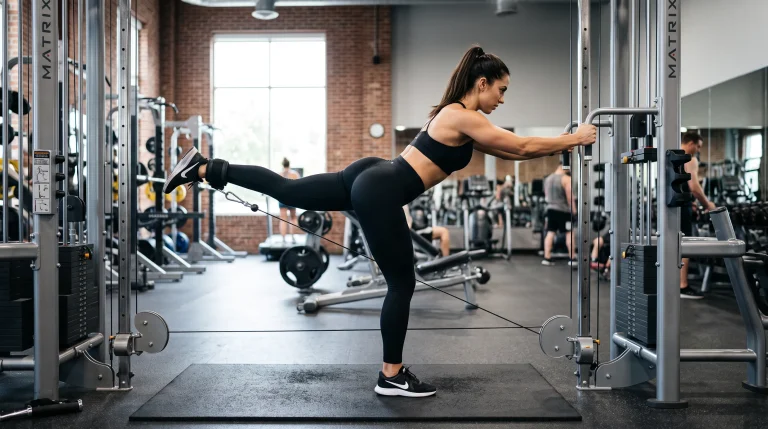
A cable station offers real versatility. For the cable hip extension — also called a cable kickback in most exercise libraries, including Befit’s — attach an ankle strap to a low pulley, face the machine, and kick your leg straight back while keeping your core tight.
This variation provides constant resistance, unlike free weights, so the tension stays high even at the bottom of the movement. It also works well as a unilateral exercise to fix muscle imbalances between sides.
3. Standing hip extension
You don’t always need equipment to train your glutes. The standing hip extension uses just your body weight: stand tall, brace your core, and slowly lift one leg backward. This requires real balance and core control.
You can do this exercise anywhere, which makes it ideal for home workouts or dynamic warmups. Hold onto a wall for stability if needed, and add ankle weights later to increase the difficulty.
4. Cable cross hip extension
The cable cross hip extension adds a different angle to the movement: instead of kicking straight back, you pull the cable slightly diagonally across your body, which targets the gluteus medius alongside the maximus.
You’ll need a dual cable station for this — stand between the pulleys and attach the straps to your opposite ankles. The crossing pattern creates a deep stretch and stimulates fibers that standard linear movements can miss.
5. Banded hip extension
Resistance bands work well for glute activation. Loop a band around your ankles or knees and perform the backward kick against the elastic tension.
Resistance increases as the band stretches, so the exercise is hardest at the peak of the contraction — a curve that matches your glute strength profile well. Bands are also portable and ideal for traveling.
6. Barbell hip thrust
The barbell hip thrust is the undisputed king of glute builders. Rest your upper back on a bench, place a barbell across your hips, and drive your hips upward until your thighs and torso form a straight line. This setup lets you move serious weight.
If building maximum size is the goal, this belongs in your routine. It targets the glutes in their shortened position; if the barbell feels uncomfortable, the hip thrust machine is a great alternative that yields similarly strong results.
7. Glute bridge
The glute bridge is a foundational floor exercise, very similar to the hip thrust but without a bench. Lie on your back with your knees bent and feet flat, then squeeze your glutes and lift your hips toward the ceiling.
This is one of the safest glute exercises for beginners: it teaches proper pelvic tilt without spinal loading, and you can progress to single-leg bridges as you get stronger.
Comparing the top variations
Choosing the right exercise depends on your goals. Some movements build maximum strength, while others focus on isolation — use this comparison to pick what fits your current level.
| Exercise Variation | Equipment Needed | Difficulty Level | Primary Benefit |
|---|---|---|---|
| Machine extension | Gym machine | Beginner | Guided muscle isolation |
| Cable extension | Cable station | Intermediate | Constant tension curve |
| Standing extension | Bodyweight | Beginner | Convenience and balance |
| Barbell hip thrust | Barbell and bench | Advanced | Maximum strength building |
| Banded extension | Resistance band | Beginner | Peak contraction focus |
Most lifters do best rotating two or three of these across the week rather than committing to just one, which keeps the stimulus fresh and covers both strength and isolation work.
How to integrate these exercises into your routine
Building an effective plan comes down to smart exercise selection. Skip trying to fit all seven variations into one session — instead, pick two or three that complement each other, which hits the muscle from different angles without overtraining.
If you follow a workout split, place these exercises on your leg or lower body days. Start with a heavy compound movement like the barbell hip thrust, then move to isolation work like the cable or machine variations to fully fatigue the muscle.
Pay attention to your overall training volume — aim for 10 to 15 direct sets for your glutes per week, and make sure you recover adequately between sessions. Rest is just as important as the training itself for muscle growth.
Common mistakes to avoid
Many people perform these exercises incorrectly and miss out on the benefits. Avoid these common mistakes:
- Arching your lower back: hyperextending the spine shifts tension away from the glutes. Keep your ribs tucked and your core braced throughout the movement.
- Rushing the reps: swinging your leg uses momentum instead of muscle power. Control the eccentric phase, and pause for a second at the top of the contraction to maximize fiber recruitment.
- Pointing your toes inward: rotating your foot internally disengages the glutes. Keep your foot neutral or slightly turned out — a small adjustment that noticeably improves activation.
Fixing these three details alone will make almost every variation on this list feel more effective.
Frequently asked questions
-
What muscles do hip extensions work?
They primarily target the gluteus maximus and the hamstrings. Additionally, the adductor magnus assists in the movement, while the erector spinae muscles stabilize the lower back.
-
Machine or bodyweight hip extension: which to choose?
Beginners should start with bodyweight variations to master the form and mind-muscle connection. However, you should transition to machine variations to add resistance and stimulate further muscle growth.
-
I feel hip extensions in my lower back, is that normal?
No, feeling pain in your lower back indicates improper form. You are likely arching your spine instead of moving purely from the hip joint. Therefore, focus on bracing your core and squeezing your glutes.
-
Do hip extensions improve running?
Absolutely, they build explosive power in the glutes and hamstrings. Consequently, this increased strength translates directly to faster sprint times and better running efficiency.
Putting hip extension into your training
Mastering the hip extension is a genuine game changer: this movement builds powerful glutes, protects your lower back, and enhances athletic performance.
Start with the bodyweight variations to nail your technique, then gradually add cables, machines, and barbells as you get stronger. Consistency and proper form matter far more than any single exercise choice.
Are you ready to take your lower body training to the next level? Download the Befit app today to access customized workout plans and track your progress. Keep pushing your limits, and enjoy the journey to a stronger, healthier you!