
Skipping leg day is one of the fastest ways to stall your fitness progress. A well-structured lower body workout builds the foundation for everything you do inside and outside the gym, stimulating muscle growth, increasing your energy expenditure, and helping protect your joints from injury.
Whether you want to lift heavier, run faster, or simply improve your physique, prioritizing your lower body is essential. Still, many people struggle to balance their routines, overworking the front of the thighs while neglecting the glutes and hamstrings.
In this guide, you’ll learn which muscles a lower body workout trains, how leg training builds strength and muscle, the 7 best exercises, how to adapt your routine to your goals and environment, and two complete routines for the gym and for home.
What is a lower body workout and which muscles does it work?
A lower body workout trains all the muscle groups from your hips down to your ankles. Unlike a basic leg routine that may focus only on the thighs, a complete lower body workout also includes the glutes, hips, and calves for balanced development.
Knowing the main muscles involved helps you choose the right exercises and make sure no group falls behind, which prevents posture issues and knee pain. These are the main muscle groups:
- Quadriceps: located at the front of the thigh, these four muscles extend the knee and absorb impact when you walk, run, or jump.
- Hamstrings: on the back of the thigh, they flex the knee and help extend the hip in pulling and sprinting movements.
- Glutes: made up of the gluteus maximus, medius, and minimus, they generate power for hip extension and rotation and stabilize the pelvis. Learn more in our guide to what the glutes are and how they work.
- Adductors and abductors: these inner and outer thigh muscles move your legs toward and away from the midline of your body. Understanding the difference between adductor and abductor muscles is crucial for hip health and lateral stability.
- Calves: made up of the gastrocnemius and soleus, they flex the ankle and propel you forward with every step.
A complete lower body workout should train all of these groups throughout the week, not just the quads, which are the most visible in the mirror.
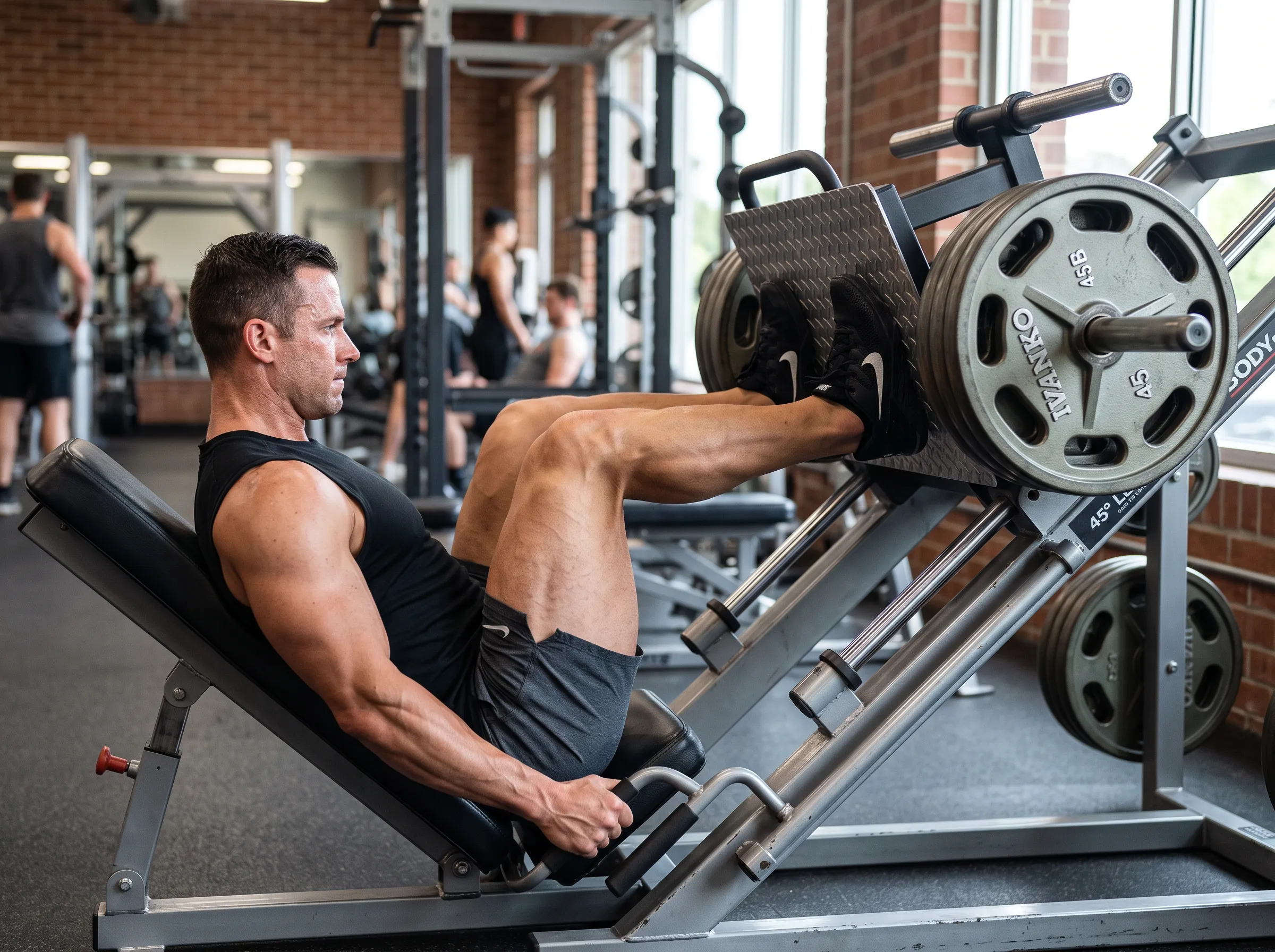
How a lower body workout builds strength and muscle
Your legs and glutes contain the largest and strongest muscles in the body. Challenging them requires a lot of energy and neurological effort, which is why heavy lower body training creates a powerful response that benefits your entire physique.
When you load your legs with resistance training, you create mechanical tension and small amounts of damage in the muscle fibers. Your body then repairs these fibers to make them thicker and stronger, a process known as muscle hypertrophy. Compound exercises like squats and deadlifts also recruit your core and upper back as stabilizers, which increases the total calorie burn of the session.
To keep progressing, you need to increase the challenge over time by adding weight, performing more reps, or improving your form. Tracking your weekly training volume per muscle group helps ensure you’re doing enough to grow without exceeding your ability to recover.
7 essential exercises for a complete lower body workout
You don’t need twenty different machines to build strong legs. Mastering a handful of foundational movement patterns gives you the best return on your time and effort. Here are the seven exercises that cover every major muscle group:
| Exercise | Primary muscles | Movement pattern | Equipment |
|---|---|---|---|
| Barbell back squat | Quads, glutes, core | Knee-dominant (bilateral) | Barbell, squat rack |
| Romanian deadlift (RDL) | Hamstrings, glutes, lower back | Hip hinge | Barbell or dumbbells |
| Bulgarian split squat | Quads, glutes, adductors | Knee-dominant (unilateral) | Dumbbells, bench |
| Hip thrust | Glutes, hamstrings | Hip extension | Barbell, bench, or machine |
| Leg press | Quads, glutes | Knee-dominant (machine) | Leg press machine |
| Seated or lying leg curl | Hamstrings | Knee flexion (isolation) | Leg curl machine |
| Standing calf raise | Gastrocnemius, soleus | Ankle plantar flexion | Machine, dumbbells, or step |
You can check the technique for each movement in the Befit exercise library.
1. Barbell back squat
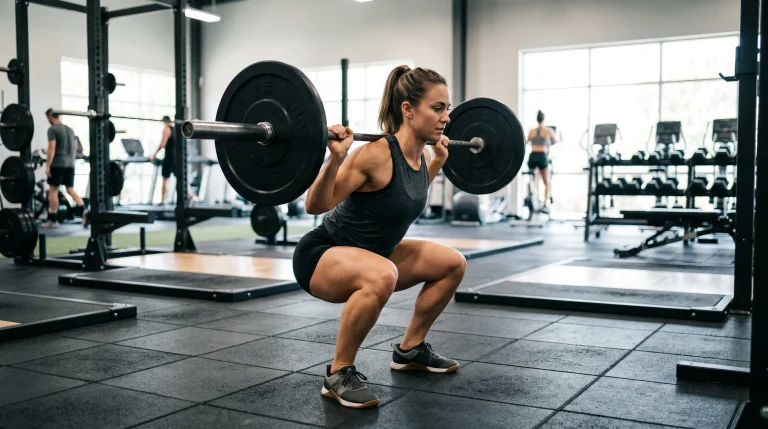
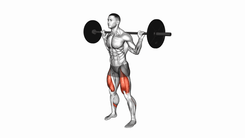
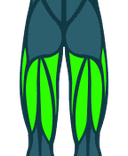
The barbell squat is often called the king of lower body exercises because it loads the whole body and recruits a large amount of muscle mass, especially the quads and glutes.
Stand with your feet about shoulder-width apart, brace your core, and lower your hips until your thighs reach parallel to the floor or slightly below. Push through your mid-foot to return to the starting position.
-
Muscles
- Primary
-
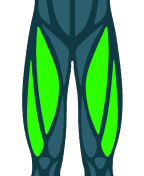 Quadriceps
- Secondary
-
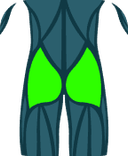 Glutes
-
 Hamstrings
-
Instructions
- Position the bar on your trapezius region and hold it with your hands
- Keep your elbows close to your torso and pointed downward
- Initially, keep your torso upright and your feet in a comfortable position, aligned with your hips or slightly wider
- In a controlled manner, flex your hips and knees, lowering as far as possible while keeping your feet firmly on the floor
- Then, return to the starting position by extending your hips and knees
-
Important Tips
- Keep your torso upright and avoid leaning forward
- Keep your feet flat on the floor throughout the movement
- Avoid using momentum or sudden movements
Barbell Back Squat
2. Romanian deadlift (RDL)
While squats focus on the front of the legs, the Romanian deadlift is one of the best exercises for the posterior chain: hamstrings, glutes, and lower back.
Hold a barbell or a pair of dumbbells in front of your thighs. With a slight bend in your knees, push your hips back until you feel a deep stretch in your hamstrings, then squeeze your glutes to stand tall.
3. Bulgarian split squat
Single-leg exercises expose and fix weaknesses quickly, and the Bulgarian split squat is one of the most effective for quads and glutes.
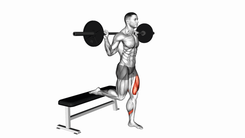
Rest your back foot on a bench and step your front foot forward. Lower your back knee toward the floor, keeping your front knee aligned with your toes. Leaning your torso slightly forward increases glute recruitment, while staying upright targets the quads.
-
Muscles
- Primary
-
Quadriceps
- Secondary
-
Hamstrings
-
Glutes
-
 Abductors
-
Instructions
- Place a barbell on your upper back/shoulders.
- Stand in a split stance with one foot elevated on a bench behind you.
- Keep your torso upright and core engaged.
- Lower your body by bending the front knee until your back knee almost touches the floor.
- Push through your front heel to return to the starting position.
-
Important Tips
- Maintain balance throughout the movement.
- Ensure your front knee tracks in line with your toes.
- Avoid leaning too far forward or backward.
- Keep your core tight to protect your lower back.
Barbell Bulgarian Split Squat
4. Hip thrust
To maximize glute development, you need a direct hip extension exercise. Learning how to use the hip thrust machine, or setting up with a barbell against a bench, targets the glutes at peak contraction.
Drive through your heels, tuck your chin, and extend your hips until your body forms a straight line from shoulders to knees, squeezing your glutes for a second at the top.
5. Leg press
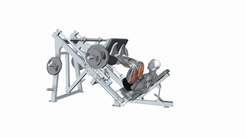
The leg press removes the spinal loading and balance demands of a free-weight squat, so you can safely push your quads close to failure. If you’re new to this machine, check how many kilograms to use on a leg press for beginners to start safely.
Place your feet about shoulder-width apart on the platform and keep your lower back pressed against the pad throughout the movement, lowering the platform under control.
-
Muscles
- Primary
-
Quadriceps
- Secondary
-
Glutes
-
Hamstrings
-
Instructions
- Sit on the machine, positioning your hips and torso against the backrest
- Place your feet in the middle of the platform, maintaining alignment with your hips
- Flex your hips and knees as far as your range of motion allows
- Return in a controlled manner and repeat
-
Important Tips
- Keep your torso upright and avoid leaning forward
- Keep your hips positioned without lifting them off the backrest
- Avoid using momentum or sudden movements
45-Degree Leg Press
6. Seated or lying leg curl
The hamstrings cross both the hip and the knee, so to develop them fully you should combine hip-hinge movements, like the RDL, with direct knee flexion. The leg curl machine isolates the hamstrings effectively. Focus on a slow, three-second lowering phase on every repetition.
7. Standing calf raise
Calves respond best to a full range of motion and a pause at the bottom, which reduces the bounce from the Achilles tendon and makes the muscle do more of the work.
Stand on an elevated edge, lower your heels as far as is comfortable, hold for two seconds, and push up onto the balls of your feet.
How to adapt your lower body workout to your goals and environment
There’s no single template for a lower body workout. The ideal structure depends on your goals, your experience level, and the equipment you have available.
Lower body workout for men and women
Men and women share the same muscle groups and biomechanics, so there are no exclusive exercises for either. What usually changes are the aesthetic or athletic priorities, which influence how the volume is distributed.
A typical lower body workout for men often emphasizes heavy quad and hamstring work to build overall thigh size and strength, while a lower body workout for women frequently places more volume on the glutes and posterior chain. Regardless of your goals, a balanced program should include knee-dominant exercises, hip hinges, and unilateral work.
Lower body workout at the gym vs. at home
A gym lower body workout gives you access to heavy barbells, cables, and specialized machines, which makes progressive overload simple. Guided machines also help you get close to failure safely at the end of the session.
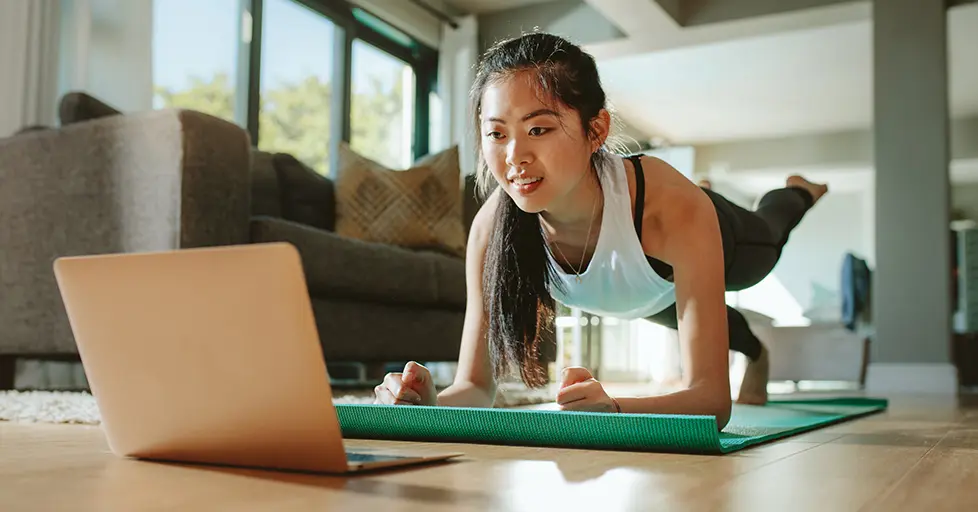
A lower body workout at home requires more creativity. Without heavy weights, you can increase the intensity by slowing down your tempo, shortening rest periods, and prioritizing single-leg movements. For more setup tips, see our guide on how to build a home workout.
2 complete lower body workout routines
Before touching a weight, always spend five to ten minutes raising your core temperature and mobilizing your hips and ankles. A proper warm-up before a workout lubricates your joints and prepares your nervous system for heavy loads. Below are two complete routines you can plug into your weekly schedule immediately.
1. Complete lower body workout at the gym
Perform this workout once or twice a week, leaving at least 72 hours of recovery between sessions. Rest for 2 to 3 minutes between sets on the first two exercises, and 60 to 90 seconds on the remaining movements.
- Barbell back squat: 3 to 4 sets of 6 to 8 reps.
- Barbell or dumbbell Romanian deadlift: 3 sets of 8 to 10 reps.
- Leg press: 3 sets of 10 to 12 reps.
- Machine or barbell hip thrust: 3 sets of 10 to 12 reps (pause for 1 second at the top).
- Seated leg curl: 3 sets of 12 to 15 reps.
- Standing machine calf raise: 4 sets of 15 reps.
When you can complete the top of each rep range with good form, increase the load slightly in your next session.
2. Lower body workout at home (bodyweight and dumbbells)
If you prefer training in your living room, check out our guide on how to build a home workout for more setup tips. For this routine, focus on strict form and keep rest periods between 45 and 60 seconds to maximize metabolic stress.
- Goblet squats (holding one dumbbell or heavy household object): 4 sets of 12 to 15 reps.
- Bulgarian split squats: 3 sets of 10 to 12 reps per leg.
- Single-leg Romanian deadlifts: 3 sets of 12 reps per leg.
- Single-leg glute bridges (back on couch or floor): 3 sets of 15 reps per side.
- Reverse lunges: 3 sets of 12 reps per leg.
- Single-leg standing calf raises (on a stair step): 3 sets to near failure per leg.
When this routine starts to feel easy, use a heavier dumbbell or slow the lowering phase to three or four seconds.
Want a ready-made session for any day of your week? The Befit workout generator builds a complete workout based on the muscles you choose, your goal, and the equipment you have.
5 benefits of training your legs and glutes regularly
Dedicating one or two days a week to a focused lower body workout brings benefits that go well beyond aesthetics. Here are the main ones:
- Higher energy expenditure: muscle tissue is metabolically active, and building mass in your legs and glutes slightly increases the calories you burn at rest, on top of the high energy cost of each session.
- Better athletic performance: almost every athletic movement, from sprinting to jumping, starts by pushing force into the ground, so stronger legs mean more explosive power.
- Joint protection: strengthening the muscles around your hips, knees, and ankles helps absorb shock and reduces wear on ligaments and tendons.
- Improved balance and mobility: moving through a full range of motion in squats and lunges improves hip and ankle mobility, keeping you agile as you age.
- Better symmetry and posture: adding unilateral training for symmetry and stability corrects left-to-right strength imbalances that can contribute to lower back pain.
These benefits appear faster when you train your lower body consistently, at least once or twice a week.
Common mistakes to avoid on leg day
Because lower body exercises demand high energy and coordination, technical breakdowns are common. Avoiding these four frequent errors will skyrocket your results and keep you out of the physical therapist’s office.
- Cutting your depth short: Half-reps on squats and leg presses rob your glutes and adductors of growth while placing unnecessary shear stress on your knee tendons. Lower the weight and move through your full, pain-free range of motion.
- Letting your knees cave inward: Known as knee valgus, this usually happens when pushing up from a squat or lunge. Actively push your knees outward in line with your middle toes to engage your glutes and protect your ligaments.
- Rushing through repetitions: Dropping rapidly into the bottom of a squat and bouncing back up uses momentum rather than muscle fiber recruitment. Control the lowering phase for two full seconds on every lift.
- Ignoring progressive overload: Doing the exact same weight for the exact same reps every week will eventually lead to a plateau. Keep a training log and aim to add a small amount of weight or one extra repetition each week.
Frequently Asked Questions
-
Should I do cardio before or after a lower body workout?
Always perform your cardio after your lower body strength training, or on a completely separate day. Doing intense cardio beforehand depletes your glycogen stores and fatigues your stabilizing muscles, which reduces your strength and increases injury risk during heavy lifts.
-
Can I do a lower body workout every day?
No, you should not train your lower body intensely every day. Your muscles grow while resting, not while lifting. Allow 48 to 72 hours of recovery between heavy lower body sessions to let muscle fibers repair and prevent overtraining injuries.
-
How many exercises should a lower body workout have?
An effective lower body session should include 4 to 6 exercises. Pick 2 heavy compound lifts (like squats and deadlifts), 1 or 2 unilateral or machine movements (like lunges or leg presses), and 1 or 2 isolation exercises for the hamstrings and calves.
-
What is the difference between a lower body workout and a leg workout?
People often use the terms interchangeably, yet a traditional leg workout typically focuses on the thighs and calves. Conversely, a complete lower body workout intentionally integrates the glutes, hips, pelvis, and lower back alongside the quads, hamstrings, and calves.
Build your lower body workout with Befit
Mastering your lower body workout is one of the best investments you can make in your health and physique. By combining knee-dominant exercises, hip hinges, and single-leg work, you’ll build stronger joints, more power, and balanced muscle mass.
Remember that consistency and progressive overload matter much more than perfection on day one. Ready to take the guesswork out of leg day? Download the Befit app to get personalized workout splits, video form guides, and smart weight tracking.