
Building a strong, resilient core requires much more than traditional crunches. If you want real functional stability, you need to learn how to do a side plank — a powerful isometric movement that targets your obliques and builds serious lateral core strength.
Core training often focuses too heavily on the front of the abdomen, and neglecting the sides of your torso can lead to muscular imbalances. Incorporating lateral stability exercises like this one matters for overall core health, not just aesthetics.
This guide walks you through exactly how to execute the movement, plus the progressions that keep it challenging as you get stronger, so you build a midsection that looks good and actually performs.
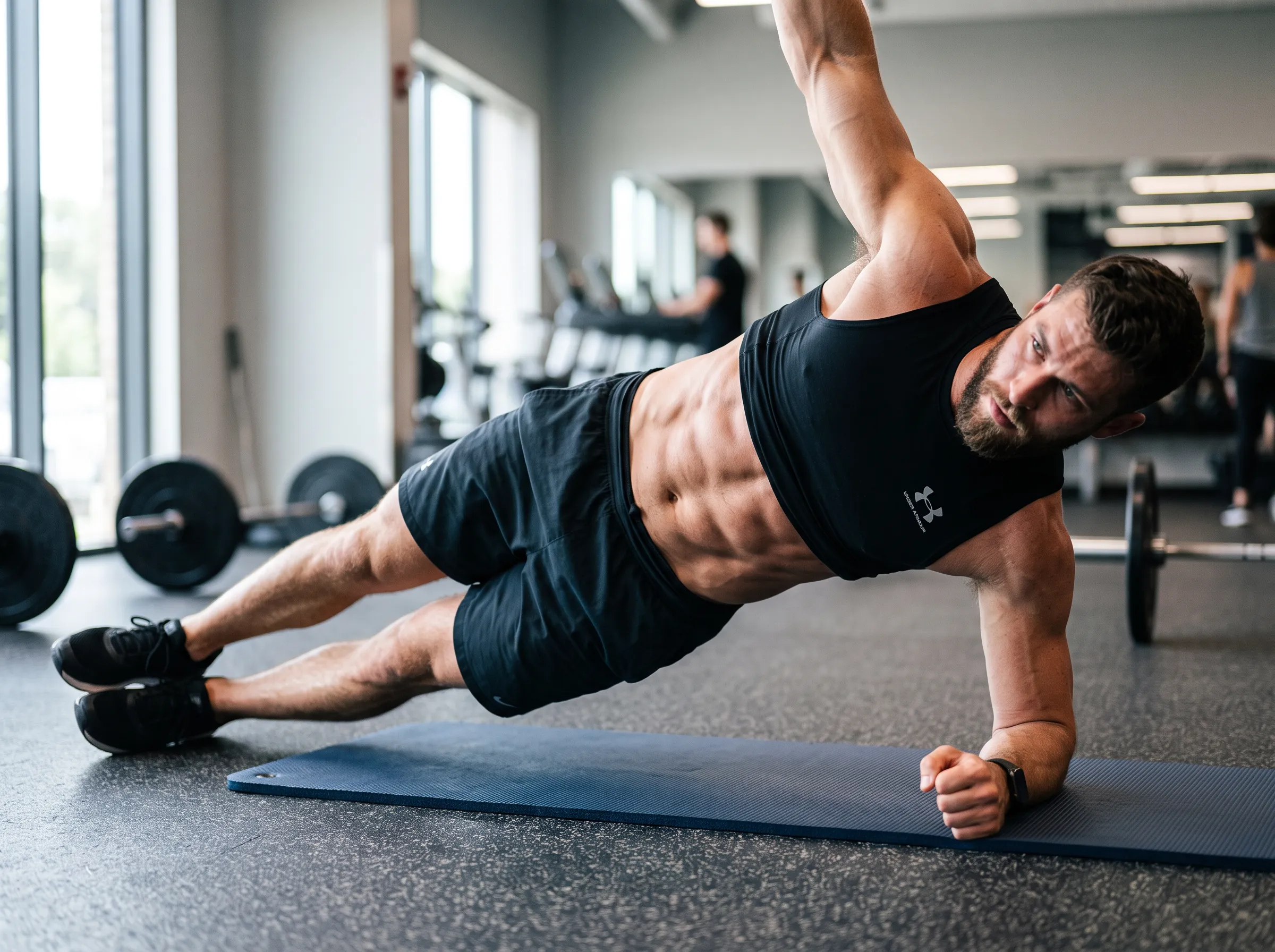
What is a side plank?
A side plank is a unilateral isometric hold that forces your body to resist the pull of gravity, building real stability along the entire lateral chain of your torso. Unlike front-facing holds, it challenges your body asymmetrically, which helps you develop a more balanced, resilient physique.
The exercise requires zero equipment — you just use your own body weight to create tension. Unilateral training like this also helps identify and correct left-to-right strength imbalances, so both sides of your core end up equally strong.
-
Muscles
- Primary
-
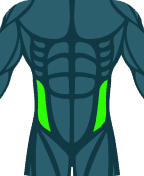 Obliques
- Secondary
-
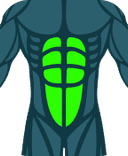 Abdominals
-
Instructions
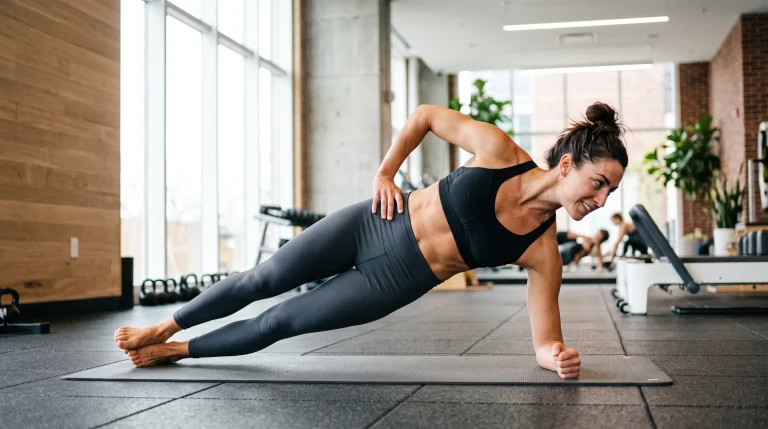
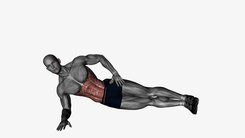
- Position yourself sideways on the floor and support your elbow aligned with your shoulder
- Place your opposite hand on your hip
- Keep your knees straight and one foot on top of the other
- Lift your body, aligning your torso, hips, and knees, and hold in isometry
-
Important Tips
- Avoid letting your hips drop lower than your torso and/or knees
- Do not misalign your elbow in relation to your shoulder
- Avoid jerks and sudden movements; simply hold still
Side plank
What does side plank work?
This exercise primarily targets your internal and external obliques — the muscles that run along the sides of your abdomen and control torso rotation. It also heavily engages your quadratus lumborum, a deep lower back muscle essential for spinal health, so strengthening this area directly helps prevent lower back pain.
Beyond the core, your upper body works hard too: your shoulder stabilizers, especially the rotator cuff, fire continuously to support your body weight safely. Your glutes and hip abductors also contract to keep your hips elevated, which makes this a genuine full-body stabilization challenge.
How to do a side plank with perfect technique
Executing the side plank correctly matters — a sloppy setup can lead to shoulder strain or lower back discomfort. Follow these steps to get the setup and execution right from the first rep.
- Starting position: Lie on your side on a comfortable mat with your legs fully extended and stacked.
- Elbow placement: Place your bottom elbow directly underneath your shoulder joint for support.
- Core engagement: Engage your core deeply and squeeze your glutes as tightly as possible.
- Lift: Lift your hips off the floor to create a straight line from head to heels.
- Hold: Hold this position while breathing deeply and evenly into your belly.
Maintaining tension is the key to a good hold — actively push the floor away with your forearm, and keep your neck neutral by looking straight ahead. If you’d like a visual reference, ACE Fitness has a solid breakdown of the form.
The main benefits of the side plank exercise
Adding this movement to your weekly routine offers real advantages. It protects your spine by strengthening the deep stabilizing muscles around it, and it improves balance and everyday posture. A strong lateral core also carries over to heavy compound lifts — expect better stability during squats and heavy pulls.
Unlike traditional sit-ups, the side plank involves no spinal flexion, so it doesn’t compress your spinal discs — generally a safer choice if you have a history of back pain.
Building strong obliques also tends to create a more tapered waistline, so you get aesthetic and functional benefits at once. Pair it with other effective abdominal exercises to round out your core routine.
Side plank variations for every fitness level
Once you master the basic hold, explore different variations to keep progressing. Dynamic movement, like side plank hip dips, increases the difficulty considerably; true beginners can modify the exercise to build foundational strength safely.
| Variation | Difficulty | Primary benefit |
|---|---|---|
| Knee side plank | Beginner | Learning basic hip elevation safely |
| Standard side plank | Intermediate | Building baseline lateral core stability |
| Side plank hip dips | Advanced | Dynamic oblique strengthening and mobility |
| Star side plank | Expert | Maximum full-body balance and control |
The knee variation reduces the lever length, making it easier on your shoulders, while the standard version builds baseline endurance. Once you can hold that for a minute, add side plank hip dips to force your obliques to actively contract and stretch. The star variation, which has you lift your top leg and arm, demands the most balance of all four.
Common mistakes and how to fix them
Many gym-goers struggle with form when they first learn this movement. Watch for these two issues:
- Dropping the hips toward the floor: the most frequent error, and it places unnecessary strain on the lower back. Squeeze your bottom glute to push your hips upward, and imagine a string pulling your waist toward the ceiling.
- Poor shoulder alignment: positioning the elbow too far outward stresses the shoulder. Keep your elbow directly beneath your shoulder joint, and avoid letting your top hip roll forward or backward — your body should stay stacked, as if trapped between two narrow walls.
Integrating the movement into your core routine
Programming this exercise well means steady progress without overtraining. Use it as a core activator during your dynamic warm-up to prepare your nervous system for heavy lifting, or place it at the end of your strength session as a finisher — it fits into almost any training structure.
A simple weekly progression: start with three sets of twenty seconds per side, then add five seconds each week until you can hold a full minute without shaking. If you’re training at home, these tips for training without a personal trainer can help you keep your form honest.
Comparing core stability exercises
The traditional front plank is excellent for the rectus abdominis and transverse abdominis, but it largely ignores the lateral stabilizers. Doing both variations builds a more complete core, so no muscle group gets left behind.
Rotational exercises like cable woodchoppers offer a different stimulus: they build rotational power but not static anti-lateral flexion strength, so isometric holds like the side plank stay uniquely useful for spinal health. For more comprehensive routines, check out the best exercises to slim your waist.
Advanced techniques for maximum core activation
Once you can hold a standard side plank for sixty seconds, look for new challenges. Placing your forearm on a balance trainer or stability ball adds instability, forcing your stabilizing muscles to work harder to keep you from falling. You can also add resistance by holding a light dumbbell in your top hand.
Another advanced option is adding a row: near a cable machine, perform a single-arm row while holding the elevated position, which heavily challenges your anti-rotation capability. Just make sure your form is flawless before adding resistance or instability.
The role of breathing during isometric holds
Proper breathing matters during any isometric core exercise. Many beginners instinctively hold their breath when the movement gets hard, which spikes blood pressure and limits oxygen delivery to the working muscles.
Practice diaphragmatic breathing while keeping your core braced: inhale through your nose, expanding your ribcage laterally, then exhale through your mouth, pulling your belly button toward your spine. This actually increases intra-abdominal pressure, making your core stronger while you hold.
How lateral strength improves sports performance
A powerful lateral chain translates to better athletic performance. Runners rely on oblique strength to prevent energy leaks during their stride, and a stable pelvis reduces the risk of knee and hip injuries.
If you play rotational sports like tennis or golf, lateral stability matters even more: your obliques absorb and transfer force quickly, and mastering this static hold builds the foundation for explosive rotational power. To learn more about athletic preparation, see what conditioning is and why it matters for your fitness.
Building a balanced weekly workout split
To get the best results, integrate core training into a well-designed program rather than training your obliques heavily every day. Aim for two to three dedicated core sessions per week, which gives your muscles time to recover and grow, and pair core work with your upper or lower body days.
For example, do planks and leg raises after a heavy squat session, then rotational work after a bench press day — this hits every function of the core without piling on excess fatigue. If you need help structuring your week, see our guide on building a balanced weekly workout split.
Understanding the active tension technique
A strong mind-muscle connection makes isometric holds far more effective. Instead of passively hanging out in the elevated position, actively contract every muscle you can — squeeze your quads, brace your glutes, and flex your lats at the same time. The hold gets harder, but it’s also more productive.
This active tension technique teaches your body to generate full-body stiffness, which is exactly the skill you need for lifting heavy weights safely — treat every core set as practice for your main compound lifts.
Frequently asked questions
-
Is the side plank better than a regular plank?
Neither is inherently better; they simply target different areas of the core. The regular plank focuses on the anterior core, while the lateral version targets the obliques. Therefore, you should include both variations in your routine for balanced development.
-
Why does my side plank hurt my shoulder?
Shoulder pain usually occurs when your elbow is not directly underneath your shoulder joint. This misalignment places excessive stress on the rotator cuff. Always check your setup in a mirror to ensure your arm forms a perfect straight line.
-
How do I modify a side plank if I’m a beginner?
The best modification is to perform the exercise from your knees instead of your feet. Bend your knees to 90 degrees and lift your hips from that shortened position. This reduces the weight your core and shoulder must support.
Making the side plank a habit
Mastering this core movement is worth the effort for anyone serious about their fitness. Now that you know how to do a side plank properly, start with manageable holds and progress slowly, prioritizing perfect spinal alignment over adding more seconds to the clock.
A strong lateral core protects your lower back, improves your posture, and enhances athletic performance, so it’s worth making this exercise a regular part of your weekly routine.
If you want to track your core strength progress, check out the best workout apps available today, or download the BeFit app to find customized routines and expert guidance.