The 15 Best Calf Exercises for Your Workout
A good calf workout trains the two main muscles in the area — the gastrocnemius (more superficial, visible, activated with the knee straight) and the soleus (underneath, activated with the knee bent). Because of that, alternating between standing calf raises (straight knee, more gastrocnemius) and seated calf raises (bent knee, more soleus) matters for training both muscles fully.
On this page you'll find 15 calf exercises curated by Befit, with execution videos, range-of-motion tips, and variations for the gym, home gym, and bodyweight training. Every exercise has been reviewed by a fitness professional specialized in strength training.
If you already know what you want, use the level and equipment filters to jump straight to the right exercise. If you'd rather start somewhere, check the top 10 below — the movements with the strongest consensus for calf hypertrophy and strength.
And if you want a calf workout built from scratch, personalized to your goal, your time, and your equipment, that's exactly what the Befit app does automatically.
How to build your Calves workout
Volume per session: 2 to 3 exercises, 9 to 15 total sets — calves respond well to relatively high volume, since they're conditioned to daily effort (walking, standing).
Movement split: 1 standing exercise (straight knee, gastrocnemius focus) and 1 seated or leg-press-based exercise (bent knee, soleus focus).
Sets and reps: 3 to 4 sets of 12 to 20 reps — calves tend to respond better to higher reps than other muscle groups.
Frequency: 2 to 3 times a week, since they recover quickly between sessions.
Top Calves exercises
| # | Exercise | Level | Equipment | Muscle focus | |
|---|---|---|---|---|---|
| 1 |
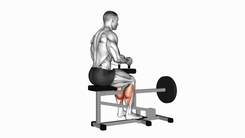 Seated Calf Raise |
Beginner | Calf Machine | Calves | See execution |
| 2 |
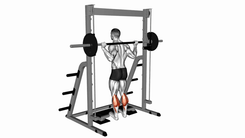 Smith Machine Calf Raise |
Beginner | Smith machine | Calves | See execution |
| 3 |
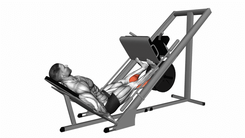 Leg Press Calf Raise |
Intermediate | Leg Press 45 | Calves | See execution |
| 4 |
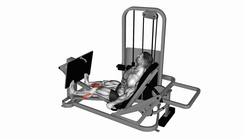 Horizontal Leg Press Calf Raise |
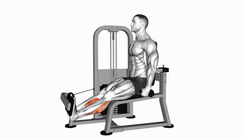
Beginner | Seated Leg Press machine | Calves | See execution |
| 5 |
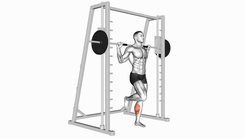 Smith Machine Calf Raise (Unilateral) |
Intermediate | Smith machine | Calves | See execution |
| 6 |
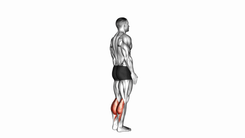 Standing Calf Raise |
Beginner | Calves | See execution | |
| 7 |
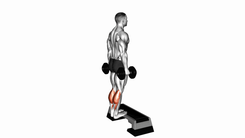 Standing Dumbbell Calf Raise |
Beginner | Dumbbells | Calves | See execution |
| 8 |
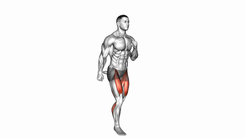
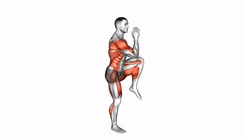 High Knees |
Beginner | Calves | See execution | |
| 9 |
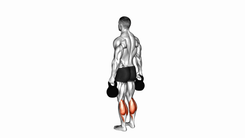
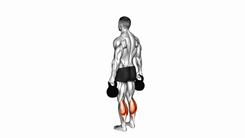 Standing Kettlebell Calf Raise |
Intermediate | Kettlebell | Calves | See execution |
| 10 |
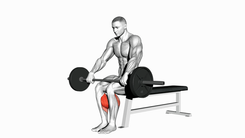
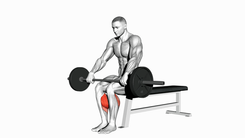 Seated Barbell Calf Raise |
Beginner | Olympic barbell | Calves | See execution |
Seated Calf Raise
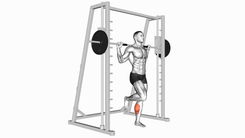
Smith Machine Calf Raise
Leg Press Calf Raise
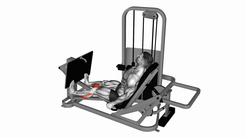
Horizontal Leg Press Calf Raise
Smith Machine Calf Raise (Unilateral)
Standing Calf Raise
Standing Dumbbell Calf Raise
High Knees
Standing Kettlebell Calf Raise
Seated Barbell Calf Raise
All 16 Calves exercises
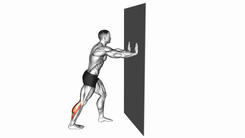
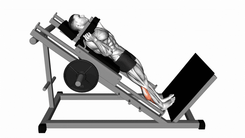
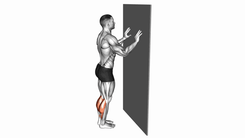
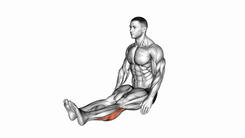
Calves workout at home vs. at the gym
Training calves at home is simple: bodyweight standing calf raises (on a step, for extra range of motion) are already a good stimulus, and a pair of dumbbells adds load once bodyweight stops being enough.
Stepping up and down on one leg (single-leg) is a good way to increase intensity without needing more equipment.
At the gym, the toolkit is bigger. You've got a dedicated calf machine (standing or seated), a leg press to do calf raises with heavy load and less balance demand, and a Smith machine for a guided standing calf raise.
Use the Bodyweight or Home Gym filter above to see only exercises that fit your setup.
How Befit builds your Calves workout with AI
Picking an exercise is only half the problem. The other half is: how many sets, how many reps, what load, in what order, when to switch things up. And that changes every week as you progress.
Befit solves this with an AI that builds a personalized training plan for your goal (hypertrophy, strength, definition), your level, your time per session, and your equipment. Every week, the algorithm adjusts volume and load based on what you've logged.
You don't need to know how to program periodization. Just train and log it.
Safety tips for Calves training
- Use full range of motion — a deep stretch at the bottom (heel below toe level, if you're on a step) and a strong contraction at the top.
- Avoid locking your knee fully straight with heavy load on standing calf raises — keep a slight bend.
- Control the lowering phase instead of letting the weight drop fast — the eccentric phase is where calves get much of their stimulus.
- If you feel pain behind your knee, check whether you're hyperextending it — standing calf raises need an almost-straight knee, but not locked.
- Rest at least 24 to 48 hours between calf sessions — it's a muscle group that recovers relatively fast.
Frequently asked questions about Calves training
-
How many exercises should I do for a calf workout?
An effective calf workout has 2 to 3 exercises per session, alternating between a standing movement (gastrocnemius focus) and a seated or leg-press movement (soleus focus). Total volume between 9 and 15 sets per week works well, since calves tolerate relatively high volume.
-
How many sets and reps for calf hypertrophy?
Calves tend to respond better to higher reps than other muscle groups — 3 to 4 sets of 12 to 20 reps, with a full stretch and a strong contraction at the top of each rep.
-
What's the best beginner calf workout?
For beginners, a solid calf workout has 2 exercises: bodyweight standing calf raises (or with dumbbells if you need more load) and a seated calf machine. Focus on using full range of motion before adding load.
-
Can you train calves at home?
Yes. Bodyweight standing calf raises (ideally on a step, for extra range of motion) and the single-leg version cover this muscle group well without any equipment. Use the Bodyweight filter in the exercise list above.
-
What other muscle group pairs well with calves?
Calves pair well with any leg day (quads, hamstrings, or glutes), usually at the end of the session, since they don't interfere with performance on the other leg exercises.
-
How many times a week should I train calves?
Two to three times a week works well — calves recover relatively fast between sessions, since they're already conditioned to repeated daily effort (walking, standing).
-
What's the difference between standing and seated calf raises?
With the knee straight (standing), the gastrocnemius (the visible part that forms the calf's "peak") is recruited more. With the knee bent (seated or on the leg press), the soleus underneath takes on more of the work. Doing both exercises trains the calf fully.
-
How do I know I'm training calves the right way?
You should feel the calf contracting hard at the top and stretching at the bottom of the movement — if you're using a lot of momentum or a short range of motion, the stimulus drops a lot. Film a set from the side and compare it to the execution video on Befit.