The 7 Best Forearm Exercises for Your Workout
A good forearm workout trains the wrist flexors (palm up, activated in wrist curls) and extensors (palm down, activated in reverse wrist curls) — the main muscles responsible for grip strength. Forearms already get plenty of indirect stimulus from any pulling or gripping exercise (back, biceps, deadlifts), so direct training tends to be a supplement rather than the bulk of your volume.
On this page you'll find 7 forearm exercises curated by Befit, with execution videos, range-of-motion tips, and variations for the gym, home gym, and bodyweight training. Every exercise has been reviewed by a fitness professional specialized in strength training.
If you already know what you want, use the level and equipment filters to jump straight to the right exercise. If you'd rather start somewhere, check the top exercises below — the movements with the strongest consensus for forearm hypertrophy and strength.
And if you want a forearm workout built from scratch, personalized to your goal, your time, and your equipment, that's exactly what the Befit app does automatically.
How to build your Forearms workout
Volume per session: 2 exercises, 6 to 8 total sets — forearms already get a lot of indirect stimulus from other workouts, so they don't need high direct volume.
Movement split: 1 wrist curl (palm up, flexor focus) and 1 reverse wrist curl (palm down, extensor focus) — both sides of the forearm, for balance.
Sets and reps: 3 sets of 15 to 20 reps — forearms respond better to moderate load and more reps than most other muscle groups.
Frequency: twice a week is enough, factoring in the indirect stimulus they already get from pulling and lifting exercises.
Top Forearms exercises
| # | Exercise | Level | Equipment | Muscle focus | |
|---|---|---|---|---|---|
| 1 |
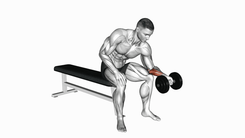 Dumbbell One arm Wrist Curl |
Beginner | Dumbbells | Forearms | See execution |
| 2 |
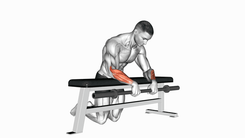 Barbell palm down wrist curl over a bench |
Beginner | Standard barbell | Forearms | See execution |
| 3 |
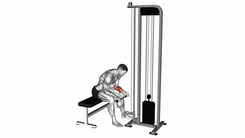
 Cable Wrist Curl |
Beginner | Cable pulley machine | Forearms | See execution |
| 4 |
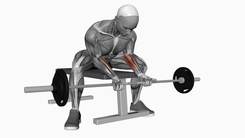 Barbell Wrist Curl |
Beginner | Olympic barbell | Forearms | See execution |
| 5 |
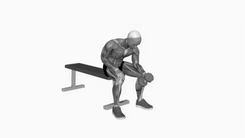 Neutral wrist flexion |
Beginner | Dumbbells | Forearms | See execution |
| 6 |
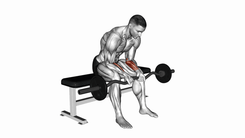 EZ Bar Seated Wrist Curl |
Beginner | EZ curl bar | Forearms | See execution |
| 7 |
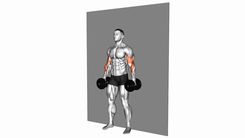 Dumbbell Wrist Curl |
Beginner | Dumbbells | Forearms | See execution |
Dumbbell One arm Wrist Curl
Barbell palm down wrist curl over a bench
Cable Wrist Curl
Barbell Wrist Curl
Neutral wrist flexion
EZ Bar Seated Wrist Curl
Dumbbell Wrist Curl
All 7 Forearms exercises
Forearms workout at home vs. at the gym
Training forearms at home is simple: a single dumbbell already covers wrist curls and reverse wrist curls, resting your forearm on a table, a couch arm, or your own knee.
Since forearms respond well to moderate load, you don't need much weight — even a light dumbbell is enough for a good stimulus at higher reps.
At the gym, the toolkit is bigger. You've got a straight or Olympic barbell for wrist curls resting on a bench (bilateral load), a cable machine to keep constant tension throughout the movement, and an EZ bar for a more comfortable wrist grip.
Use the Bodyweight or Home Gym filter above to see only exercises that fit your setup.
How Befit builds your Forearms workout with AI
Picking an exercise is only half the problem. The other half is: how many sets, how many reps, what load, in what order, when to switch things up. And that changes every week as you progress.
Befit solves this with an AI that builds a personalized training plan for your goal (hypertrophy, strength, definition), your level, your time per session, and your equipment. Every week, the algorithm adjusts volume and load based on what you've logged.
You don't need to know how to program periodization. Just train and log it.

Safety tips for Forearms training
- Use light to moderate load — forearms are a group of small muscles and sensitive tendons, and too much load raises the risk of tendinitis (pain around the elbow).
- Move through the full range of motion, but under control — don't let the weight "drop" your wrist between reps.
- If you feel pain around the elbow (not the forearm itself), reduce load and frequency — it can be a sign of tendon overload.
- Since forearms are already activated indirectly in almost every pulling workout, avoid training them heavily the day before an important back or biceps session.
- Rest at least 48 hours between direct forearm sessions.
Frequently asked questions about Forearms training
-
How many exercises should I do for a forearm workout?
An effective forearm workout has 2 exercises per session — 1 wrist curl and 1 reverse wrist curl. Total volume between 6 and 8 sets per week is enough, since forearms already get plenty of indirect stimulus from other workouts.
-
How many sets and reps for forearm hypertrophy?
Forearms respond better to moderate load and higher reps — 3 sets of 15 to 20 reps work well, unlike the 6-to-12-rep range more common in other muscle groups.
-
Is it worth training forearms directly?
It's worth it, especially if you notice your grip failing before the target muscle in pulling exercises (like deadlifts or pull-ups). But it doesn't need to be a priority — forearms already get plenty of indirect stimulus from everyday training.
-
Can you train forearms at home?
Yes. A single dumbbell already covers wrist curls and reverse wrist curls, resting your arm on a table or your knee. Use the Bodyweight filter in the exercise list above.
-
What other muscle group pairs well with forearms?
Forearms pair well with biceps or back, usually at the end of the session — training forearms heavily before those groups could hurt your grip strength on the main exercises.
-
How many times a week should I train forearms?
Twice a week is enough for most people, factoring in the indirect stimulus they get from any pulling workout (back, biceps) or deadlift.
-
What's the best exercise for forearms?
The dumbbell or barbell wrist curl has the strongest consensus for the flexors, and the equivalent reverse wrist curl for the extensors. Both together cover the forearm in a balanced way.
-
How do I know I'm training forearms the right way?
You should feel your forearm (not your elbow) working, with the characteristic burn of a small muscle under high reps. If you feel sharp pain at the elbow, reduce the load. Film a set and compare it to the execution video on Befit.