
Many gym-goers focus on the “mirror muscles”: chest, biceps and front deltoids. Over time, this builds an impressive front view, but it often leaves one critical area behind. The posterior shoulder, also known as the rear deltoid, is one of the most undertrained muscles in the gym, and that gap shows up in both your physique and your joint health.
Training the back of your shoulders brings real benefits. It helps balance the pushing work you already do, supports better posture and reduces the risk of shoulder discomfort. It also gives your shoulders the rounded, “3D” look that front and side raises alone can’t create.
In this guide, you’ll learn what the posterior shoulder is, how it works and the 7 best posterior shoulder exercises to add to your routine. You’ll also find out how many sets and reps to do, which mistakes to avoid and how to fit this muscle into your weekly training split.
What is the posterior shoulder?
The posterior shoulder is the rear portion of the deltoid, the triangular muscle that covers your shoulder joint. The deltoid has three heads: the anterior (front), the lateral (side) and the posterior (rear). According to StatPearls, a medical reference from the U.S. National Library of Medicine, the posterior head starts on the spine of the scapula (your shoulder blade), all three heads insert on the humerus (your upper arm bone), and the deltoid as a whole is a key stabilizer of the shoulder.
Because it attaches to your shoulder blade, the rear delt works closely with upper back muscles such as the rhomboids, the trapezius and the latissimus dorsi. You can see how these structures connect in our article on shoulder anatomy. This connection explains why a strong posterior shoulder supports joint stability and helps balance the constant pushing work most people do at the gym.
What do the posterior shoulder muscles do?
Your posterior shoulder muscles perform three main movements. The first is horizontal abduction, which means pulling your arms back away from your chest, as in a reverse fly. The second is external rotation, turning your arm outward away from your body. The third is shoulder extension, bringing your arm down and back, as when you row or pull.
Since they take part in almost every pulling movement, the rear delts get some work during back training. However, heavy rows and pulldowns are usually dominated by larger muscles like the lats, so the posterior shoulder rarely gets enough stimulus to grow on its own. Targeted exercises solve this problem. To understand how muscles respond to this kind of training, read our guide on what muscle hypertrophy is.
Top benefits of training your posterior shoulder
A strong rear deltoid offers advantages that go far beyond aesthetics. Here are the main reasons to make it a priority in your weekly routine:
- Improved posture: Modern lifestyles force us into hunched positions over screens. Consequently, strengthening the back of your shoulders pulls your posture upright.
- Injury prevention: Weak rear delts lead to severe shoulder instability. Thus, balancing your shoulder strength protects the delicate rotator cuff.
- Aesthetic balance: Overdeveloped front delts look disproportionate and rounded. Furthermore, adding mass to the back creates a round, balanced shoulder.
- Better compound lifts: A strong rear shoulder creates a stable shelf for heavy lifts. Therefore, your bench press and squat will feel much more secure.
These benefits add up over time. Even two or three rear delt exercises per week are enough to start correcting the imbalance that years of chest-focused training tend to create.
7 best posterior shoulder exercises for a balanced physique
The right exercises make a big difference when training this stubborn muscle group. The 7 posterior shoulder exercises below combine machines, cables, free weights and bodyweight, so you can build a routine that fits your level and your gym.
1. Cable face pulls
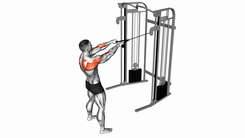
Cable face pulls are one of the best movements for shoulder health. They train external rotation and horizontal abduction at the same time, recruiting the rear delts and the small muscles of the rotator cuff in a single exercise. Here’s how to do it:
- Set a cable pulley at upper chest height with a rope attachment.
- Grip the rope with your thumbs pointing backward.
- Pull the rope toward your face while keeping your elbows high.
- Squeeze your shoulder blades together at the peak contraction.
- Return to the starting position slowly and under control.
Face pulls are about control, not load. If your lower back arches or your shoulders shrug toward your ears, the weight is too heavy for you to keep good form.
-
Muscles
- Primary
-
 Shoulders
- Secondary
-
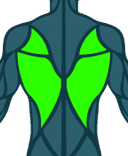 Back
-
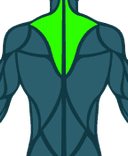 Trapezius
-
Instructions
- Attach a rope to the high pulley and stand facing the machine.
- Hold the ends of the rope with your palms facing inward and take a step back to tension the cable.
- With your arms extended forward, pull the rope towards your face, separating your hands at the end of the movement.
- Squeeze the shoulders and upper back at the top.
- Slowly return to the starting position with control.
-
Important Tips
- Keep your elbows above shoulder level during the movement.
- Pull the rope toward your face, separating your hands at the end.
- Do not arch your lower back — engage the core for stability.
- Use light to moderate load to maintain control and good form.
Cable Standing Face Pull with Rope
2. Machine reverse fly
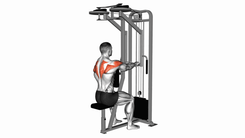
The machine reverse fly isolates the rear deltoids very effectively. Because the machine supports your body, you don’t need to stabilize your core and can focus entirely on the muscle contraction. Our dedicated guide to the reverse fly has more technique tips. To perform it:
- Adjust the seat so the handles line up with your shoulders.
- Grip the handles lightly with your palms facing inward.
- Keep a slight bend in your elbows throughout the movement.
- Pull the handles back in a wide arc until your arms line up with your body.
- Pause briefly before returning to the starting position.
If you feel the exercise mostly between your shoulder blades, think about moving your arms out wide instead of pinching your scapulae together. This small mental cue shifts more of the work to the rear delts.
-
Muscles
- Primary
-
Shoulders
- Secondary
-
Trapezius
-
Back
-
Instructions
- In the starting position, adjust the bench to a height where your shoulders align with the hand position on the machine
- Your chest should be fully pressed against the support
- Arms extended forward with palms facing down
- Perform the movement until your arms align with your torso, then return in a controlled manner
-
Important Tips
- Avoid turning your neck to the sides
- Avoid using momentum or sudden movements
- Do not lift your chest off the bench support
Reverse machine fly
3. Dumbbell bent-over lateral raise
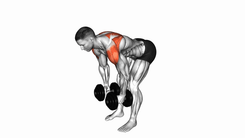
The bent-over lateral raise is a classic free-weight exercise for building muscle in the rear delts. Strict form is essential to avoid swinging the weight, so keep your torso nearly parallel to the floor throughout the set:
- Hold two dumbbells and hinge forward at the hips.
- Let the weights hang directly beneath your chest.
- Raise the dumbbells out to the sides while keeping your back flat.
- Lead the movement with your elbows, not your hands.
- Lower the weights under control to maintain tension.
Most people need much lighter dumbbells here than they expect. If you have to swing your torso to lift the weight, choose a lighter pair and focus on a slow, controlled tempo.
-
Muscles
- Primary
-
Shoulders
- Secondary
-
Trapezius
-
Instructions
- In the starting position, keep your torso bent parallel to the ground
- Position your arms aligned with your shoulders while holding the dumbbells
- Raise your arms to the side until your elbows align with your torso
- Lower your arms in a controlled manner
-
Important Tips
- Avoid using momentum or sudden movements with your arms and torso
- Do not arch your torso
- Do not let your torso drop more than necessary
Bent over rear delt fly dumbell
4. Single-arm cable rear delt fly
Unilateral exercises help correct strength and size differences between your left and right sides. In this cable reverse fly variation, the cable also keeps the muscle under constant tension through the full range of motion. Learn more about the power of unilateral training. Here’s the step by step:
- Set a cable pulley to shoulder height and remove any attachments.
- Stand sideways to the machine and grab the cable across your body.
- Pull your arm out and back in a wide, sweeping motion.
- Keep your torso completely still to prevent momentum.
- Slowly return to the starting position to maximize the eccentric phase.
Start each set with your weaker side and match the same number of reps on the stronger one. Over time, this simple habit helps even out the imbalance.
5. Incline bench dumbbell reverse fly
Lying chest-down on an incline bench makes it almost impossible to use momentum. In this prone rear delt fly, the posterior deltoid has to do all the work, which makes it a great option for anyone who struggles with strict form:
- Set an adjustable bench to a 45-degree angle.
- Lie chest-down on the bench holding two light dumbbells.
- Let your arms hang straight down toward the floor.
- Raise the weights out to your sides in a controlled arc.
- Squeeze the back of your shoulders hard at the top.
Because your chest is supported, you can safely take your sets close to failure. This makes the incline reverse fly an excellent finisher at the end of a pull or shoulder workout.
6. Wide grip inverted row
Traditional rows focus mainly on the lats, but a wide grip and a pull toward the upper chest increase the contribution of the rear shoulders. The inverted row is also a great bodyweight option for all levels:
- Set a barbell in a squat rack at waist height.
- Lie underneath and grab the bar with a grip wider than shoulder-width.
- Keep your body in a straight line from head to heels.
- Pull your chest up to the bar by driving your elbows back.
- Lower yourself slowly to the starting position.
To make the exercise easier, raise the bar or bend your knees. To make it harder, elevate your feet on a bench or pause for two seconds at the top of each rep.
7. Rope straight-arm pulldown (modified)
Adding a pull-apart at the end of the straight-arm pulldown brings the rear delts into the movement. Spreading the rope ends at the bottom increases the work of the posterior shoulder on top of the shoulder extension:
- Attach a rope to a high cable pulley.
- Step back and hinge slightly at the hips for stability.
- Keep your arms straight and pull the rope down toward your thighs.
- Pull the ends of the rope apart forcefully as it reaches your legs.
- Control the eccentric phase on the way back up.
This variation still relies heavily on the lats, so use it as a complement to the more isolated exercises above, not as your main rear delt movement. For complete routine ideas, check out our shoulder workout guide.
Comparing posterior shoulder exercises
The best exercise depends on your goals, your experience and the equipment you have. Use the comparison table below to choose the right movements for your current level:
| Exercise | Primary benefit | Equipment needed | Difficulty level |
|---|---|---|---|
| Cable face pulls | Shoulder health and rotation | Cable machine, rope | Beginner |
| Machine reverse fly | Strict isolation without momentum | Pec deck machine | Beginner |
| Bent-over lateral raise | Mass building and strength | Dumbbells | Intermediate |
| Single-arm cable fly | Fixing muscular imbalances | Cable machine | Intermediate |
| Incline bench fly | Momentum prevention | Bench, dumbbells | Beginner |
| Wide inverted row | Bodyweight strength | Barbell or Smith machine | Intermediate |
A good routine usually combines one isolation exercise, such as the machine reverse fly, with one movement that also trains rotation or pulling strength, such as face pulls or inverted rows. Rotating these choices every few weeks keeps your training varied.
How to add posterior shoulder exercises to your workout split
Programming these exercises correctly is what turns them into results. As a small muscle usually trained with light loads, the rear delt tends to tolerate higher training frequency well, so you can train it more than once a week without overdoing it.
If you follow a standard split, add rear delt work on your pull days. Consequently, they synergize perfectly with your heavy back exercises. You can learn more about structuring this in our best workout split guide.
Alternatively, you can include them on your dedicated shoulder days. Meanwhile, you should always perform them after your heavy compound lifts. For example, do your heavy presses first. You can read about safe pressing techniques in our shoulder press machine guide. After pressing, hit the rear delts with higher volume.
How many sets and reps for the posterior shoulder?
Training volume is one of the main drivers of muscle growth. A meta-analysis published in the Journal of Sports Sciences found a dose-response relationship between weekly sets and hypertrophy: up to a certain point, more weekly sets lead to more muscle growth. For the rear delts, a practical target is 8 to 12 direct sets per week.
Because the posterior shoulder is a small muscle that’s easily overpowered by larger back muscles, moderate to high reps work very well. Sets of 12 to 20 repetitions let you use lighter loads with good form and create plenty of metabolic stress. Keep your rest periods moderate, around 60 to 90 seconds, to maintain the pump without compromising performance. Read more about training volume per muscle group to plan your whole week.
To keep progressing, increase the challenge gradually: add reps, add a little weight or slow down the tempo. This principle is called progressive overload, and our guide on how to use progressive overload without injuring yourself shows how to apply it safely.
Common errors in posterior shoulder training
Many lifters struggle to grow this muscle because of poor technique. Therefore, you must avoid these common pitfalls to ensure steady progress. Consequently, fixing these mistakes will accelerate your results significantly.
- Using too much weight: Heavy weights force your larger back muscles to take over. Consequently, the rear delts miss out on the stimulus. Always prioritize perfect form over moving heavy weight.
- Retracting the scapula too early: If you pinch your shoulder blades immediately, your rhomboids do the work. Thus, you must focus on moving the weight with your arms first.
- Neglecting the mind-muscle connection: You must actively think about the muscle contracting during the rep. Furthermore, pausing at the peak of the movement helps establish this vital connection.
- Ignoring exercise variety: The rear delt has multiple functions. Therefore, you should use different angles and machines to stimulate all the fibers. Read more about exercise variety in our rear delts training guide.
Fixing just one of these mistakes is often enough to finally feel the back of your shoulders working. Filming a set from the side is a simple way to check your form.
Frequently asked questions
Frequently Asked Questions
-
Why is the posterior shoulder usually underdeveloped?
Most people focus heavily on exercises they can see in the mirror, like bench presses. Consequently, the front deltoids receive excessive volume. Furthermore, modern sedentary lifestyles promote a hunched posture that weakens the rear shoulder muscles over time.
-
How often should I train my posterior shoulder?
You should train this muscle group two to three times per week. Because it is a small muscle, it recovers very quickly. Therefore, frequent stimulation yields the best hypertrophy results without causing overtraining.
-
How many reps work best for the posterior shoulder?
Higher repetition ranges work best for this specific muscle. Thus, you should aim for 12 to 20 repetitions per set. This range maximizes metabolic stress and prevents heavier back muscles from taking over the movement.
-
Why do I feel posterior shoulder exercises in my traps instead?
You likely use too much weight or shrug your shoulders during the movement. Consequently, your upper traps compensate for the weak rear delts. Therefore, lower the weight and focus on pushing your arms outward rather than pulling them back.
Integrating rear delts into a full upper body routine
A balanced physique depends on how your exercises work together. Pairing face pulls with heavy chest presses, for example, balances the push and pull forces on your shoulders and helps keep the joint healthy.
Your diet needs to support your training as well. Building muscle is easier when you eat enough protein and, for most people, a small caloric surplus, a strategy we explain in our article on what bulking is. Our guide on how much protein to eat per day helps you set your daily target, and our upper body workout guide has complete routines to match your nutrition.
To plan your calories with more precision, start by finding out how much energy your body burns at rest. The Befit BMR calculator gives you this number in seconds, and it’s the starting point for setting the right calorie intake to support muscle growth.
Basal Metabolic Rate (BMR) Calculator: Find Out How Many Calories Your Body Burns
Your result
Your basal metabolic rate (BMR) is:
kcal per day
Comparison between formulas
Every formula is an estimate. The difference between them shows the margin of error, usually around 10%.
Total daily energy expenditure
Your BMR multiplied by your activity level. Tap a level to update the goals below.
Calories for your goal
Your data
Next step
Always warm up before loading the shoulder joint. Light band pull-aparts are an excellent primer for your upper body days, improving muscle activation and reducing joint discomfort. Our guide to warm-up and cool-down routines has more ideas.
Build stronger posterior shoulders with Befit
Training your posterior shoulder improves your upper body aesthetics and your long-term joint health. With the exercises in this guide, the right volume and strict form, you can build fuller, more balanced shoulders and reduce your risk of injury.
Remember that consistency and technique matter more than heavy weights, so leave your ego at the door when training the rear delts. Start adding these exercises to your weekly routine and you’ll notice the difference in a few weeks.
To make it easier to stay consistent, download the Befit app. It gives you personalized workout plans that balance your shoulder development with your overall fitness goals, so your progress continues week after week.