
You do crunch after crunch, but the area right below your chest still doesn’t look or feel any stronger. Maybe your neck gets sore before your abs do, or you’re simply not sure which exercises actually work the upper abdominal region. You’re not alone: this is one of the most common frustrations for people who train their core.
The good news is that getting results doesn’t take a complicated routine or expensive equipment. In most cases, the problem comes down to technique, exercise choice and consistency. Small adjustments in how you move can shift much more of the effort to the right muscle fibers.
In this guide, you’ll learn what the upper abdominal muscles are, what science says about training them, and 7 practical tips to build a stronger, more defined core. You’ll also find answers to common questions, such as how long it takes to see results and whether you really need to train your abs every day.
What are the upper abdominal muscles?
The upper abdominal muscles are the top portion of the rectus abdominis, a long, flat muscle that runs vertically from your lower ribs and sternum down to your pubic bone. When people talk about “upper abs,” they mean the section between the bottom of the chest and the belly button. Its main job is spinal flexion: bringing your ribcage closer to your pelvis, as you do when you curl your torso forward.
The rectus abdominis is one single muscle, not separate “upper” and “lower” muscles. The six-pack look comes from tendinous intersections, bands of connective tissue that cross the muscle horizontally. The number and alignment of these bands is genetic, which is why some people have a four-pack or slightly uneven abs. You can learn more about this in our article on the myths and truths about six-pack abs.
Can you really target the upper abs?
Yes, to a certain degree. A study published in the Archives of Physical Medicine and Rehabilitation found that, among people who performed the movement correctly, the curl-up produced greater activity in the upper rectus abdominis. Research in the Journal of Sports Science and Medicine reached a similar conclusion: different exercises activate each portion of the muscle somewhat differently, but the whole rectus abdominis still works as a functional unit.
In practice, this means you can’t completely isolate the upper abs, but you can shift more of the work toward them. Movements that start from the top, with the ribcage curling down toward the hips, are the ones that put the most tension on this region. That’s exactly what the tips below will help you do.
How to train your upper abdominal muscles: 7 practical tips
Getting results in the upper abs depends on three things: moving with the right technique, choosing exercises that load the region, and supporting your training with smart programming and nutrition. The 7 tips below cover all of them, in the order you should apply them:
- Curl your ribcage toward your pelvis. The upper abs work through spinal curling, not by lifting your whole torso off the floor. In a well-executed crunch, your shoulders rise only about 30 to 40 degrees while your lower back stays on the floor. Coming all the way up shifts the work to your hip flexors.
- Keep your neck neutral and your hands light. Feeling crunches in your neck usually means you’re pulling your head with your hands. Imagine holding an orange between your chin and chest, or cross your arms over your chest.
- Exhale on the way up and control the descent. Exhaling helps your ribcage drop and strengthens the contraction. Lowering yourself over 2 to 3 seconds keeps your abs under tension for longer.
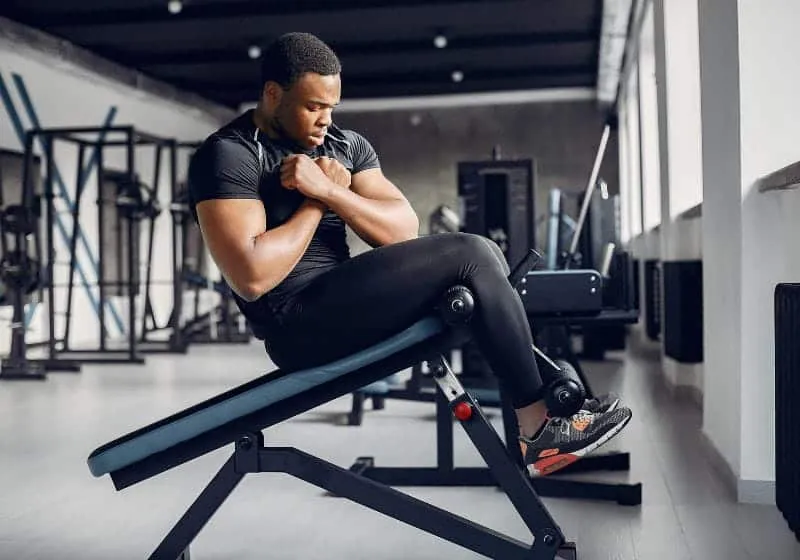
- Prioritize crunch variations. Floor, stability ball, machine and cable crunches all follow the ribcage-to-pelvis pattern, so they’re the best choices for this region. V-ups and full sit-ups rely heavily on the hip flexors and work better as complements.
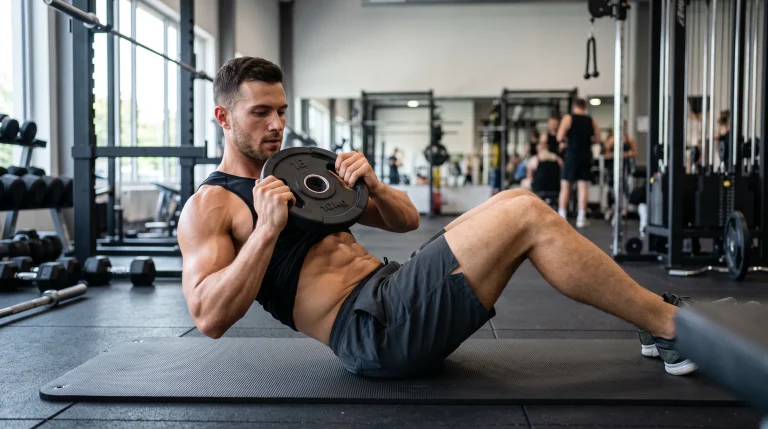
- Add load progressively. Your abs need an increasing challenge to keep improving, a principle called progressive overload. Add a weight plate, increase the cable load or slow down the tempo once you can finish all your sets with one or two reps to spare.
- Train your abs 2 to 3 times a week. Like any other muscle, your abs need rest to recover, so training them every day doesn’t speed up results. Three or four sets at the end of your regular workouts are enough.
- Lower your body fat with a balanced diet. Spot reduction doesn’t work, so revealing your abs requires a moderate caloric deficit. Check your energy needs with the Befit BMR calculator, prioritize protein at every meal and find more strategies in our guide on how to lose belly fat.
These tips work best together. Perfect technique won’t show if your body fat stays high, and a good diet alone won’t build strength without progressive training.
To put tip 4 into practice, use the table below to choose the crunch variation that best fits your level and equipment:
| Exercise | Equipment | Level | Why it works for the upper abs |
|---|---|---|---|
| Floor crunch | None (mat optional) | Beginner | Teaches the basic curl and can be done anywhere |
| Stability ball crunch | Stability ball | Beginner to intermediate | Allows a larger range of motion than the floor version |
| Machine crunch | Gym crunch machine | Beginner to intermediate | Guided path makes it easier to focus on the contraction |
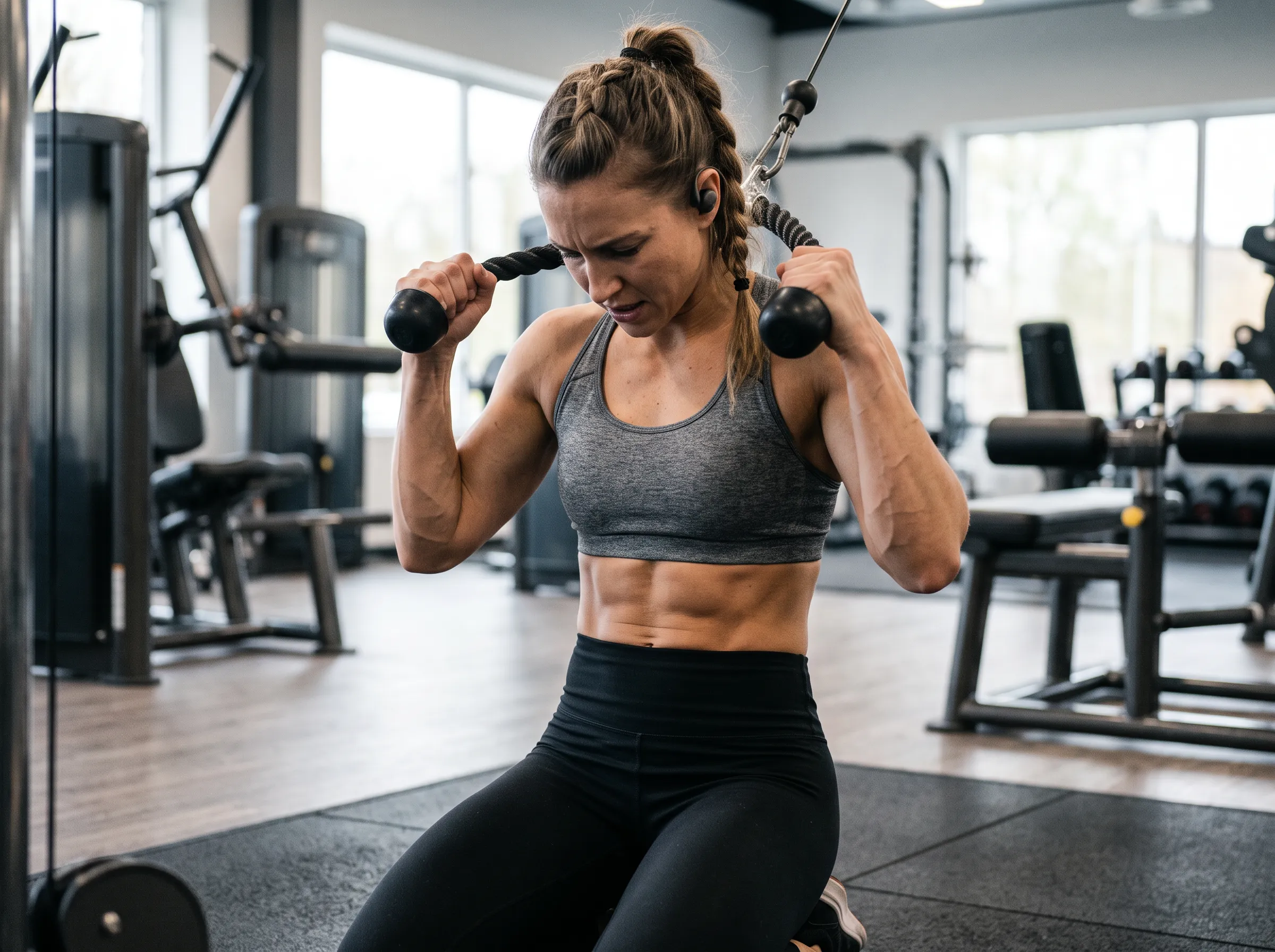
| Cable crunch | Cable machine with rope | Intermediate to advanced | Easy to add load progressively |
If you’re not sure where to start, the stability ball crunch is a great option. In an electromyography study in the Journal of Strength and Conditioning Research, the curl-up performed on a ball generated higher activity in both portions of the rectus abdominis than the other exercises tested. For more options, see our list of the 10 best ab exercises for a strong, defined core and our guide to core training on the machine.
Upper vs. lower abs: what’s the difference?
Even though the rectus abdominis is a single muscle, the direction of the movement changes which portion works hardest. Understanding this difference helps you build a balanced routine instead of training only one area.
| Upper abs focus | Lower abs focus | |
|---|---|---|
| Movement pattern | Ribcage moves toward the pelvis | Pelvis moves toward the ribcage |
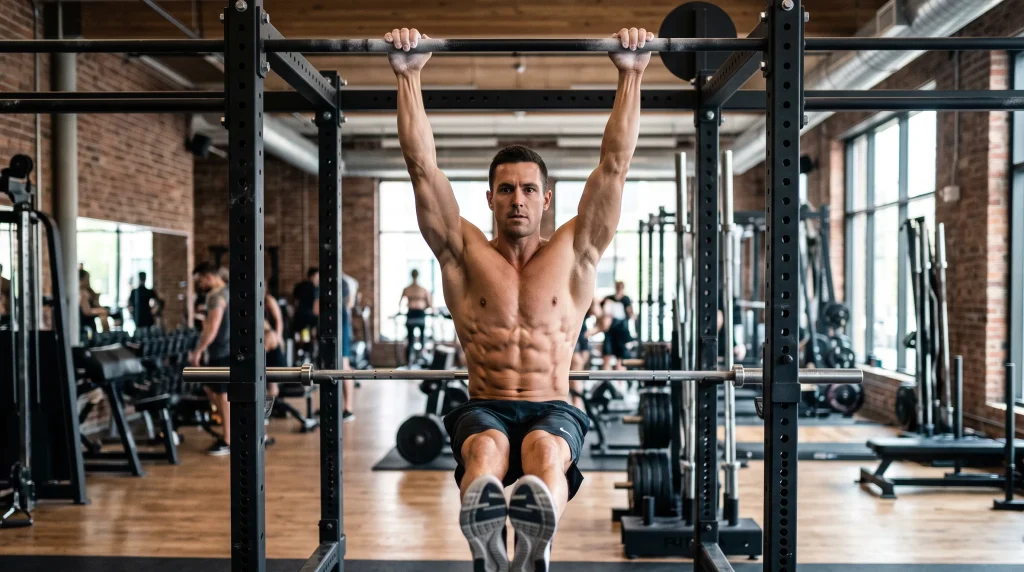
| Example exercises | Crunch, cable crunch, ball crunch | Reverse crunch, hanging knee raise |
| Most common mistake | Pulling the neck | Swinging the legs with momentum |
The ideal routine includes both patterns. A complete core is also made up of the obliques and the deep stabilizing muscles, which you can learn more about in our article on how to improve your core strength beyond just abs workouts.
How long does it take to see upper abdominal definition?
The answer depends mostly on your starting point. Strength gains in the abs usually show up within 4 to 8 weeks of consistent training. Visible definition, however, depends on your body fat percentage. As a general reference, abs tend to become visible at around 10% to 14% body fat in men and 16% to 20% in women, although this varies with genetics.
If you’re starting from a higher body fat percentage, it may take several months of training and diet to see the upper abs clearly. That’s why tracking only the mirror can be discouraging. Monitoring your waist and other body measurements shows progress much earlier, and our guide on how to take body measurements explains how to do it the right way.
A practical way to do that is with the Befit ideal measurements calculator. It gives you a reference for the proportions that fit your body, so you can set realistic goals and compare your progress over time.
Ideal Measurements Calculator: See How Big Each Body Part Should Be
Your result
Your ideal chest by the McCallum standard is:
Ideal measurements
The comparison uses the McCallum measurements.
Chest-to-waist ratio
In the McCallum standard, the waist is 70% of the chest.
How we calculate
McCallum: chest = 6.5 × wrist. The other measurements are percentages of the chest: hips 85%, waist 70%, thigh 53%, neck 37%, arm 36%, calf 34% and forearm 29%.
Steve Reeves: arm = 2.52 × wrist, calf = 1.92 × ankle and neck = 0.79 × head.
Your data
Want a science-based reference?
Common mistakes when training the upper abs
Even with the right exercises, a few habits can limit your results. Many of them are subtle, so it’s worth checking whether any of them show up in your routine:
- Pulling your neck: shifts the tension away from your abs and can cause neck discomfort.
- Using momentum: swinging up quickly reduces the time your muscles spend under tension.
- Going too high: coming up to a seated position turns the crunch into a hip flexor exercise.
- Holding your breath: makes you lose control and reduces the contraction.
- Never progressing: doing the same easy workout for months stops producing results.
Correcting just one or two of these mistakes is often enough to finally feel your upper abs working. Recording a set on your phone is a simple way to check your form.
Frequently asked questions
-
Why do I feel upper ab exercises more in my neck?
You’re probably pulling your head forward with your hands. Keep your hands light, imagine an orange between your chin and chest, or cross your arms over your chest.
-
Can I train upper abs at home without equipment?
Yes. Floor crunches, slow-tempo crunches and crunches with a pause at the top are effective without any equipment. A backpack with books can work as extra load when you need to progress.
-
Is it normal for upper abs to look uneven?
Yes. The alignment of the tendinous intersections is genetic, so slightly asymmetrical abs are very common and don’t indicate a training problem.
-
Why do my upper abs disappear after I eat?
Your stomach sits right behind the upper abdominal region, so it expands temporarily after meals. This is a normal part of digestion and doesn’t mean you’ve lost progress.
-
Do upper abs show before lower abs?
For many people, yes. The body tends to store more fat in the lower belly, so the upper abs often become visible first as body fat drops.
Build stronger upper abdominal muscles with Befit
Training your upper abdominal muscles is about doing the right movements well, not doing endless reps. Curl your ribcage toward your pelvis, protect your neck, control every rep and increase the challenge over time. Combined with 2 to 3 weekly sessions and a balanced diet, these tips build a stronger core and, with patience, a more defined midsection.
The hardest part is staying consistent, and that’s where Befit can help. Download the Befit app to follow structured workouts, keep your routine organized and turn these tips into results week after week.