The 48 Best Chest Exercises for Your Workout
A good chest workout trains the pectoralis major (clavicular, sternal, and costal heads) and the pectoralis minor underneath it. Changing the bench angle — flat, incline, decline — shifts emphasis within the pec itself: incline recruits more of the upper (clavicular) head, decline recruits more of the lower head.
On this page you'll find 48 chest exercises curated by Befit, with execution videos, grip tips, and variations for the gym, home gym, and bodyweight training. Every exercise has been reviewed by a fitness professional specialized in strength training.
If you already know what you want, use the level and equipment filters to jump straight to the right exercise. If you'd rather start somewhere, check the top 10 below — the movements with the strongest consensus for hypertrophy and strength in the chest.
And if you want a chest workout built from scratch, personalized to your goal, your time, and your equipment, that's exactly what the Befit app does automatically.
How to build your Chest workout
Volume per session: 4 to 5 exercises, 12 to 18 total sets.
Movement split: 1 flat press (barbell or dumbbell bench press), 1 incline press (dumbbell incline bench press), 1 decline or machine press, and 1 to 2 isolation moves (cable fly, machine fly).
Sets and reps: 3 to 4 sets of 6 to 12 reps for hypertrophy, with load close to failure on the last reps and 60 to 90 seconds of rest.
Frequency: twice a week is the sweet spot between stimulus and recovery for most people.
Top Chest exercises
| # | Exercise | Level | Equipment | Muscle focus | |
|---|---|---|---|---|---|
| 1 |
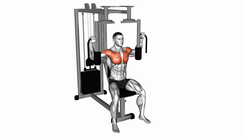
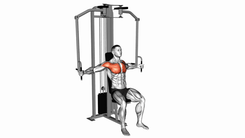 Machine fly |
Beginner | Dual pec deck fly machine | Chest | See execution |
| 2 |
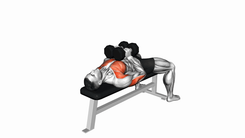
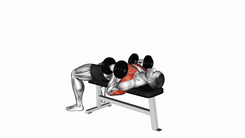
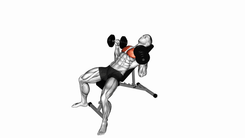 Dumbbell Incline Bench Press |
Intermediate | Dumbbells | Chest | See execution |
| 3 |
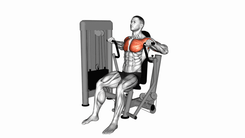 Chest Press Machine |
Beginner | Chest press machine | Chest | See execution |
| 4 |
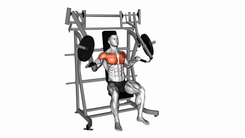 Machine chest press incline |
Beginner | Chest press machine | Chest | See execution |
| 5 |
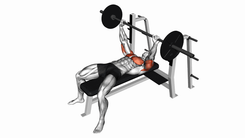
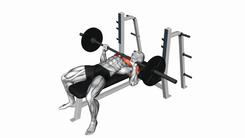 Barbell Bench Press |
Intermediate | Olympic barbell | Chest | See execution |
| 6 |
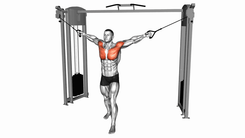 Cable machine high to low |
Intermediate | Dual cable pulley machine | Chest | See execution |
| 7 |
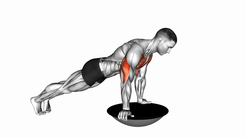
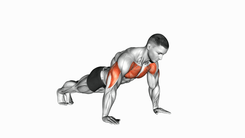 Push-ups |
Beginner | Chest | See execution | |
| 8 |
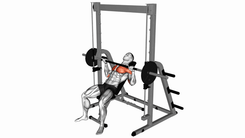
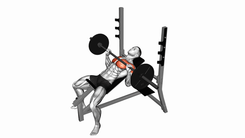 Barbell Inclined Bench Press |
Intermediate | Olympic barbell | Chest | See execution |
| 9 |
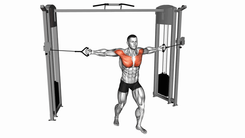 Cable Middle Fly |
Intermediate | Dual cable pulley machine | Chest | See execution |
| 10 |
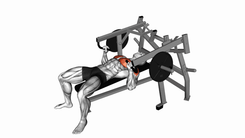
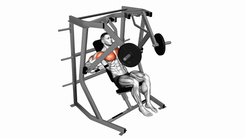 Lever Decline Chest Press |
Beginner | Chest press machine | Chest | See execution |
Machine fly
Dumbbell Incline Bench Press
Chest Press Machine
Machine chest press incline
Barbell Bench Press
Cable machine high to low
Push-ups
Barbell Inclined Bench Press
Cable Middle Fly
Lever Decline Chest Press
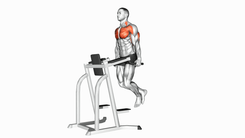
All 47 Chest exercises
Chest workout at home vs. at the gym
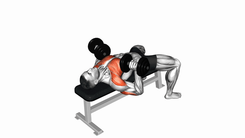
Training chest at home is doable with a pair of adjustable dumbbells and, ideally, a bench (even an improvised one, like a sturdy chair).
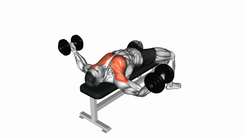
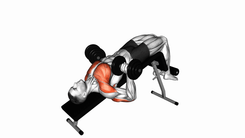
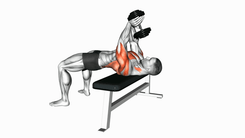
With that minimum you can build a chest workout with dumbbell bench press, dumbbell incline press, push-ups in their variations (standard, feet-elevated, close-grip for triceps), and a dumbbell fly. That covers flat press, incline press, and isolation, even without a single machine.
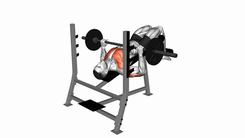
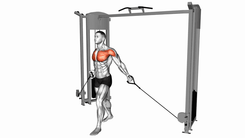
At the gym, the toolkit is bigger. You've got a chest press machine (flat and incline), a cable machine for high-to-low and low-to-high flys, a pec deck fly machine for controlled isolation, plus a barbell for flat, incline, and decline bench press with free weight.
Use the Bodyweight or Home Gym filter above to see only exercises that fit your setup.
How Befit builds your Chest workout with AI
Picking an exercise is only half the problem. The other half is: how many sets, how many reps, what load, in what order, when to switch things up. And that changes every week as you progress.
Befit solves this with an AI that builds a personalized training plan for your goal (hypertrophy, strength, definition), your level, your time per session, and your equipment. Every week, the algorithm adjusts volume and load based on what you've logged.
You don't need to know how to program periodization. Just train and log it.

Safety tips for Chest training
- Warm up the shoulder (external/internal rotation with a band or light dumbbell) before any heavy bench press — the chest works together with the rotator cuff, and a cold shoulder is the most common cause of bench press pain.
- On the bench press, don't let your elbow flare past roughly 75-80° from your torso on the way down. A fully flared elbow at 90° overloads the shoulder joint.
- Control the eccentric phase (lowering the bar or dumbbells). Letting the weight drop fast toward your chest is the most common cause of shoulder injury in bench press.
- On flys, keep a slight, constant bend in the elbow — a locked-out elbow during the movement transfers unwanted stress to the elbow and shoulder.
- Rest at least 48 hours between chest sessions.
Frequently asked questions about Chest training
-
How many exercises should I do for a chest workout?
An effective chest workout has 4 to 5 exercises per session, covering flat press, incline press, decline (or a machine variation), and fly isolation. Total volume between 12 and 18 sets per week is the range best supported by research for pec hypertrophy.
-
How many sets and reps for chest hypertrophy?
For hypertrophy, the most common range is 3 to 4 sets of 6 to 12 reps, with load that brings you to or near failure on the last reps. Rest 60 to 90 seconds between sets. Control the lowering phase of the bar or dumbbells especially closely.
-
What's the best beginner chest workout?
For beginners, a solid chest workout has 3 exercises: a machine press (more stable than a free barbell), a dumbbell incline press, and push-ups as an accessory. Focus on learning to control the descent before adding load.
-
Can you train chest at home?
Yes. With a pair of dumbbells and a bench (or a sturdy chair), flat and incline dumbbell press plus push-up variations cover the main chest angles. Use the Bodyweight filter in the exercise list above.
-
Does training chest and triceps on the same day work?
It works very well. The triceps are already activated in every chest press movement, so training them together takes advantage of that pre-warm-up. Suggested order: chest first (heavier compound lifts), triceps after (2 to 3 isolation moves like pushdowns or overhead extensions).
-
How many times a week should I train chest?
Twice a week is the sweet spot between stimulus and recovery for most people. You can have one session with more press volume and another focused on isolation. Beginners get good results with once a week in the first few months.
-
What's the best exercise for upper chest?
The incline press (dumbbell or barbell, bench at 30-45°) shows the highest activation of the clavicular (upper) chest in EMG studies. An incline chest press machine is a more stable alternative while you're still learning the movement pattern.
-
How do I know I'm feeling it in my chest and not my shoulder during bench press?
You should feel your pecs (center of the chest) working, not the front of your shoulder. If your shoulder aches or tires before your chest does, check your elbow angle (don't flare too wide) and your shoulder blade position (retracted and down, not loose). Film a set and compare it to the execution video on Befit.